A clay tile roof inspection checklist covers seven zones: the ridge and hip caps and their mortar, the field tiles, the valleys, the flashings at walls, chimneys and vents, the eaves, fascia and gutters, the underlayment under a few lifted tiles, and the attic. On Santa Barbara’s Spanish-style roofs the tiles often come through wind and rain intact while the layers beneath them fail first, so the checklist goes below the surface. To book a tile roof inspection, call NEMA Roofing at 805-977-5949.
Santa Barbara Clay Tile Roof Inspection Checklist: What Pros Actually Look For
Most people assume a tile roof is nearly indestructible because the individual tiles are heavy and hard. In Santa Barbara, that assumption costs homeowners money every year. The tiles themselves often survive a wind event just fine; it’s the mortar, the underlayment, the ridge caps, and the flashings underneath them that fail quietly, long before a single tile visibly cracks. If you’re on the fence about whether your roof needs attention after a storm or a stretch of strong offshore or onshore winds, this checklist explains exactly what a trained eye looks for on a classic Spanish or Mediterranean clay tile roof along the Santa Barbara coast.
This guide is designed to help you understand the inspection process so you can have an informed conversation with a roofing professional. For a broader picture of how coastal weather patterns drive the specific damage patterns we see here, see our complete guide to evaluating roof damage after Santa Barbara ocean winds and storms.
DIY Visual Check vs. Professional Roof Inspection: Two Very Different Things
Before walking through the checklist, it helps to understand what separates a homeowner’s ground-level scan from a professional tile roof inspection. Both have a role, but they answer different questions.
A homeowner visual check is done from the ground or from a window, using binoculars if available. It can catch obvious displaced tiles, missing ridge caps, or debris sitting in valleys. It takes a few minutes and costs nothing. What it cannot do is assess the condition of the underlayment, check mortar integrity at hip and ridge lines, probe for soft spots in the decking beneath the tiles, or evaluate flashing seals around chimneys, vents, and parapet walls.
A professional tile roof inspection involves physically walking the roof (with proper footwear and technique to avoid cracking tiles), lifting select tiles to examine the underlayment below, probing mortar and sealant joints, and checking interior attic spaces for moisture intrusion or daylight penetration. In Santa Barbara, where many tile roofs are decades old and carry original or once-replaced underlayment, the condition below the tile is often the most important finding.
Comparison: What Each Approach Reveals
| Inspection Criterion | Homeowner Visual Check | Professional Tile Roof Inspection |
|---|---|---|
| Displaced or cracked tiles | Often visible from ground | Full surface walk confirms all affected tiles |
| Ridge cap and hip mortar condition | Partially visible; detail unclear | Hands-on probe reveals loose, hollow, or failing mortar |
| Underlayment integrity | Not visible | Assessed by lifting tiles at vulnerable zones |
| Flashing seals (chimney, vents, walls) | Partially visible; gaps often missed | Each transition point physically inspected and documented |
| Attic moisture or daylight intrusion | Not visible | Interior attic check included in thorough inspection |
| Debris in valleys and gutters | Visible from ground or ladder | Cleared and documented as part of inspection |
The takeaway is simple: a homeowner visual check is a useful first filter, but it cannot replace a professional inspection when coastal winds or storm activity have occurred. The table above makes clear that the most consequential damage, underlayment wear and flashing failure, is invisible from the ground.
The Santa Barbara Context: Why Clay Tile Roofs Here Face Specific Pressures
Santa Barbara’s architectural identity is built around the Spanish Colonial Revival style, which means clay tile roofs are everywhere, from the historic Riviera neighborhood to the Eastside, Montecito, and the hillside homes above State Street. The city’s design guidelines actively encourage tile roofing on new construction and remodels in many zones, so this is not a niche roof type. It’s the dominant residential roof in the area.
That matters because clay tile roofs in Santa Barbara face a specific combination of stressors that differs from inland California. Salt-laden marine air accelerates the oxidation of metal flashings and fasteners. The Sundowner winds, gusty downslope winds off the Santa Ynez Mountains that peak from early evening to mid-morning, can hit the mesa and hillside neighborhoods with surprising force and create uplift at ridges and roof edges. Seasonal moisture swings, from dry summers to wet winters with periodic atmospheric river events, cause the mortar at ridge and hip lines to expand and contract repeatedly over decades until it cracks and loosens. Homes near the ocean also accumulate salt deposits in the grout and mortar over time, which accelerates deterioration.
Many older Santa Barbara tile roofs were also laid over a single layer of felt underlayment. That material has a finite service life, and on a home that hasn’t had a full re-roof, the underlayment may be decades past its expected lifespan even if the tiles above it look intact. This is one reason a ground-level check after a storm can be misleading: the tiles survived, but the layer doing the actual waterproofing work may already be compromised.
For more on how the marine layer and salt air interact with roofing materials over time, this breakdown of coastal marine layer roof wear explains the cumulative degradation process in detail.
The Professional Tile Roof Inspection Checklist: Zone by Zone
A thorough inspection of a Santa Barbara clay tile roof follows a systematic zone-by-zone approach rather than a random walk. Here is what each zone covers and why it matters.
1. Ridge and Hip Lines
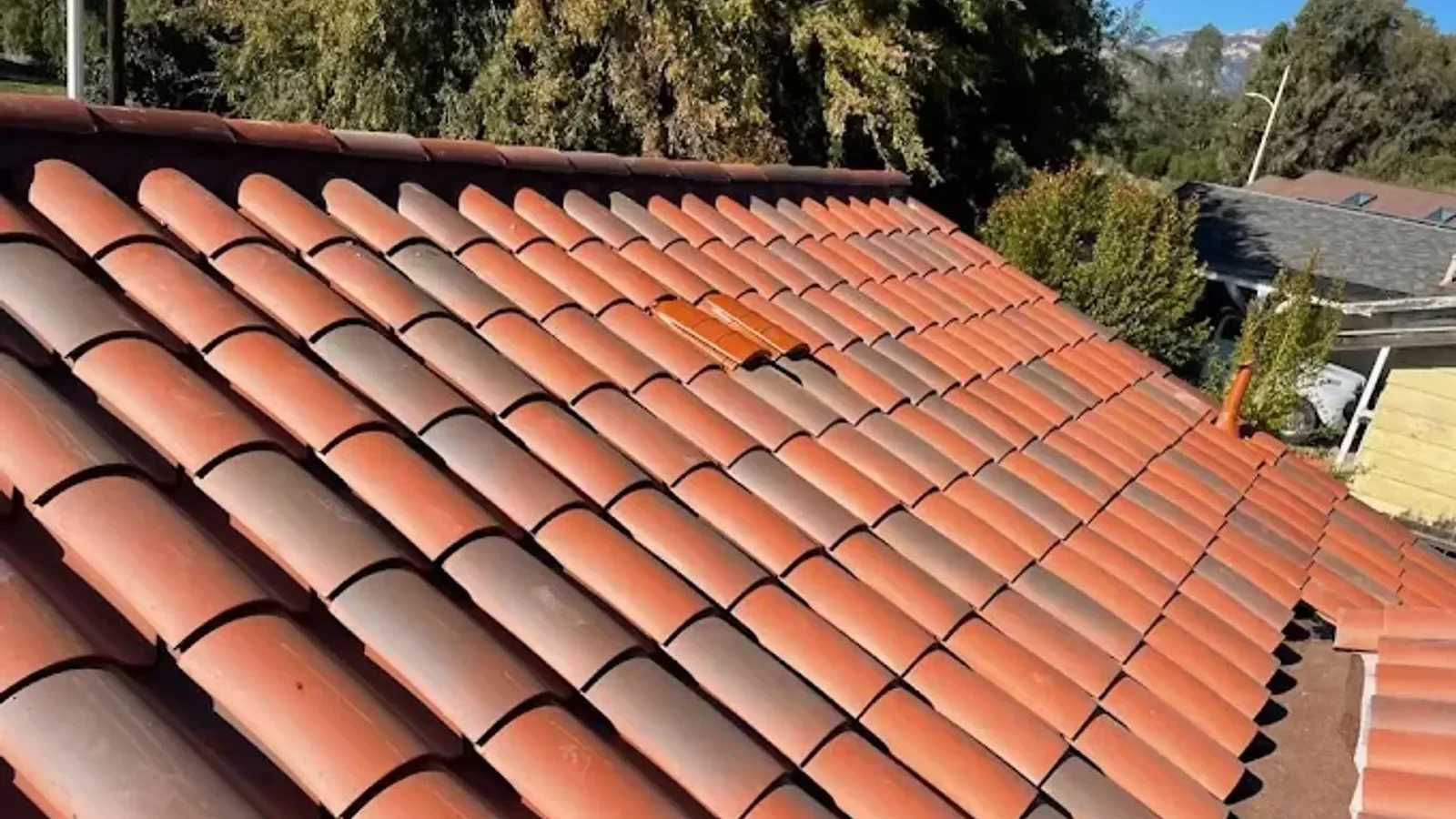
The ridge (the peak of the roof) and hips (the angled edges where two roof planes meet) are finished with mortar-set or mechanically fastened cap tiles. These are the first areas to show wind damage because the uplift forces are greatest at edges and peaks. A professional will:
- Tap each cap tile with a rubber mallet to listen for a hollow sound indicating a failed mortar bond
- Check for visible cracking, spalling, or missing mortar at the base of each cap tile
- Look for any cap tiles that have shifted laterally, even slightly, which can open a gap to wind-driven rain
- Assess whether the existing mortar is a sand-cement mix (older, more brittle) or a modern polymer-modified mortar (more flexible)
Loose ridge cap tiles are among the first things to check after a Sundowner wind event in Santa Barbara. They don’t always fall off immediately; they may sit in place while allowing water to wick underneath during the first significant rain.
If you want it handled correctly the first time, our tile roofing service resets ridge caps and replaces broken tiles.
2. Field Tiles (The Main Roof Surface)
The field tiles cover the broad expanse of the roof. After a wind event, a professional walks the entire field looking for:
- Cracked or broken tiles, including hairline cracks that aren’t visible from the ground
- Displaced tiles that have shifted out of their overlapping position, even by a small amount
- Missing tiles where the batten or underlayment is now exposed
- Tiles that have lost their fastener and are being held only by gravity and neighboring tiles
- Debris (branches, eucalyptus seed pods, palm fronds) that has wedged under tiles and is holding them lifted
On older Santa Barbara homes, tiles were often set in mortar directly rather than fastened to battens. That installation method can mean that when one tile loosens, neighboring tiles can follow: a cascade effect that a single-tile replacement won’t fully address.
3. Valleys
Valleys are the internal angles where two roof planes meet and channel water toward the gutters. They are high-volume water-flow zones and are particularly vulnerable in Santa Barbara’s heavy winter rain events. Inspection points include:
- Condition of the valley flashing (typically galvanized steel or aluminum): corrosion, holes, or lifted edges
- Debris accumulation that redirects water flow under adjacent tiles
- Whether the valley is open (metal exposed) or closed (tiles overlapping the center); each type has different failure modes
- Staining or moss growth patterns that indicate standing water or slow drainage
4. Flashings at Penetrations and Transitions
Flashings seal the transitions between the tile field and vertical surfaces: chimneys, skylights, dormer walls, parapet walls on flat-to-tile transitions, and plumbing or HVAC penetrations. These are a common source of active leaks on an otherwise intact tile roof. A professional checks:
- Step flashing along walls: each individual piece should overlap and lie flat
- Counter flashing embedded in mortar joints on masonry chimneys: mortar can crack and allow the counter flashing to pull away
- Pipe boot flashings around vent stacks: the rubber collar degrades over time and is a frequent source of leaks that homeowners trace to the wrong location
- Sealant condition at any caulked joint: sealant has a finite lifespan and requires periodic renewal
Salt air in Santa Barbara accelerates corrosion of galvanized flashings faster than in inland areas. Homes close to the ocean or in low-lying coastal zones may need flashing replacement on a shorter cycle than the manufacturer’s general guidance suggests.
5. Eaves, Fascia, and Gutters
The eave zone is where water exits the roof system. Inspection here covers:
- Eave tiles and their mortar: these are often set in mortar and can loosen over time
- Fascia board condition: soft or rotting fascia indicates water has been running behind the gutter
- Gutter attachment and slope: gutters pulling away from the fascia redirect water against the wall
- Bird or pest entry points at the eave where tiles are raised; Santa Barbara’s climate is hospitable to birds and rodents that nest under lifted eave tiles
6. Underlayment Assessment
This is the step that separates a surface-level tile check from a genuine inspection. At several representative locations (typically near valleys, at low-slope sections, and near any area showing interior staining), a professional will carefully lift tiles to examine the underlayment below. Signs of concern include:
- Felt that is brittle, cracked, or disintegrating
- Moisture staining or active dampness on the felt or decking
- Mold or biological growth on the underside of tiles or on the felt surface
- Daylight visible through gaps in the decking when viewed from the attic
On older Santa Barbara homes that have never been re-roofed, original underlayment in serviceable condition is uncommon. When the underlayment is at or past end-of-life, a targeted tile repair addresses the symptom but not the underlying vulnerability.
7. Interior Attic Check
A complete inspection includes at least a visual sweep of the attic space with a flashlight. The professional looks for:
- Water stains on the sheathing or rafters (the stain location often doesn’t match the leak entry point above)
- Daylight penetrating through the roof deck
- Insulation that is wet, compressed, or discolored
- Evidence of pest activity that may have compromised the roof deck
Which Findings Require Immediate Action vs. Monitoring?
Many Santa Barbara homeowners rely on a professional inspection report for exactly this.
Not every inspection finding demands emergency repair. A professional will typically categorize findings into three tiers.
Immediate attention: Any active water intrusion, missing tiles over exposed underlayment, failed flashings at penetrations, or severely deteriorated underlayment. These conditions can escalate quickly, especially in Santa Barbara’s short winter rain season, when a single atmospheric river storm can bring heavy rain in a short time.
Repair within the season: Loose ridge cap tiles with mortar that is failing but not yet open, minor flashing sealant failures with no active leak, and isolated cracked field tiles. These are stable in dry conditions but become active problems with the first significant rain.
Monitor and document: Early-stage mortar weathering, minor biological growth, and minor gutter separation that hasn’t yet affected the fascia. These are noted, photographed, and revisited at the next inspection cycle.
If your inspection turns up signs in the first two categories, the next step is connecting with a roofing professional who works regularly with clay tile in Santa Barbara. For a broader look at what warning signs appear between formal inspections, this overview of signs a coastal roof needs repair covers the indicators homeowners can track on their own.
Frequently Asked Questions
How often should a clay tile roof in Santa Barbara be professionally inspected?
Plan on an inspection at least once a year, with an additional check after any significant wind event or storm. Santa Barbara’s Sundowner wind season and the winter atmospheric river pattern make a post-storm inspection particularly valuable, since damage that develops in fall or early winter can go undetected until it causes interior water damage.
Can I walk on my clay tile roof to check it myself?
Clay tiles crack under point loads if you step directly on them rather than on the batten or structural zone of each tile. Without knowing where to place your weight, a homeowner walking a tile roof risks creating new damage. A ground-level visual check with binoculars is the safer approach for homeowners; leave the roof walk to a professional with experience on tile systems.
My tiles look fine from the ground. Do I still need an inspection after a wind event?
Yes, and this is the most common misconception about tile roofs. The tiles are the outermost layer, but the underlayment below them does the actual waterproofing work. Wind events can lift tiles just enough to abrade or tear the underlayment without visibly displacing the tile. The only way to assess underlayment condition is to lift select tiles and look, which requires a professional on the roof.
What is the lifespan of the underlayment on a Santa Barbara clay tile roof?
Shorter than the tile’s. Felt underlayment has a finite service life, and coastal salt air and repeated heating and cooling can shorten it, while the Tile Roofing Institute notes that a clay or concrete tile roof can reasonably be expected to outlast the building it protects. If your home is decades past its last re-roof and the underlayment has never been replaced, an inspection that includes lifting tiles to assess underlayment condition is worth scheduling regardless of whether you’ve had a recent storm.
How is a tile roof inspection different from a home inspection?
A general home inspection covers many systems at a surface level and typically does not include walking the roof or lifting tiles. A dedicated roofing inspection by a roofing contractor goes considerably deeper: it includes a physical roof walk, tile lifting at key zones, attic assessment, and documentation of specific findings with repair recommendations. If you are buying or selling a Santa Barbara home with a tile roof, a roofing-specific inspection is a worthwhile addition to the general home inspection.
What should I do immediately after a major wind event before a professional arrives?
Do a ground-level visual check for obviously displaced or missing tiles. If you see open areas on the roof, contact a roofing professional promptly; most can provide temporary protective measures if rain is forecast before a full repair can be completed. Avoid entering the attic during or immediately after a storm if there is any sign of active water intrusion. Document what you observe with photos from the ground to share with the inspector.
Scheduling a Professional Tile Roof Inspection in Santa Barbara
A clay tile roof is a significant investment, and in Santa Barbara’s climate, its performance depends on more than the tiles themselves. The mortar, underlayment, flashings, and decking all require periodic professional evaluation, especially after the wind and storm events that are a regular part of life here.
For context on how storm activity specifically displaces tiles and creates the conditions this checklist addresses, the full guide to roof damage evaluation after Santa Barbara storms provides detailed coverage of the wind and moisture dynamics involved. And if you want to understand what a maintenance schedule looks like between inspections, this post-storm roof maintenance guide for Santa Barbara outlines the steps that help protect a tile roof through the rainy season.
NEMA Roofing Repair Company serves Santa Barbara homeowners with professional tile roof inspections, tile repair, and full re-roofing services. If you’ve had a recent wind event or simply haven’t had your tile roof professionally assessed in several years, reach out to schedule an inspection. Our team works with clay tile roofs throughout Santa Barbara and the surrounding area and can document exactly what your roof needs, and what it doesn’t.
Tile roofs are not only a Santa Barbara story: NEMA Roofing’s five locations (Downey, Tarzana, Woodland Hills, Oxnard and Santa Barbara) put tile roof inspections within reach of every part of Ventura, Los Angeles, Santa Barbara, Riverside and San Bernardino counties, as the service areas page shows. For the general checklist that covers shingle, metal and flat roofs as well, see our roofing inspection checklist.
Call 805-977-5949 or visit our roof inspection service page to schedule a professional tile roof inspection and get a clear picture of where your roof stands before the next storm season arrives.