
Flat Roof Repair & Installation in Santa Barbara
Flat roof repair means finding the exact point where water gets through a flat or low-slope roof (an open seam, flashing that has pulled away from a wall, a blocked drain, a worn-out membrane) and sealing it with material that is compatible with the roof already there. NEMA Roofing repairs, re-covers and replaces flat roofs on homes and commercial buildings in all five counties it serves (Santa Barbara, Ventura, Los Angeles, Riverside and San Bernardino), from five Google-verified locations in Santa Barbara, Oxnard, Woodland Hills, Tarzana and Downey. Call 866-631-3366 for a free on-site assessment.
This page covers the warning signs, where flat roofs actually leak, the common roof systems and how each one is repaired, how to decide between a repair, a re-cover and a replacement, and the drainage and energy-code rules that apply when a flat roof is redone in California. If you want to understand the repair steps in detail before you call anyone, read our guide on how to repair flat roofing without replacing the entire roof.
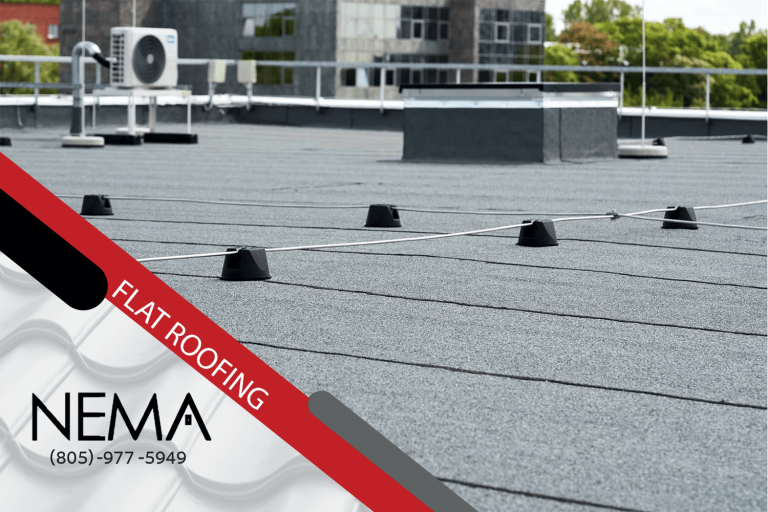
Signs your flat roof needs repair
- Water still standing two days after rain. The California Building Code describes a properly drained roof as one that drains within 48 hours of precipitation. Water that stays longer loads the deck and finds every weak seam.
- Blisters and bubbles in the membrane, which mean trapped moisture or air under the surface.
- Splits, cracks and open seams, most often along laps, around corners and where the roof meets a wall.
- Flashing pulling away from parapets, walls, curbs and pipes.
- Soft or spongy spots underfoot, a sign of wet insulation or a damaged deck.
- Stains on the ceiling or on the top of an inside wall, even when the roof looks fine from the ground.
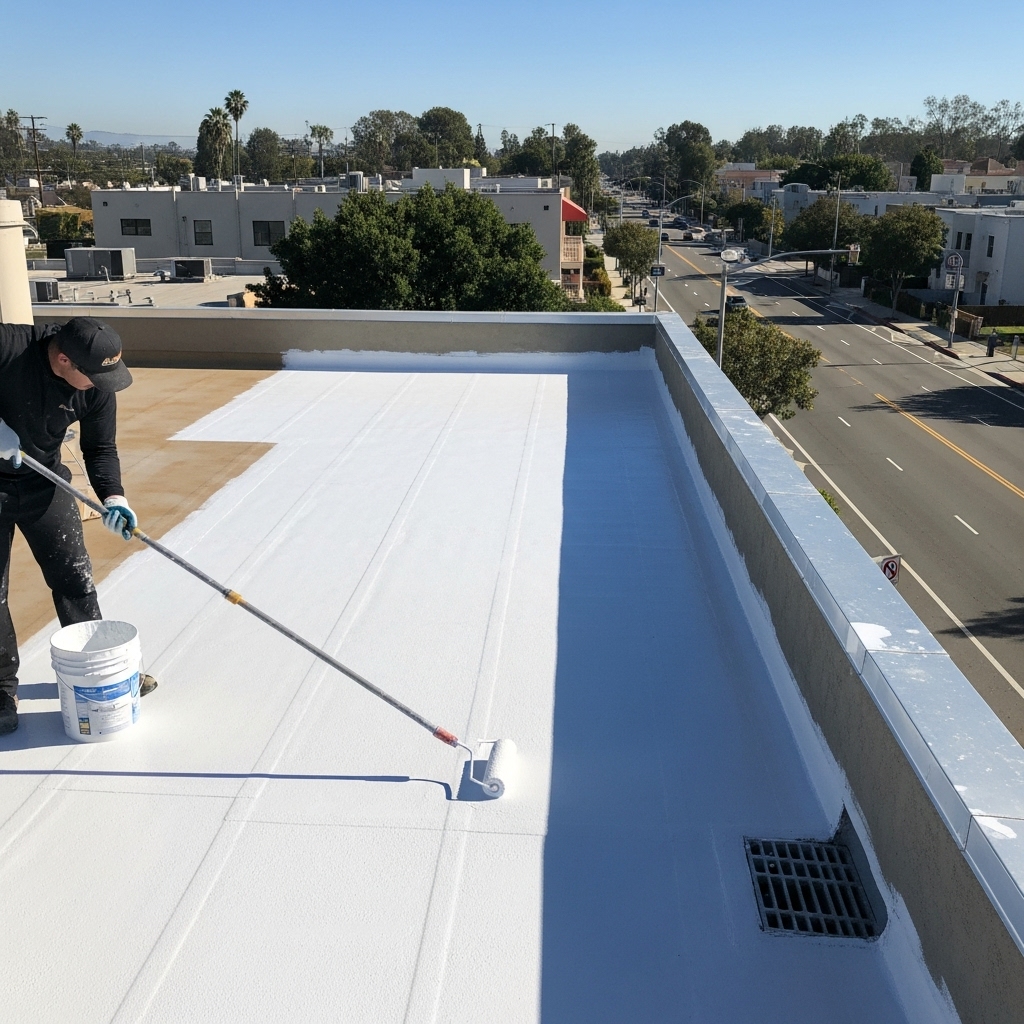
Where flat roofs leak, and why the stain is rarely under the hole
On a sloped roof, water runs off before it has time to look for a way in. On a flat roof it sits, and it moves sideways under loose membrane or through the insulation before it drips. That is why the ceiling stain and the actual entry point are often several feet apart. A repair that patches the spot directly above the stain can miss the leak entirely.
Most flat roof leaks start in one of five places:
- Seams and laps between sheets of membrane, where adhesive or welds weaken with heat and age.
- Perimeter and wall flashing, especially at parapets, where the roof turns up a wall and the membrane is under constant stress.
- Penetrations: air-conditioning curbs, vent pipes, skylights, satellite and solar mounts. Every hole through the roof has a seal that eventually needs attention.
- Drains and scuppers. A drain blocked by leaves or debris turns part of the roof into a pond; a scupper with a failed seal leaks straight into the wall.
- Low spots where the deck has sagged or the original slope was too flat, so water ponds in the same place after every storm.
Common flat roof systems and how each one is repaired
The first thing to establish on any flat roof is what it is made of, because a patch has to bond to the existing surface. A mismatched material can look fine for a season and then peel away.
| System | What it is | How a repair is usually made |
|---|---|---|
| Built-up roof (BUR) | Alternating layers of roofing felt and asphalt, often topped with gravel | Gravel cleared from the damaged area, new plies of felt and asphalt built up over it, surface restored |
| Modified bitumen | Asphalt-based rolls, torch-applied, cold-applied or self-adhered, often with a granule surface | A patch of compatible modified bitumen bonded over the cleaned and primed area, seams sealed |
| TPO and PVC (single-ply) | Thermoplastic sheets whose seams are welded with hot air | A patch of the same material heat-welded over the damage; a split seam can often be re-welded |
| EPDM (single-ply) | Synthetic rubber sheets with glued or taped seams | Cleaned and primed, then a compatible EPDM patch or seam tape applied |
| Spray polyurethane foam (SPF) | Foam sprayed on the deck and protected by a coating | Damaged foam cut out, new foam applied, the area recoated |
| Roof coatings | Fluid-applied acrylic, silicone or similar layers | Used to restore a sound, dry roof surface; a coating does not fix wet insulation or a failed deck underneath |
Flat roofing solutions: repair, re-cover or replace
California’s building code uses three terms that are worth knowing when you compare proposals. A roof repair renews part of an existing roof to correct damage. A roof recover installs a new covering over the existing one without removing it. A roof replacement removes the existing covering, repairs damaged substrate and installs a new one.
- Repair when the damage is local (a seam, a flashing, a puncture, one drain) and the rest of the membrane is still flexible, bonded and dry.
- Re-cover or restore when the surface is worn across the roof but the insulation and deck beneath it are dry. Whether they are dry has to be checked, not assumed; covering wet material traps the water.
- Replace when insulation or decking is wet over large areas, when there are already several layers of roofing, when repairs keep failing in new places, or when the drainage itself has to be rebuilt.
A useful test: if the proposal for repairs covers much of the roof, ask for the price of a replacement next to it. Several patches on an aging membrane often cost more over the next few years than one new roof.
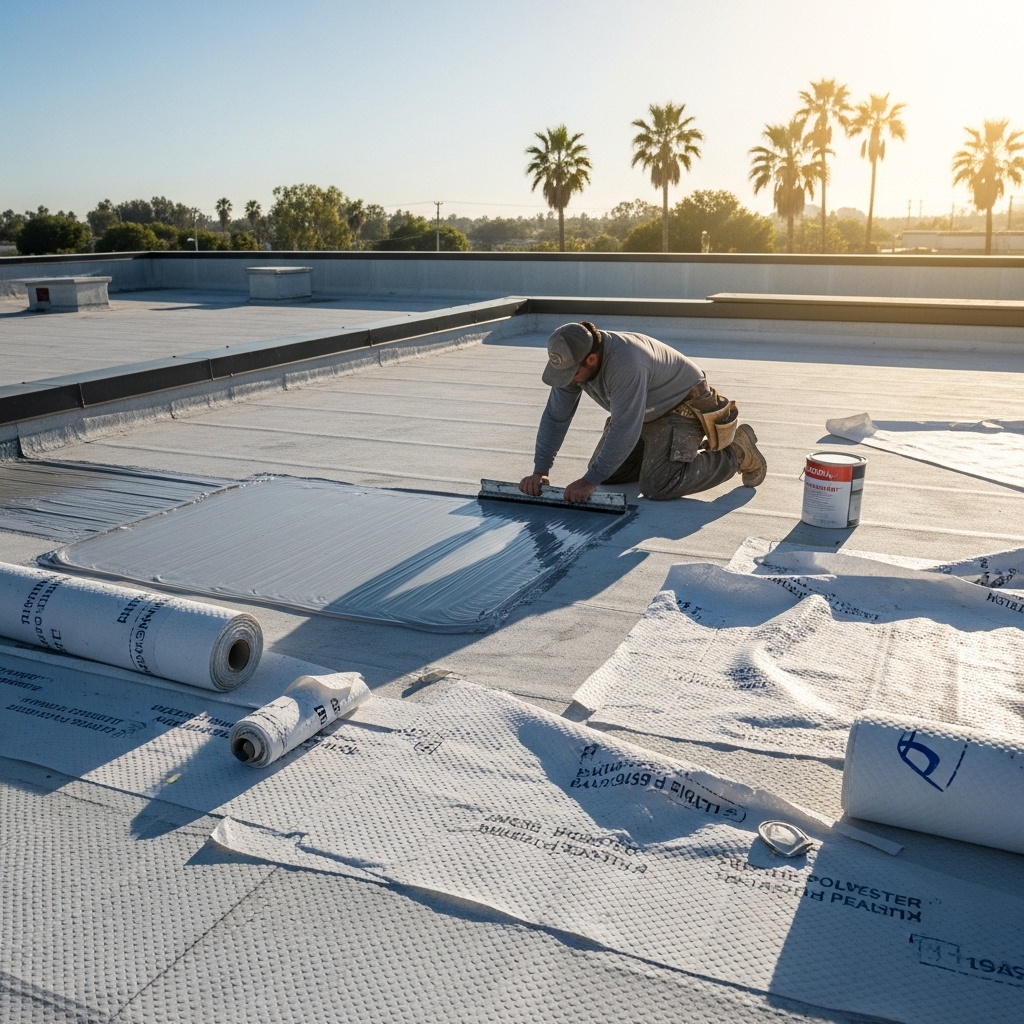
Drainage and code rules that shape a flat roof
A “flat” roof is never truly flat. The California Building Code (2025 edition, section 1507) requires built-up, modified bitumen, single-ply and spray foam roofs to have a design slope of at least 1/4 inch per foot for drainage. When water ponds, the fix is often slope, not another patch: tapered insulation, a cricket that steers water toward the drain, or a larger or additional drain or scupper.
Replacing a flat roof also brings in California’s Energy Code. Under the 2025 code, in force since January 1, 2026:
- Houses: re-roofing a low-slope roof in climate zones 4 and 6 through 15 calls for a cool-rated product with an aged solar reflectance of at least 0.63 and a thermal emittance of at least 0.75 (or a solar reflectance index of 75), with an insulation trade-off allowed. Santa Barbara, Goleta, Carpinteria, Montecito, Ventura, Oxnard and Camarillo are in zone 6; Ojai, Westlake Village and Woodland Hills are in zone 9; Riverside and San Bernardino are in zone 10. All of them are covered.
- Commercial buildings: the same cool-roof values apply in every climate zone when more than half of the roof area, or more than 2,000 square feet, whichever is less, is being re-roofed.
The cool roofing page explains the ratings and how to read a product’s Cool Roof Rating Council label.
Flat roofs on the Santa Barbara and Ventura coast
Coastal flat roofs deal with the same three stresses year after year. Sun and heat age the membrane surface. Salt air works on metal edges, flashing and fasteners faster than it does a few miles inland. And long dry months let debris collect in drains, so the first heavy rain of the season often finds a blocked outlet and a new pond. In fire hazard severity zones, which the State Fire Marshal maps across hundreds of thousands of acres in both counties, a replacement also has to meet the state’s Class A roof assembly requirement, and that applies to low-slope roofs too.
That is why a flat roof here benefits from a check before the rainy season: drains and scuppers cleared, seams and flashing inspected, and any small opening sealed while it is still small. Our roof maintenance page lists what that visit covers.
What a proper flat roof repair visit includes
Whoever you hire, a flat roof repair visit should include these steps. If a quote skips them, ask why.
- Tracing the leak from the inside stain to the likely entry point on the roof, not just patching above the stain.
- Checking every drain and scupper, because a blocked outlet causes many of the leaks that get blamed on the membrane.
- Identifying the roof system and matching the repair material to it.
- Looking for wet insulation or soft deck around the leak, which decides whether a patch will hold.
- Photos of what was found, so you can see the problem yourself.
- A clear recommendation: repair, re-cover or replace, and why.
NEMA is a Polyglass Preferred Contractor and a GAF Master Elite contractor, and both manufacturers issue their warranties through registered contractors; ask which warranty applies to the system on your roof before work starts. For offices, shops and apartment buildings, see commercial roofing.
What decides the cost of a flat roof repair
We do not publish prices, because two flat roofs of the same size can need very different work. These are the factors that move the number:
- How many separate problem areas there are, and how easy the roof is to reach.
- The roof system, since welded, torched and coated repairs use different materials and equipment.
- Whether insulation or decking underneath is wet and has to be replaced.
- Flashing work at parapets, walls and curbs, which takes more labor than open-field patches.
- Drainage corrections such as tapered insulation, crickets or new drains.
- For a replacement, how many old layers come off, and the cool-roof and fire-rating requirements the new roof must meet.
The free on-site assessment ends with a no-obligation proposal that names the system, the scope and what is included.
Flat roof repair questions
Can a flat roof be repaired instead of replaced?
Yes, when the damage is local and the membrane, insulation and deck around it are sound. When the roof is wet or failing in many places, repairs stop being good value and a re-cover or replacement is the better choice.
Why does my flat roof leak only in heavy rain?
Usually because water rises high enough to reach a weak seam or flashing, or because a drain or scupper cannot keep up. Check the drains first; then look at the flashing at the highest water line.
Is a roof coating a repair?
A coating can seal a sound, dry roof surface and add reflectivity. It does not dry out wet insulation or fix a failed deck, so it should go on only after leaks are repaired and wet material is removed.
Do you repair flat roofs in Ventura County and Los Angeles?
Yes. NEMA works across Santa Barbara, Ventura, Los Angeles, Riverside and San Bernardino counties; see our Ventura County service area and the full service areas list.
Does a new flat roof on my house have to be a cool roof?
In every climate zone NEMA serves, yes, unless the insulation trade-off or another exception in the Energy Code applies. The rule covers low-slope re-roofing on houses in zones 4 and 6 through 15.
To book a visit, call 866-631-3366 or use the form below.
Our Roofing Services
Now We Offer Financing: Contact Us for More Info
Little Taste From Big Projects
LUXURY METAL ROOFING - BEVERLY HILLS
FIRE RATED METAL ROOFING
2 PIECE TILE - SANTA BARBARA
CLASS A FIRE-RATED TILE ROOF
TILE ROOF INSTALLATION - SANTA BARBARA
TILE ROOF INSTALLATION - MONTECITO
METAL ROOF INSTALLATION - MALIBU
ROOF INSTALLATION - SANTA BARBARA
ASPHALT SHINGLE ROOF INSTALLATION
SHINGLE ROOF REPLACEMENT
TILE ROOF REPLACEMENT
PRESIDENTIAL SHINGLE INSTALLATION
REVIEWS
Here in NEMA Roofing. We are always happy to hear when our clients feel satisfied. Here is what some of them have said:
EXCELLENTTrustindex verifies that the original source of the review is Google. We got several quotes and Nema Roofing was the best. No games like a few guys we got estimates from before them who started with very high prices and then made phone calls to the "boss" to get us a different price. Nema Roofing gave us a fast, fair quote and a work list detailing the work we needed. Honest and relaxed and everything explained up front. That is what I was looking for and they delivered. We are so happy with the new roof. They did everything from demo to completion in 3 days on a house and garage. The team worked efficiently and left our yard clean. The new roof looks great and beyond expectations. I would happily refer this team to any friends or family looking to have some roofing work done.Posted on GoogleTrustindex verifies that the original source of the review is Google. I would recommend NEMA for flat roof work after they did the one over my garage and ADU. I reached out to Adam a few months back and got about 4 other quotes too. He stood out from the rest because he made the pricing and scope very clear and said he would take care of the whole thing. Worried a lil bit about El Niño and didn’t want to save for a rainy day. The actual work took 3 days just like he told me. Day 1 they tore off the old roof, day 2 they dropped off supplies after the inspection, and day 3 they finished the roof. There was just one extra day for the final inspection and sign off.Posted on GoogleTrustindex verifies that the original source of the review is Google. Knowing that the roof was installed properly and with care is so important when making this huge investment in your property. We are very happy with our decision to select Nema Roofing from all the vendors we met with. Mike and Melvin were a pleasure to work with, both very communicative throughout the project. They set clear and realistic expectations and completed the job within the estimated time frame. They followed up on all pending items, and a couple of weeks later, we received our manufacturer roof warranty. Soup to nuts service that I highly recommend. Thank you Nema Roofing!Posted on GoogleTrustindex verifies that the original source of the review is Google. After getting 9 quotes for a roof installation, I checked the BBB and only two companies were registered, one being Nema Roofing. When I compared materials and warranties, they offered the best value for the money, so I went with a full reroof. Adam handled the removal and reinstall of my 22 solar panels through a certified solar company so my warranty stayed intact. His guys also fixed the bowl in my flat roof and added proper slope for drainage. Professional, on time, beautiful work. I'll 1000% recommend them. Ask for Adam!Posted on GoogleTrustindex verifies that the original source of the review is Google. I noticed a neighbor getting a brand new commercial TPO roof installed on his property, and it looked sharp. I spoke with him about the crew, and he had nothing but great things to say about their work. Our own roofing job went just as smoothly. We ended up going with a sleek metal roofing installation, and the finished product looks incredible. Mike was our project manager, and he was fantastic from day one. He kept us fully informed throughout the entire process and whenever we had questions he always knew what to say and do. Nema is one of the best in the city!Posted on GoogleTrustindex verifies that the original source of the review is Google. Nema ROOFING is a breath of fresh air in the sometimes unreliable world of roofing contractors. They replaced the underlayment and flashing on the tile roof on my 2,600 square foot house in Santa Barbara, set the clay tiles aside and then put them back without damage or problems. They added 3 attic vents at my request at minimal cost. They found a termite area and cause of a leak, showed me the condition and replaced the plywood. Melvin responded quickly to my calls and inquiries, explained things clearly, and his team did the work on time and a fair price! They know what they are doing.Posted on GoogleTrustindex verifies that the original source of the review is Google. Had a great experience getting our roof replaced with Adam and the crew at Nema Roofing. He made the whole process simple by taking care of all the city inspections and permits from start to finish. He kept us in the loop every step of the way and answered every question we had without rushing us. The crew always showed up right on time, paid close attention to detail, and did a thorough sweep of the yard and driveway so we didn’t find any random nails lying around afterwards. Working with them was completely stress free, and Adam made sure we were 100% happy with the work before finishing up.Posted on GoogleTrustindex verifies that the original source of the review is Google. This review is long overdue! Nema Roofing completed a new roof along with five skylights on my house 3 months ago! Mike and his crew did an excellent job on a difficult roof. One roofing contractor, who is highly rated online, turned it down because it was too steep! True!!! My roof has a lot of sharp angles requiring skill in cutting the shingles combined with, yes, the steep roof in putting the puzzle together. Mike is on the roof daily working alongside his crew who are skilled and hardworking. He replaced old composite shingles with the new black DaVinci shingles that improved the look of the house immensely. We are very happy with the finished roof and the process after working with them. I highly recommend you call him for any roofing matters.Posted on GoogleTrustindex verifies that the original source of the review is Google. I am very pleased with the work done by Nema Roofing. Adam, Mike, Thomas, and the entire crew are hard working pros! I now realize what an incredibly complex job it is to coordinate all the repairs, discarding old materials, reroofing, acquiring permits and supplies and the whole time being respectful of my property. Adam walked me through the entire roofing process and answered all my questions. I recommend Nema to anyone looking for reliable, honest, fully licensed and insured professionals.
What The Rumors Say
CONTACT US
As one of the leading roofing contractors, The NEMA Roofing team proudly provides a wide range of roofing services for residential and commercial properties. Whether you need installation, maintenance, or roof repairs, our roofing experts deliver tailored solutions to meet your specific needs.
Interested in working with a trusted roofing contractor? Simply fill out the form below to schedule your free on-site assessment and receive a no-obligation proposal.