Roof replacement cost factors in Woodland Hills start with the roofing material and the roof’s size, pitch and shape, then add tear-off (how many layers come off), deck repair found underneath, access for trucks and dumpsters, and three local rules: a cool roof product for most reroofs, a Class A covering in the Very High fire zones, and the Los Angeles Department of Building and Safety (LADBS) permit. NEMA Roofing does not publish prices, because each of these changes the total; for a written, itemized estimate, call 818-528-6412.
This guide explains each driver so you can compare proposals and tell a thorough, transparent estimate from a vague one. When you’re ready to put numbers to your own roof, working with a qualified roof contractor in Woodland Hills is the clearest path to an accurate figure.
Which roofing material costs more, and why?
The covering you choose usually moves the price more than any other single factor, because it sets the material cost, the labor per square and the accessories the system needs. In Woodland Hills, the choice also has to meet the state energy code’s cool roof values (see the rules section below).
- Asphalt architectural shingles remain the most widely installed option in the Valley’s residential neighborhoods. They come in cool-rated colors, perform reasonably well against moderate wind and are familiar to most roofing crews, which keeps labor hours predictable.
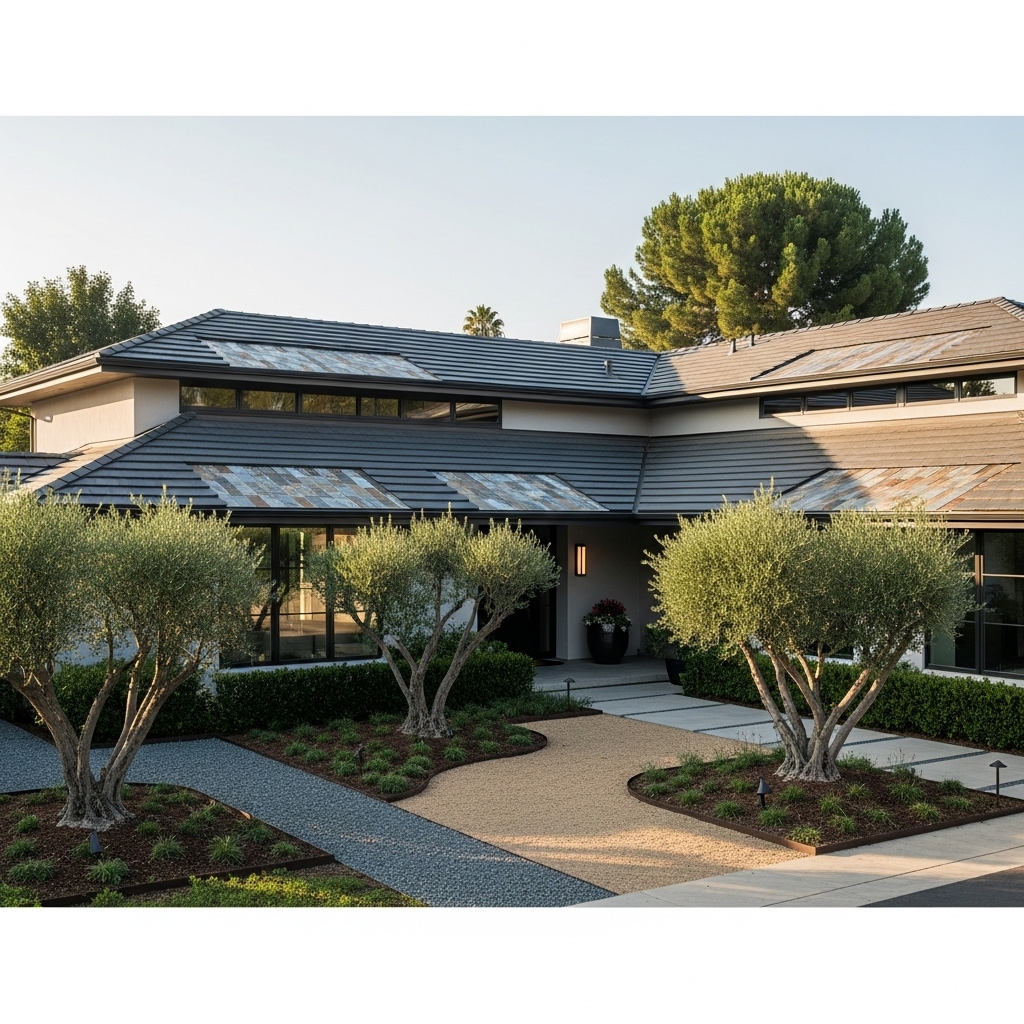
- Concrete and clay tile are common on Spanish Colonial and Mediterranean-style homes throughout Woodland Hills. Tile carries a higher material cost and needs a structural check because of its weight, but it handles the region’s sun well and can last several decades with proper maintenance.
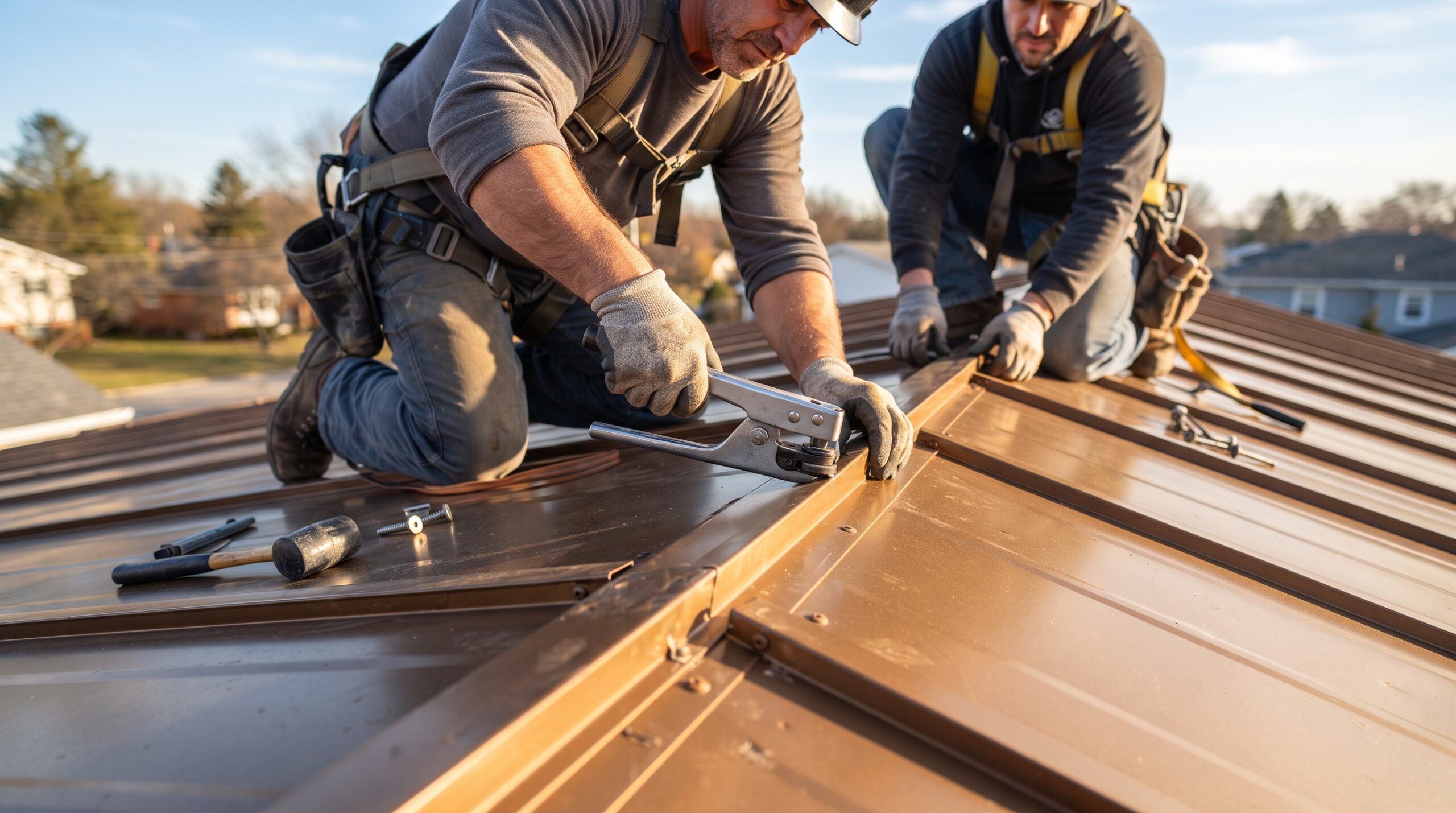
- Metal roofing (standing seam or exposed-fastener panels) costs more up front and is chosen on hillside homes for its long service life and fire performance. The steel roofing cost guide for Woodland Hills breaks down what moves a metal quote.
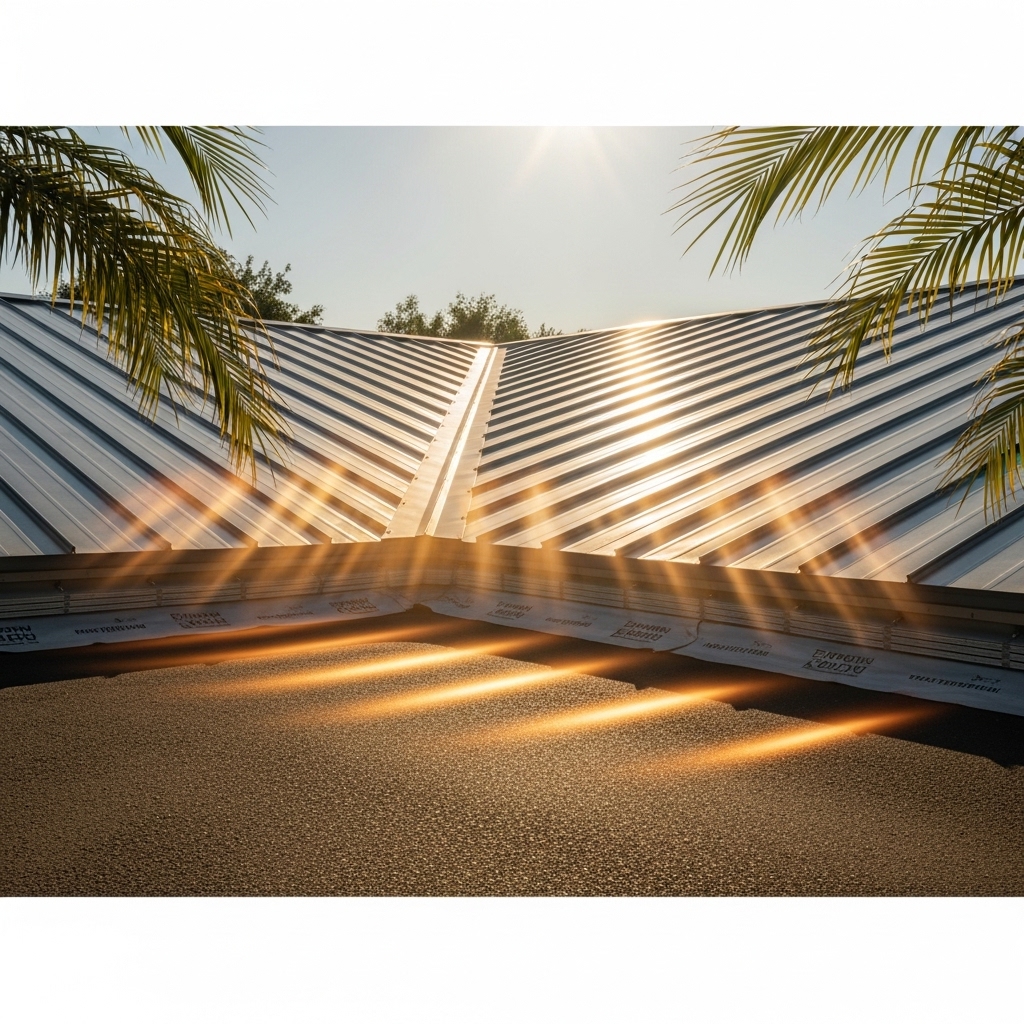
- Flat and low-slope systems (TPO, modified bitumen or built-up roofing) cover mid-century flat-roof homes, patio covers and additions. They are installed differently from steep-slope products and have their own cool roof values.
To get a material recommendation that fits your house the first time, talk to a professional roof contractor serving Woodland Hills.
How do size, pitch, shape and access change the labor?
Roofing is quoted in squares (one square equals 100 square feet of roof surface). The number of squares is the baseline; three physical factors then adjust the labor:
- Pitch. Steeper roofs need fall protection, slower movement and often more crew members, so an estimate for a steep hillside roof should say whether a steep-pitch charge applies.
- Shape. A simple two-plane gable goes faster than a hip roof with valleys, dormers and penetrations. Each valley, skylight, chimney and pipe needs flashing work that adds time and material.
- Access. Homes on narrow canyon roads or lots with little staging room make delivery and waste removal slower. When a crew cannot park a dump trailer beside the house, haul time goes up, and so does labor.
Why do tear-off and old layers matter?
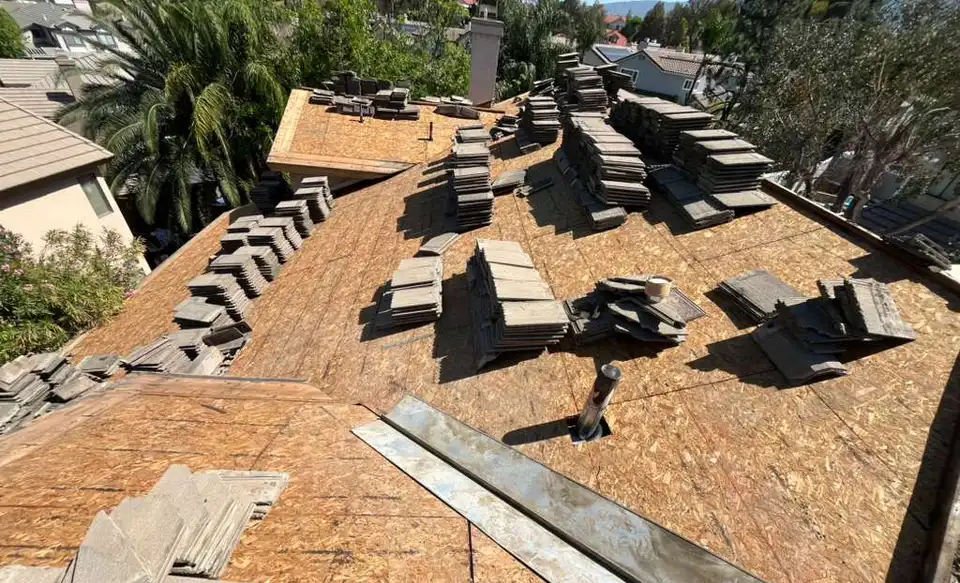
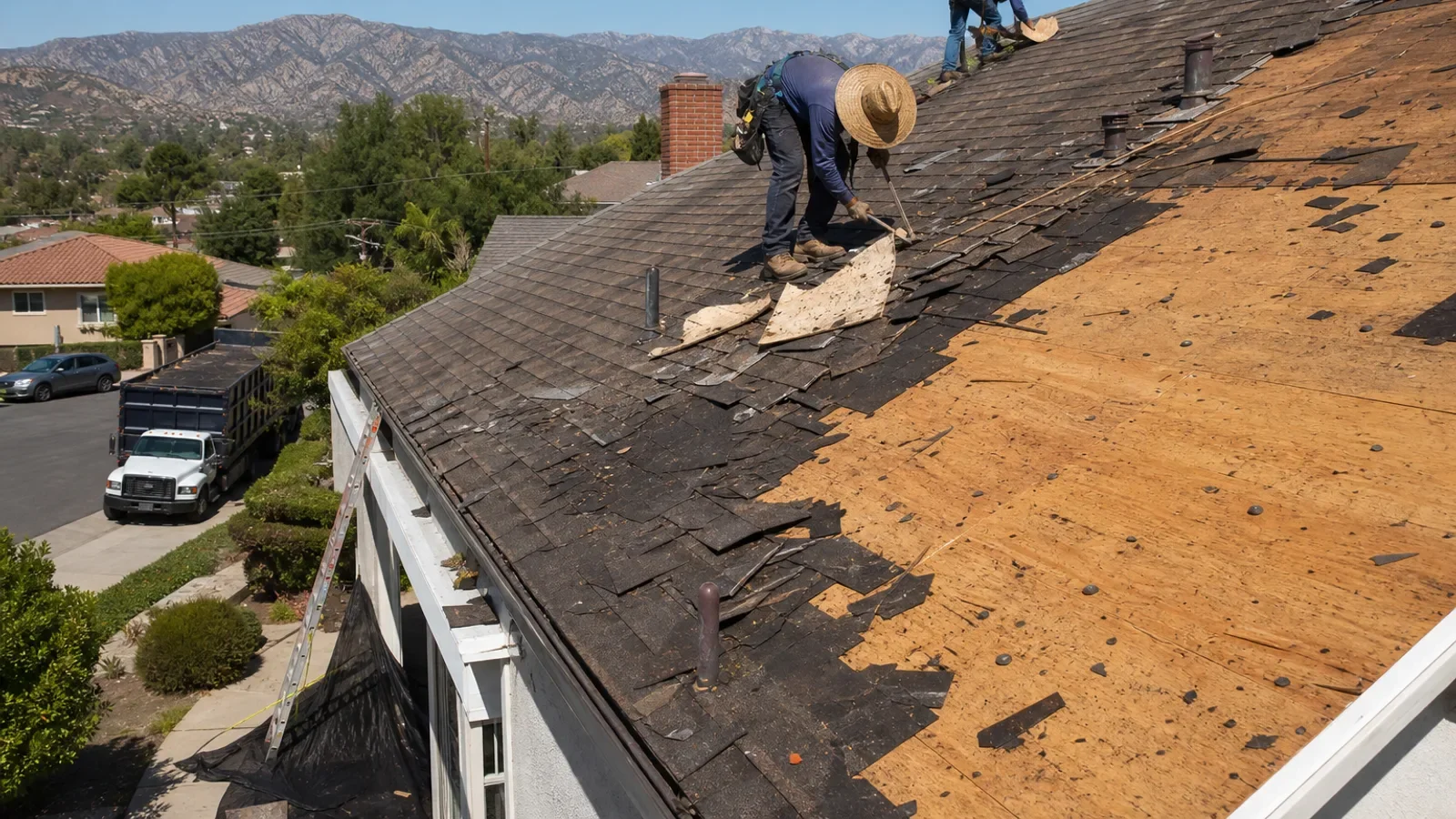
California’s residential code (2025 CRC section R908) defines a roof replacement as removing the existing layers down to the deck. A new covering may go over an old one only in limited cases, and never over a roof that is water-soaked or deteriorated, over clay or cement tile, or over two or more existing layers. Each layer removed adds labor, dumpster loads and disposal fees, and heavy tile adds more of both. Ask each contractor how many layers they found or assumed, and how the price changes if another turns up.
What hidden deck and structural work can come up?
Many Woodland Hills houses are old enough to be on their second or third roof. Census estimates put the median year built at 1967 in ZIP code 91364 and 1975 in 91367, and about 64 percent of the neighborhood’s homes were built before 1980. Tear-off on a house that age can reveal:
- Delaminated plywood or soft board sheathing that must be replaced before the new roof goes on, usually billed per sheet or per linear foot once the extent is visible.
- Rafter or truss damage from long-term moisture or pests.
- Fascia and soffit rot at the eaves, which affects how the starter course and drip edge are installed.
- Earlier ventilation cuts that need correcting.
A careful roof inspection before the project surfaces many of these in advance, so the estimate can carry a realistic allowance instead of change orders mid-project. Ask how deck repairs found during tear-off are priced and whether that cost is capped in the contract.
This is also where many Woodland Hills homeowners lean on an experienced roof contractor in Woodland Hills, because the deck allowance is the line that most often decides the final bill.
Which Woodland Hills rules affect the price?
Woodland Hills is a neighborhood of the City of Los Angeles, so the reroof permit comes from LADBS, not from Los Angeles County. Three rules can change which products qualify:
- Cool roof. ZIP codes 91364 and 91367 both fall in state climate zone 9, and under LADBS rules a reroof covering over half of a house’s roof area needs a product certified by the Cool Roof Rating Council. For steep slopes, the 2025 state energy code sets minimums of 0.20 aged solar reflectance and 0.75 thermal emittance (an SRI of 16 is the alternative), with exceptions such as ample ceiling insulation or a radiant barrier. Low-slope sections face much higher values (aged reflectance 0.63), which usually means a white or very light membrane.
- Fire zone. LADBS requires a Class A roof covering in a Very High Fire Hazard Severity Zone. The share differs sharply by ZIP code: a state-map grid estimate puts about 55 percent of the land in 91364 in the Very High zone, against about 2 percent in 91367. Your lot’s map status decides whether a cheaper non-Class A assembly is allowed at all.
- Permit. LADBS lists reroofing with Class A or B coverings lighter than 6 pounds per square foot over solid sheathing among its Express Permits, issued without plan check. Permit fees are set by the city and belong in every honest estimate; be cautious of a proposal that leaves the permit out.
How does Woodland Hills’ heat affect material and underlayment choices?
The NOAA station at Pierce College in Woodland Hills averages 115 days a year at or above 90°F and about 35 days at or above 100°F (1991 to 2020 normals), with an August average high of 97.4°F. That heat makes a high-temperature underlayment, balanced attic ventilation and a product that meets the cool roof values part of the base scope rather than optional upgrades, and those items should appear as named lines in the estimate. Most of the 16.4 inches of normal yearly rain falls between December and March, so a roof opened in winter needs a plan to seal it every night.
Key cost factors side by side
| Factor | Lower-cost case | Higher-cost case | Why it matters in Woodland Hills |
|---|---|---|---|
| Material | Cool-rated asphalt shingles | Concrete or clay tile, standing seam metal | Cool roof values and fire rating limit which products qualify |
| Pitch | Walkable low to moderate slope | Steep slope needing safety staging | Hillside homes are often steeper and harder to reach |
| Shape | Simple two-plane gable | Multi-hip with dormers, skylights, chimneys | Valley and penetration flashing adds labor on complex designs |
| Deck | Sound sheathing | Delamination or rot needing replacement | Most homes here predate 1980 |
| Existing layers | One layer | Two or more layers, or tile | State code bars recovering over two layers or over tile |
| Fire zone | Lot outside the Very High zone | Lot inside it: Class A assembly required | About 55 percent of the land in 91364 is mapped Very High |
| Access | Flat lot, room for a dumpster | Narrow canyon road, limited truck access | Delivery and haul-out add crew time |
Does a leak or storm change the scope?
If the replacement follows storm or leak damage, document the damage before work begins: it matters for an insurance claim and for making sure the contract captures the full scope. The emergency roof leak steps for Woodland Hills explain what to record and how to protect the house in the meantime.
Common questions about Woodland Hills replacement costs
Does Woodland Hills require a permit for a full roof replacement?
Yes. A reroof in Woodland Hills needs a permit from LADBS, the City of Los Angeles building department. A legitimate contractor pulls it as part of the project and lists it in the estimate.
Can I avoid a full tear-off if my existing roof looks intact?
Only in limited cases. State code allows a new covering over an existing one when the manufacturer’s instructions permit it, but not over two or more layers, over tile, or over a water-soaked or deteriorated roof. Installing over a layer can also hide deck damage and affect the new material’s warranty, so an inspection should decide.
What should a complete, transparent estimate include?
Itemized materials with product names and colors, labor, tear-off and disposal, the permit, flashing and accessories, ventilation, and a stated unit price for deck repairs found during tear-off. Vague lump-sum estimates make it hard to compare proposals or see what you are buying.
Is a higher-end material worth it in Woodland Hills’ climate?
Often. Heat, UV and wind are the main stresses on a Valley roof, so products with better reflectivity, wind ratings and manufacturer warranties tend to hold up longer; weigh the upfront cost against the expected service life with your contractor.
Get an estimate that reflects your actual roof
Online calculators are a starting point, not a budget. The factors that move the price most here (deck condition, pitch, access, cool roof compliance, the fire zone and the number of layers) are specific to your property and need an inspection. Woodland Hills is one of NEMA Roofing’s six locations, alongside Tarzana, Downey, Oxnard, Santa Barbara and San Bernardino, and our estimators work across all of Los Angeles, Ventura, Santa Barbara, Riverside and San Bernardino counties; see our roof replacement service and service areas. For an itemized estimate, call NEMA Roofing at 818-528-6412.
Ready for the next step? See how our roof contractor services in Woodland Hills work and reach out to the team.