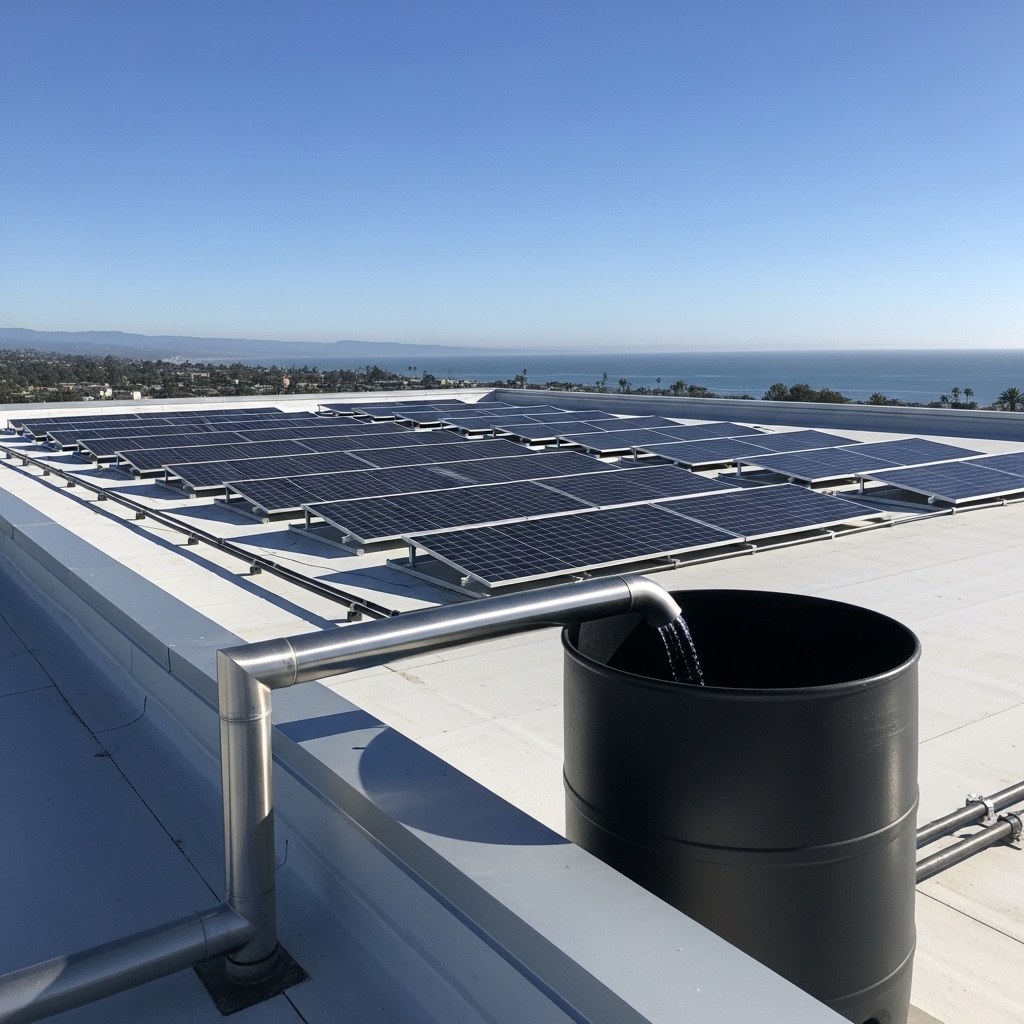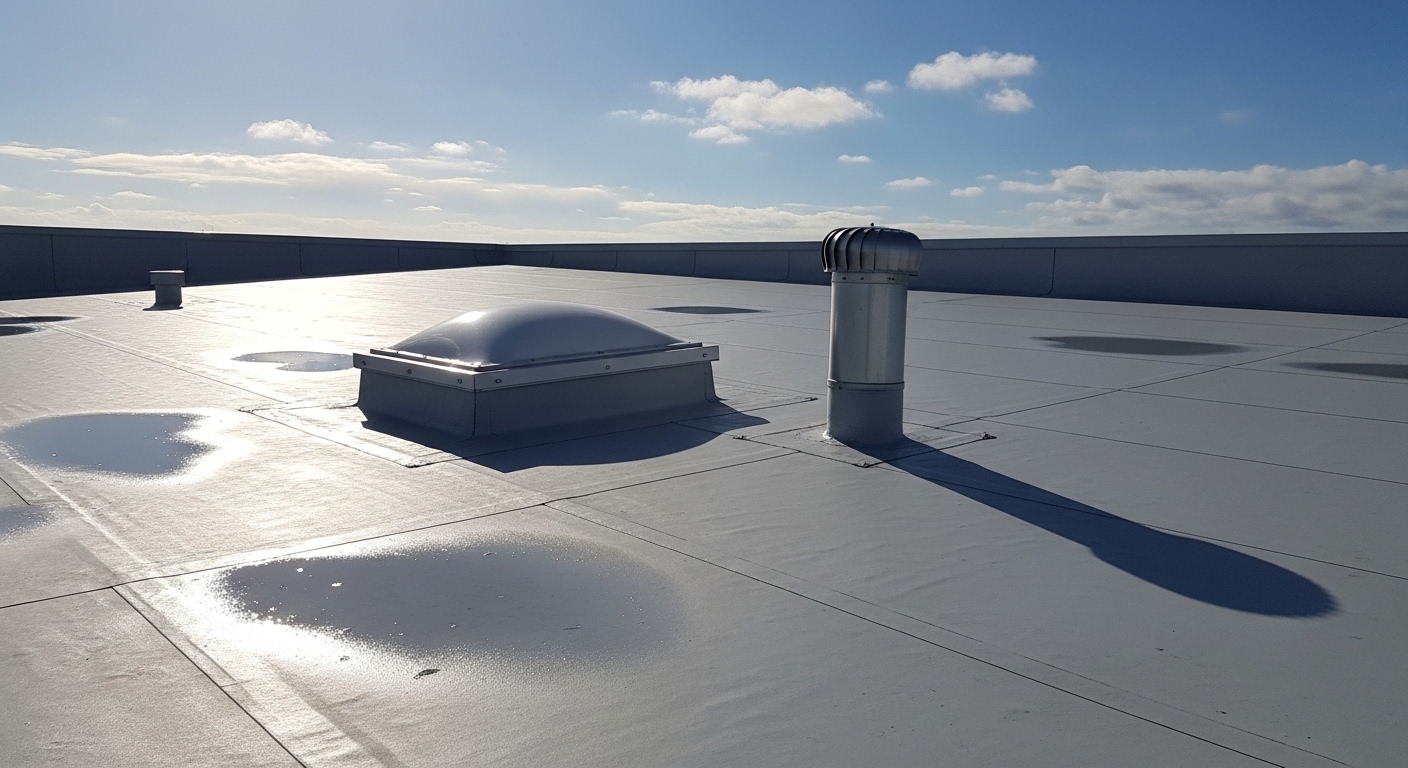
Flat roof drainage works by giving a roof that looks level a slight, steady slope (at least 1/4 inch per foot under California’s codes) toward its outlets: interior drains, scuppers through a parapet wall, or gutters at the edge, plus overflow outlets wherever a raised edge could trap water. Water that is still standing two days after rain means the slope or the outlets are not doing their job, and it shortens the roof’s life. To have a roof’s drainage checked, call NEMA Roofing at 866-631-3366.
Three ways water leaves a flat roof
| Outlet | How it works | Where it goes wrong |
|---|---|---|
| Interior drain | A drain body set into the roof at a low point, with a strainer, a clamping ring that grips the membrane, and a pipe down through the building | Leaves and grit block the strainer; the membrane pulls loose at the clamping ring; a drain set higher than the roof around it leaves a ring of standing water |
| Scupper | An opening through a parapet wall, usually into a collector head and downspout | The metal-to-membrane joint and the corners of the opening crack; a collector head packed with debris overflows against the wall |
| Edge gutter | The roof slopes to an open edge with metal edging, and water drops into a gutter | Edge metal separates from the membrane; a sagging gutter spills water onto the wall below |
The U.S. Department of Defense’s roofing criteria (UFC 3-110-03), written for military buildings, recommend drains with sump pans, under-deck clamps and a bolted clamping ring, and note that galvanized cast iron drains and strainers generally perform best. How many drains a roof needs, and the pipe sizes, come from chapter 11 of the California Plumbing Code, which the building code points to for roof drainage (CBC 1502.1).
Why a flat roof needs an overflow
If a roof drains to interior drains and its edges are raised (a parapet or curbed perimeter), a clogged drain turns the roof into a basin. California’s codes therefore require secondary overflow drains or scuppers where the roof perimeter would trap water if the primary drains back up (CRC R903.4.1 for homes, CBC 1502.2 for other buildings). The overflow sits slightly above the primary drain level and should empty somewhere you can see it: water pouring from an overflow scupper during rain is a signal that the main drain is blocked.
Weight is the reason this matters. The Defense Department criteria tell maintenance crews on failing roofs to keep drains clear and debris off specifically to prevent excessive ponding and possible roof collapse.
What counts as ponding, and what causes it?
Some water after rain is normal. The UFC definition of ponding is water in low or irregular areas that remains longer than 48 hours after rain stops, in conditions where it would normally evaporate. The usual causes:
- Too little slope. Older roofs were often built nearly level. California’s codes now require a design slope of at least 1/4 inch per foot for built-up, modified bitumen, single-ply and spray foam roofs (CRC R905.9.1 to R905.13.1, CBC 1507.10.1 to 1507.13.1).
- A sagging deck. Framing that deflects between supports creates bowls; ponded water adds weight, which deepens the sag.
- Drains set high. Extra roof layers or insulation added around a drain without a sump leave the drain above the water it should take.
- Blocked flow. Equipment curbs, rooftop ductwork supports and pipes set across the slope dam water on their uphill side.
- Crushed insulation. Foot traffic compresses soft insulation and leaves dents that hold water.
Ponding speeds up wear on every membrane, collects dirt that cuts a cool roof’s reflectance, and turns a small defect under water into a leak that runs for days. More causes of flat roof trouble are in our list of common flat roof problems.
How is ponding fixed?
- Clear and reset the drains. Remove debris, reset strainers and clamping rings, and lower a drain into a sump if it sits high.
- Add crickets. Small tapered wedges on the uphill side of curbs and between drains push water around obstacles. The UFC calls for crickets and saddles with twice the slope of the main roof.
- Retrofit tapered insulation. At a reroof, tapered boards can add slope over a level deck. The UFC ranks four-way tapered insulation (sloping to each drain from all sides) as the most effective way to drain a roof, followed by two-way tapered with saddles.
- Add outlets. A new scupper or drain at a persistent low point, sized to the plumbing code.
- Raise what the new slope buries. Adding slope raises the roof surface, so curbs, base flashings and door sills must be raised to keep their required heights.
For a reroof, California’s codes waive the 1/4-inch-per-foot minimum only where the existing roof still drains positively (CRC R908.1, CBC 1512.1), so a roof that ponds is fixed when it is replaced rather than carried forward. Where tapered insulation cannot make a low-slope roof drain, the UFC notes the roof may be a candidate for conversion to a pitched roof.
Keeping flat roof drainage working
Southern California’s rain comes in a short season: at both the Oxnard airport and the Pierce College station in Woodland Hills, NOAA’s 1991-2020 normals put more than four-fifths of the year’s rain between December and March. That makes fall the time to clear drains, scuppers, collector heads and gutters, and the first storms the time to watch where water collects. Check again after windy periods, when leaves and seed pods pile up at outlets. Our flat roof maintenance checklist covers the rest of the roof, and flat roof design explains how outlets and slope affect a new roof’s look.
Drainage repairs from NEMA Roofing
NEMA Roofing clears, repairs and redesigns flat roof drainage on homes and commercial buildings through our flat roofing services. Six NEMA locations (Downey, Tarzana, Woodland Hills, Oxnard, Santa Barbara and San Bernardino) put crews near every part of Los Angeles, Ventura, Santa Barbara, Riverside and San Bernardino counties; for Los Angeles properties, see our Los Angeles roofing page. If water is standing on your roof days after rain, call 866-631-3366.