
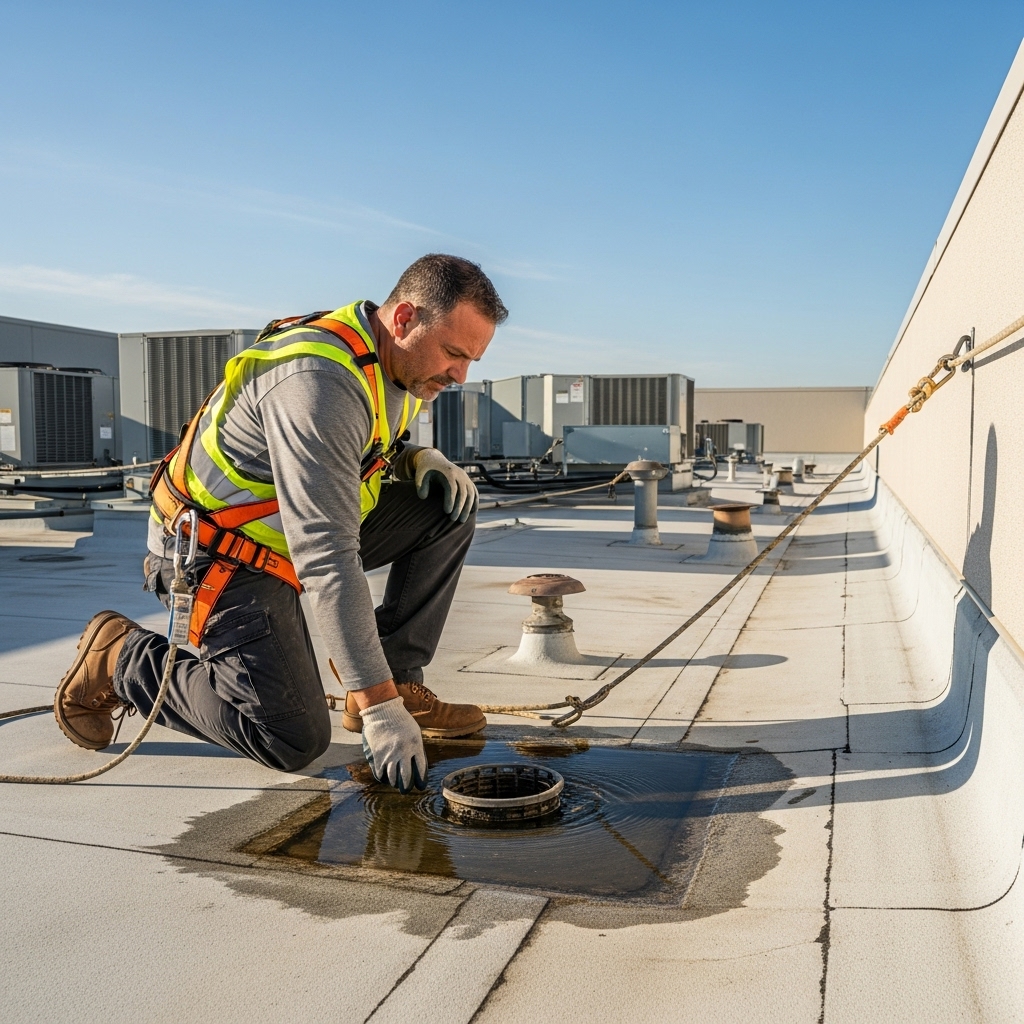
A commercial roof contractor in Tarzana should take a business roof from survey to sign-off: map the low-slope roof, its drains and rooftop equipment, recommend a membrane or coating system, pull the permit from the Los Angeles Department of Building and Safety (LADBS), meet California’s energy rules for nonresidential reroofing, and phase the work so tenants stay open. NEMA Roofing does this for Tarzana owners and property managers; call 818-528-6412.
What Tarzana’s heat and codes mean for a commercial roof
- Heat. The NOAA 1991-2020 climate normals for the Woodland Hills Pierce College station, about 2 km from Tarzana, average 115.2 days a year at 90°F or hotter and 35.5 days at 100°F or hotter, with an August average high of 97.4°F. Membranes, sealants and rooftop equipment curbs on Ventura Boulevard storefronts and offices age mostly from sun and heat, and the roof over a hot top floor drives the cooling bill.
- Rain. The same normals show 16.4 inches of rain a year, most of it in winter storms. On a flat roof, that is when blocked drains and low spots show up as ponding and ceiling stains.
- Permit. Tarzana is part of the City of Los Angeles, so LADBS issues the permit. Its Express Permit list (no plan check) includes reroofing with Class A or B coverings under 6 pounds per square foot over solid sheathing, and applying an approved coating to an existing roof; the same bulletin notes that cool roof rules may apply to nonresidential buildings under Title 24.
- Cool roof and insulation. Under the 2025 Title 24 energy code, when more than half of a nonresidential low-slope roof, or more than 2,000 square feet of it (whichever is less), is replaced, the new surface must reach an aged solar reflectance of 0.63, a thermal emittance of 0.75 and a solar reflectance index of 75, and the altered area must meet the code’s insulation level. Exceptions cover, for example, roof area under building-integrated solar panels and heavy roof constructions, and a lower reflectance is allowed where the insulation trade-off is met.
- Fire. Parts of Tarzana (ZIP 91356) lie in a Very High Fire Hazard Severity Zone, where LADBS requires a Class A roof covering. Ask the contractor to confirm the rating of the whole assembly, not just the top sheet.
Which roof systems suit Tarzana business buildings?
Most commercial buildings along the Ventura Boulevard corridor have low-slope roofs with parapet walls, package HVAC units and sign mounts, so the choice is usually among these systems:
| System | How it works | Where it fits |
|---|---|---|
| TPO single-ply | Heat-welded sheets, usually white and reflective | Offices and retail roofs that need a cool surface at a moderate cost |
| PVC single-ply | Heat-welded sheets that resist grease and many chemicals | Restaurants with kitchen exhaust on the roof |
| Built-up roofing | Several plies of felt and bitumen, often with a reflective cap or coating | Roofs that take heavy foot traffic and where layered redundancy is wanted |
| Modified bitumen | Factory-made asphalt sheets, torched, mopped or self-adhered | Small roofs with many penetrations and detailed flashing |
| Roof coating | A fluid-applied layer over a sound existing roof | Roofs that are dry underneath and need reflectivity and a longer service life, not a new system |
The right answer depends on the deck, foot traffic, ponding, rooftop equipment and budget, which is why a proposal should explain the choice rather than just name a product. For how these choices change the price, read our guide to commercial roofing cost per square foot in Tarzana.
Can the new roof go over the old one?
Sometimes. The 2025 California Building Code (section 1512.3) allows a recover over an existing covering, but not where the existing roof is water-soaked or too deteriorated to hold new roofing, where it is tile or slate, or where it already has two or more layers. A new coating can go over existing single-ply, built-up, modified bitumen, metal and some other roofs without tear-off. Before recommending either, a contractor should cut core samples and scan for trapped moisture; wet insulation left under a new roof keeps rotting the deck.
Drainage, equipment and solar
Drainage decides how long a low-slope roof lasts. During the survey, the contractor should mark ponding areas, check drain bowls and strainers, and confirm that scuppers and overflows are clear. Rooftop HVAC units need curbs tall enough for proper flashing and walkway pads so technicians do not wear paths into the membrane. If solar is on the roof or planned, the roofer and the solar installer should agree on mounts and penetrations before work starts, so both warranties stay valid.
How to keep a business open during a commercial roof replacement
- Phasing map. The roof is split into sections, and each one is made watertight by the end of the day.
- Tenant notice. Retail hours, medical procedures and restaurant service times decide when the loud tear-off happens.
- Site plan. Where the dumpster and material deliveries go, so parking and loading areas stay open.
- Safety plan. Fall protection at parapets, hatches and ladders, and protection over entrances.
- Weather plan. What happens if rain arrives mid-project.
What should a commercial roofing proposal include?
- Tear-off or recover, with the core sample and moisture findings behind that choice.
- Deck and insulation repairs, priced per unit so hidden damage does not become a dispute.
- The membrane or coating, its thickness and reinforcement, and the Title 24 values it meets.
- Flashing details at parapets, curbs and penetrations, edge metal, and walkway pads.
- The drainage plan, the phasing and safety plans, and the permit.
- Warranty terms, who registers the manufacturer warranty, and the closeout package (photos, inspection sign-offs, warranty documents).
- The contractor’s CSLB license number, which you can check on the state board’s website; NEMA Roofing holds CSLB license #1083283.
Ask for references on similar buildings (retail strips, medical offices, light industrial) and how the contractor handled access and changed conditions there.
Commercial roof maintenance after the new roof
A commercial roof holds up longer with checks before each rainy season and after strong wind, when debris, open seams and loose flashing are found early. Keep the inspection photos with the warranty file, since manufacturers can ask for maintenance records. Our preventive commercial roofing maintenance guide for Tarzana covers the checklist, and for a leak that cannot wait there is emergency roof repair in Tarzana.
Working with NEMA Roofing in Tarzana
Tarzana is one of NEMA Roofing’s five Google-verified locations, alongside Santa Barbara, Oxnard, Woodland Hills and Downey, and we take commercial work in every part of Los Angeles, Ventura, Santa Barbara, Riverside and San Bernardino counties (the service areas page lists the towns); see our Tarzana roofing page and the roofing contractor near me service. For a roof survey and a written commercial proposal, call 818-528-6412.




