
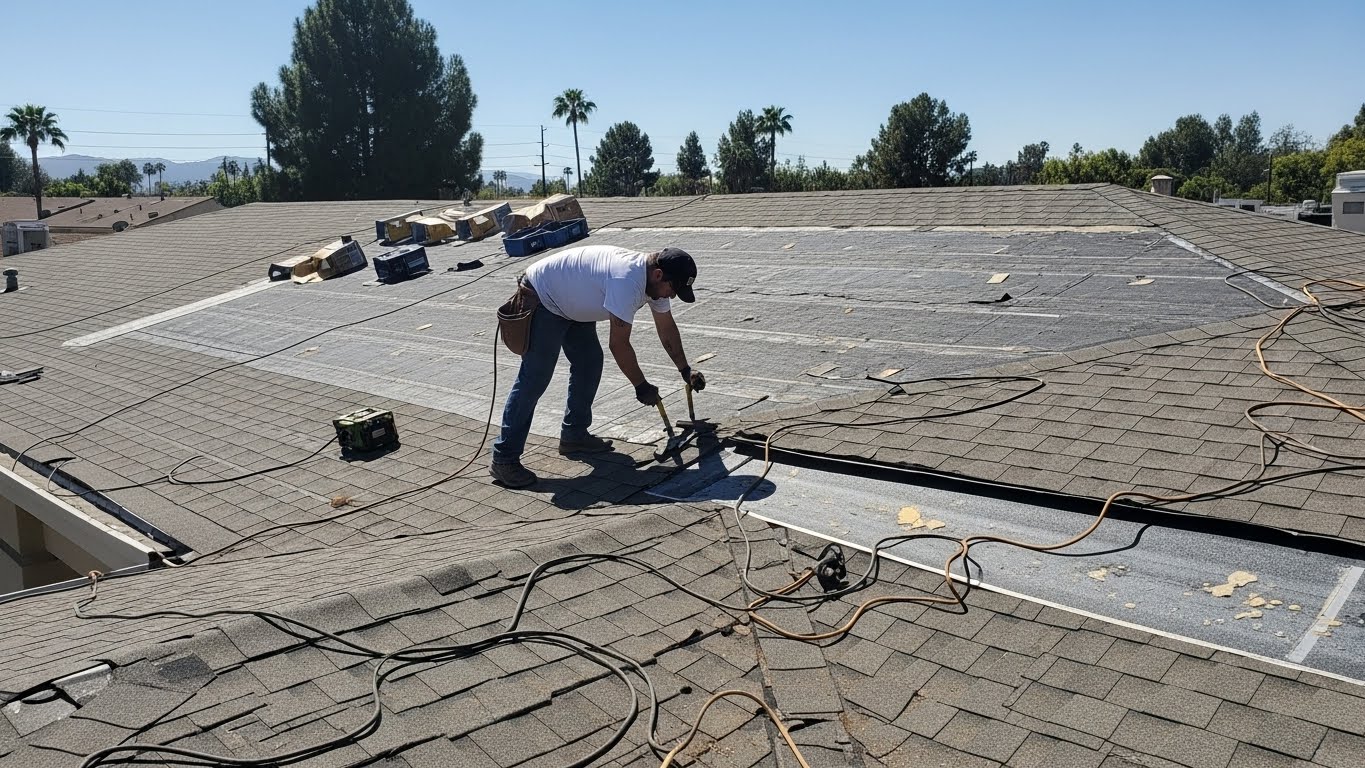
Commercial roofing cost per square foot in Tarzana, California depends on the roof system, whether the old roof is torn off or covered over, how much insulation the energy code adds, deck and drainage repairs, the edge and penetration details, access and work hours, and three local rules: an LADBS permit, California’s cool-roof requirement and a Class A roof in the Very High Fire Hazard Severity Zone areas of Tarzana. We quote no per-square-foot figure here because those drivers move the number more than any average could. This guide explains each driver so you can read and compare proposals. For a written estimate on your building, call NEMA Roofing at 818-528-6412.
Why is cost per square foot an outcome, not a starting price?
Cost per square foot is a convenient yardstick, but it is the result of the scope, not the input. Before anyone can put a meaningful figure on paper, they need to know the roof assembly you have, its condition and the performance you expect. A recover on a dry, stable deck lands very differently from a full tear-off with insulation upgrades and deck repairs.
Size and shape come next. Large, open roof areas benefit from economies of scale, while roofs broken into many small sections need more labor for flashing and detailing. Parapet height, the number of inside and outside corners, offsets and height changes all affect production pace and the quantity of accessories. Two buildings with the same square footage can need very different labor hours per square (100 square feet) because one is simple and the other is not. In Tarzana, where mid-century offices, newer tilt-ups and renovated retail sit side by side along Ventura Boulevard, that spread is common.
What drives the price of a commercial roof in Tarzana?
| Driver | Pushes cost per square foot up when |
|---|---|
| Tear-off vs recover | Old layers must come off (wet insulation, two existing coverings) and be hauled away |
| Deck condition | Rusted metal, rotted wood or cracked concrete must be repaired or reinforced |
| Insulation and cover board | The energy code requires added insulation, or foot traffic calls for a high-density cover board |
| System type | Multi-ply systems or hybrid assemblies are chosen over a single layer |
| Roof shape | Many sections, corners, parapets and height changes |
| Edges and penetrations | Many HVAC curbs, conduits and vents; long runs of edge metal |
| Drainage | Drains, crickets or tapered insulation must be added to stop ponding |
| Access and hours | No staging area, crane limits, off-hours work or odor-sensitive tenants |
| Fire classification | The address is in a Very High Fire Hazard Severity Zone and needs a Class A assembly |
| Warranty | A longer manufacturer system warranty requires specific materials, details and inspections |
How do existing conditions change the scope?
Existing conditions carry the most weight. Moisture trapped in insulation forces replacement of that insulation even when the membrane looks intact. Deck condition matters whether it is metal, wood or concrete: rust, rot or cracking trigger local repairs or reinforcement. Good contractors reduce surprises by combining moisture scans, core cuts and a visual inspection before they propose a plan.
The building code also limits covering over. Under the 2025 California Building Code (section 1512.3), a new roof may not be installed over an existing one that is water-soaked or deteriorated, or where there are already two or more roof coverings; in those cases the job becomes a tear-off, which is usually the biggest single swing in cost per square foot. A restoration coating is a lower-cost path only when diagnostics show the roof is dry, well adhered and structurally sound; it is not a shortcut around wet insulation or a failing deck.
Which Tarzana rules affect the price?
- Permit. Because Tarzana lies inside the City of Los Angeles rather than being its own city, its reroof permits are issued by LADBS, the city’s Department of Building and Safety. Its express permit list includes reroofing with Class A or B coverings weighing less than 6 pounds per square foot over solid sheathing, and notes that a cool roof may be required for non-residential buildings under Title 24.
- Cool roof and insulation. Title 24’s reroof rule for commercial buildings (2025 edition) applies once the work covers more than half of a low-slope roof or 2,000 square feet, whichever threshold is reached first; the new surface then needs rated cool-roof values (0.63 aged reflectance, 0.75 emittance, SRI 75, with exceptions) and the reroofed area needs insulation to the code’s table. Added insulation can mean raising curbs, flashings and edge metal; where rooftop equipment will not be lifted, the code allows a smaller insulation addition.
- Fire zone. State and City of Los Angeles fire hazard maps show Very High Fire Hazard Severity Zone areas within Tarzana’s 91356 ZIP code, toward the Santa Monica Mountains. LADBS requires a Class A roof covering in those zones, and the whole assembly must carry that rating.
How does Valley heat shape the system and the schedule?
Tarzana gets real heat. At the Pierce College weather station in neighboring Woodland Hills, the average August high is 97.4 degrees Fahrenheit, with about 115 days a year at or above 90 degrees and about 35 at or above 100 (NOAA 1991 to 2020 normals). That heat drives three cost decisions:
- Surface and insulation. A reflective membrane and adequate insulation protect the interior and keep the membrane from extreme temperatures; the code minimums above are the floor, not the ceiling.
- Cover boards and walk pads. Hot membranes soften under foot traffic; where HVAC technicians visit often, a high-density cover board and walkway pads reduce damage and keep seams clean.
- Work hours. Early-morning starts are common in summer, which affects crew scheduling.
Rain is concentrated in winter: about 88 percent of the station’s roughly 16 inches a year falls from November through March. Tear-offs are planned so that every section opened can be made watertight the same day, and in winter that planning takes more supervision.
How does the choice of system affect cost?
System selection is where owner priorities come into focus. Highly reflective single-ply membranes (TPO, PVC) offer energy benefits and clean seams. Modified bitumen brings toughness and multiple plies of redundancy. Hybrid assemblies that combine an adhered cover board with a welded single-ply balance puncture resistance and speed. Each path comes with its own accessories, adhesives or fasteners and edge treatments. When proposals are far apart, compare the assemblies and details before assuming the difference is markup.
Perimeter and penetration details are small on paper and large in practice. Continuous cleats, correct fastener spacing and secure terminations at the edge protect the field membrane from wind uplift. At HVAC curbs, conduits and vent stacks, good flashings and protection pads resist vibration and technician traffic. The number and complexity of these details affect both the schedule and the final cost per square foot.
Do access, logistics and tenants change the price?
Yes. A clear staging area and simple roof access allow faster production. A building with limited parking, no crane access during business hours, or loads lifted near power lines takes more time and coordination. On Tarzana’s busy commercial corridors, night or early-morning deliveries sometimes make sense but need extra supervision. Medical offices, restaurants and other occupied spaces may need off-hours work, low-odor materials and protected air intakes. Look for notes on phasing, intake protection and tenant communication in each proposal; they reflect real constraints on production.
How do warranties affect cost per square foot?
Longer or broader manufacturer warranties usually require specific materials, details, inspections and sometimes the manufacturer’s own sign-off, which can raise the price. We encourage owners to weigh warranty length against the building’s future: expected tenant changes, planned equipment, a possible expansion or sale. A solid but moderate warranty paired with a disciplined maintenance program can deliver the best value over the roof’s life. For reference, NEMA Roofing’s manufacturer credentials are GAF Master Elite, Owens Corning Preferred Contractor and Polyglass Preferred Contractor.
How to compare commercial roofing bids fairly
- Ask every bidder to price the same scope: tear-off or recover, insulation thickness, cover board type, edge metal gauge, flashing heights, walkway pads and drain work.
- Ask for deck repair as a unit price, so hidden damage is priced the same way by everyone.
- Request a simple roof plan showing the intended drainage changes; a drawing makes intent clearer than line items.
- Check that the cool-roof values, insulation level and fire classification are stated.
- Ask how mid-project discoveries will be documented and priced. A contractor who photographs hidden conditions, presents options with their trade-offs and explains the effect on cost and schedule lets you decide quickly.
Remember that the installed price is only the start of what the roof costs you. A roof that is easy to service, with walk pads, reinforced corners, good edge metal and accessible drains, needs fewer small repairs. For the long view, read commercial roof life cycle cost, and for upkeep once the roof is on, preventive commercial roof maintenance in Tarzana.
Get a written estimate for your Tarzana building
We can help you define the scope, document existing conditions and match the system to your building’s goals. Tarzana is one of NEMA Roofing’s five locations, together with Santa Barbara, Oxnard, Woodland Hills and Downey, and our commercial crews work across Los Angeles, Ventura, Santa Barbara, Riverside and San Bernardino counties. See our Tarzana roofing page, read choosing a commercial roof contractor in Tarzana, visit our commercial roofing service page, or call 818-528-6412.




