
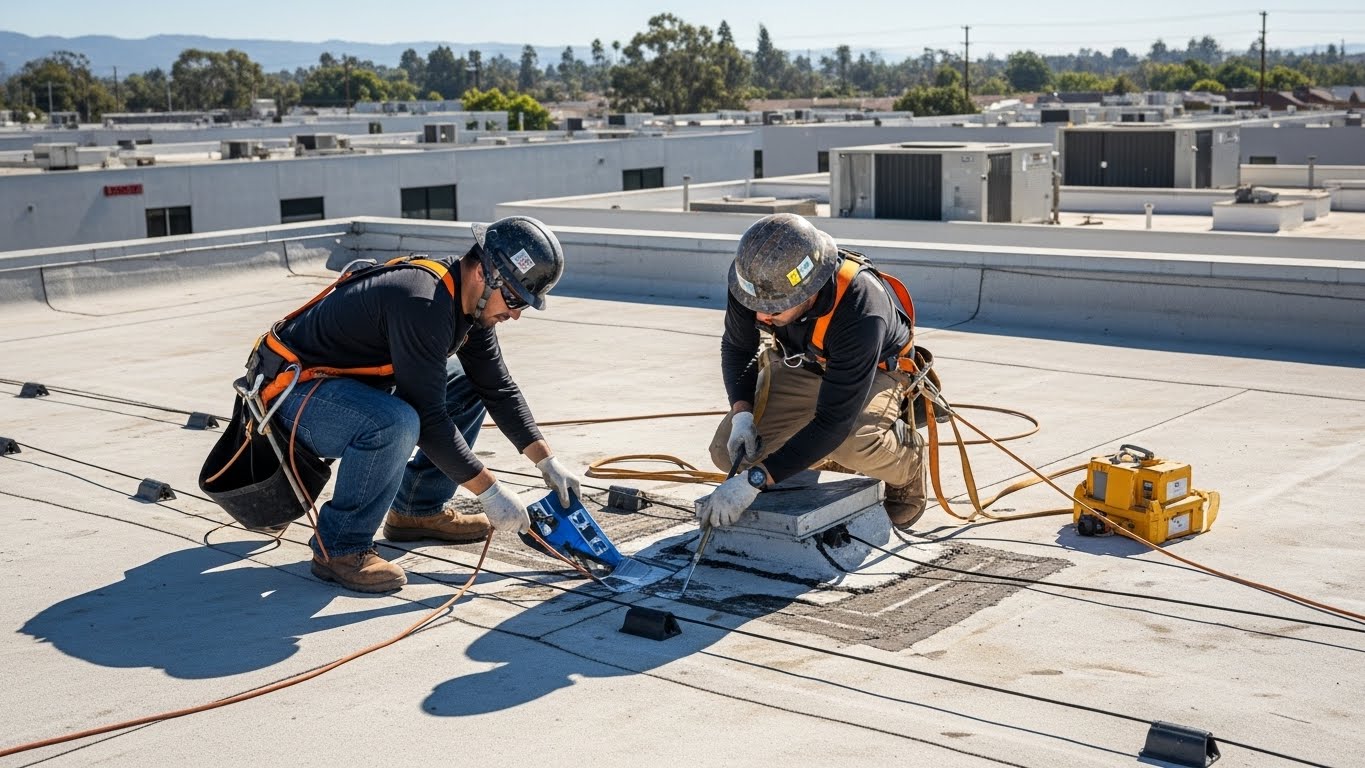
Commercial roof maintenance in Tarzana works best as two scheduled visits a year, one in spring before the Valley heat and one in fall before the winter rains, plus a check after any major wind or rain event. Each visit clears drains, checks seams, flashings, edge metal and rooftop equipment, makes small repairs and ends with a written, photo-based report. To set up a maintenance plan for your building, call NEMA Roofing at 818-528-6412.
Why does a Tarzana roof need a heat-and-rain schedule?
Tarzana sits in the San Fernando Valley, and its weather swings between two stresses. NOAA’s 1991-2020 normals for the Woodland Hills Pierce College station, about two kilometers from Tarzana, show an average August high of 97.4 degrees, about 115 days a year at 90 degrees or more and about 35 at 100 or more. The same station averages 16.4 inches of rain a year, and roughly 88 percent of it falls from November through March. The roof bakes for half the year, then has to drain a season’s worth of storms.
- Heat and UV dry out sealants, chalk coatings, wear granules off cap sheets and work seams and corners through daily expansion.
- A long dry season lets dust and debris build up in drains and on the membrane.
- Concentrated winter rain finds every clogged drain and open flashing at once.
Tarzana’s ZIP code, 91356, is in California climate zone 9. It is also a neighborhood of apartment buildings as well as shops and offices: about 42 percent of its housing units are in buildings with five or more units, according to the Census Bureau’s American Community Survey, and owners of those buildings face the same maintenance questions as retail and office owners.
What happens at each maintenance visit?
The U.S. Department of Defense roofing criteria (UFC 3-110-03) require inspecting every roof at least once a year and note that the National Roofing Contractors Association recommends at least twice a year and after significant storms. In the Valley, the two visits line up with the seasons:
| Visit | Focus | Typical tasks |
|---|---|---|
| Spring (before summer heat) | Sun and heat damage | Check seams and edges for movement, UV wear on south- and west-facing areas, sealant at flashings; gentle cleaning of white membranes to restore reflectivity |
| Fall (before the rains) | Water paths | Clear drains, scuppers and leader lines, confirm strainers are secure, mark low spots, reseal open flashing seams |
| After a major storm or wind event | Damage | Look for lifted edge metal, displaced coping, punctures, debris and blocked drains |
Buildings with heavy rooftop traffic or a lot of equipment may need more frequent walk-throughs. If the roof is under a manufacturer warranty, follow its inspection schedule as well.
Start with a baseline survey
A maintenance plan starts with knowing what is up there: membrane type and age, the layers underneath, slope, drain locations and every penetration. Early warning signs worth recording include chalking on white single-ply, granule loss on modified bitumen, heel marks near equipment and the faint rings that show where water ponds. With that baseline, each visit tracks change instead of guessing.
Where leaks are hard to trace or wet insulation is suspected, an infrared scan helps. The DoD criteria note that infrared thermography surveys the whole roof surface, while capacitance and nuclear methods sample only a small share on a grid, and that these methods supplement a visual inspection and are confirmed with a core sample.
Drainage, foot traffic and rooftop equipment
A clean drain does more good than a tube of sealant. Where water keeps ponding, small corrections help: a tapered cricket to move water toward a drain, an adjusted drain bowl, or an overflow scupper. Less standing water means less stress on the membrane.
Rooftops are workspaces for HVAC, electrical and solar technicians, who take the shortest path rather than the safest one for the membrane. Walkway pads from the access point to equipment clusters show where to step. Condensate lines that drip onto the membrane should be routed to a drain; the constant wetting leaves dirty streaks and wears the surface. Guard strips around penetrations and a rub strip where ladders land cut incidental damage further.
Edges, details and compatible repairs
Parapet corners, curb transitions and pipe flashings are where membranes pull under heat cycling, and edge metal is where wind gets a grip. Watch for lifting edge metal, loose coping joints and stress at inside corners, and fix them early with a corner patch, new counterflashing or added fastening under the edge metal. Repairs should use materials compatible with the existing roof (matching primers, tapes and patches on single-ply; compatible plies on modified bitumen) so the roof stays within its warranty terms. Our guide to commercial roofing warranties covers what most warranties expect from maintenance.
What should a commercial roof maintenance plan include?
- A fixed visit schedule (spring and fall at minimum) plus storm checks.
- A written report after each visit: photos of key areas, changes since the last visit, minor repairs made, and recommendations ranked by urgency.
- A clear list of what minor repairs are included and what needs separate approval.
- Coordination with the roof’s warranty requirements.
- Access controls: marked entry points, a posted roof map, walk paths, and fall-protection procedures for everyone who goes up.
Over time the reports become the roof’s history, which owners, managers and insurers all use. See our roof maintenance service for how we run these visits.
When is maintenance no longer enough?
Widespread moisture under the membrane, brittle surfaces across large areas, leaks that keep appearing in new places, and ponding that returns after small corrections all mean it is time to plan restoration or replacement. The DoD criteria put it plainly: a roof that keeps leaking despite repeated repairs should be scheduled for replacement. Planning that project from a maintenance history is far easier than reacting to a failure. For repairs that cannot wait, see commercial roofing repair in Tarzana.
Which permits and fire rules apply to bigger work in Tarzana?
Because Tarzana is a neighborhood inside Los Angeles city limits rather than a separate city, a reroof is permitted through LADBS, the city’s building department, which requires a Class A roof covering in Very High Fire Hazard Severity Zones. Parts of the 91356 ZIP code are mapped as a Very High zone on both the state and city fire hazard maps. A commercial low-slope reroof must also meet California’s cool-roof values once enough of the roof is replaced, recovered or recoated, so a maintenance recoat on a large section can trigger the rule.
NEMA Roofing keeps a location in Tarzana, one of five with Woodland Hills, Downey, Oxnard and Santa Barbara, and maintenance crews from them reach buildings in all five counties we serve: Los Angeles, Ventura, Santa Barbara, San Bernardino and Riverside. Local details are on our Tarzana roofing page, and the full scope of commercial roofing work is on the service page. Call 818-528-6412 to schedule a first maintenance visit.




