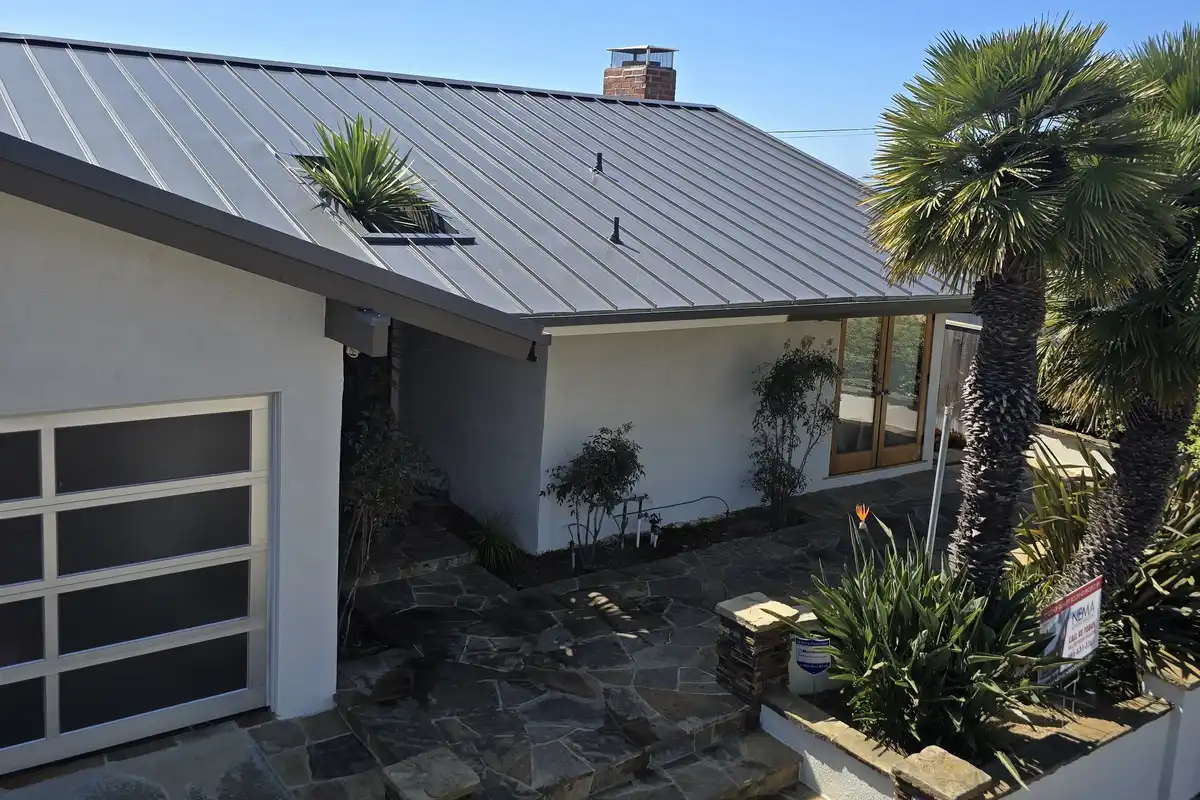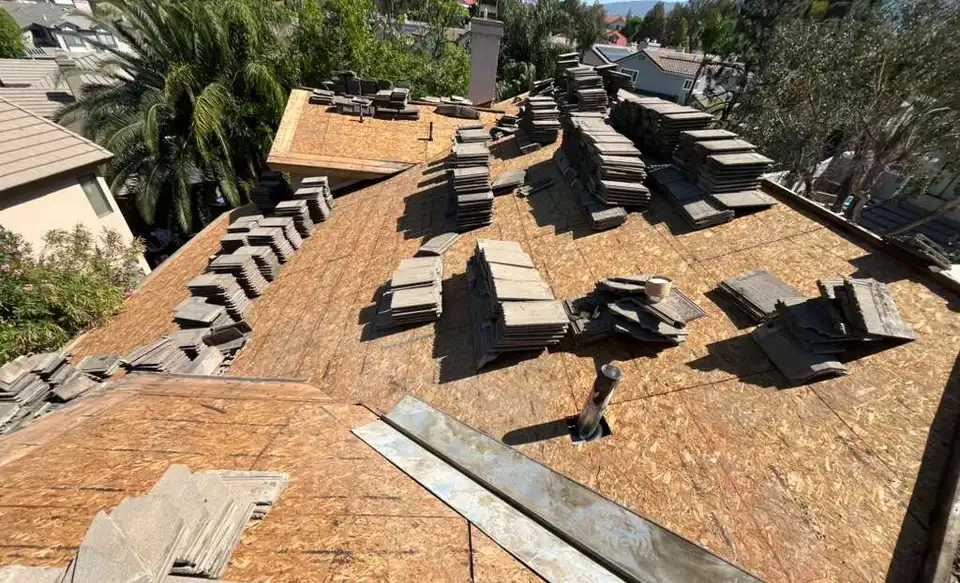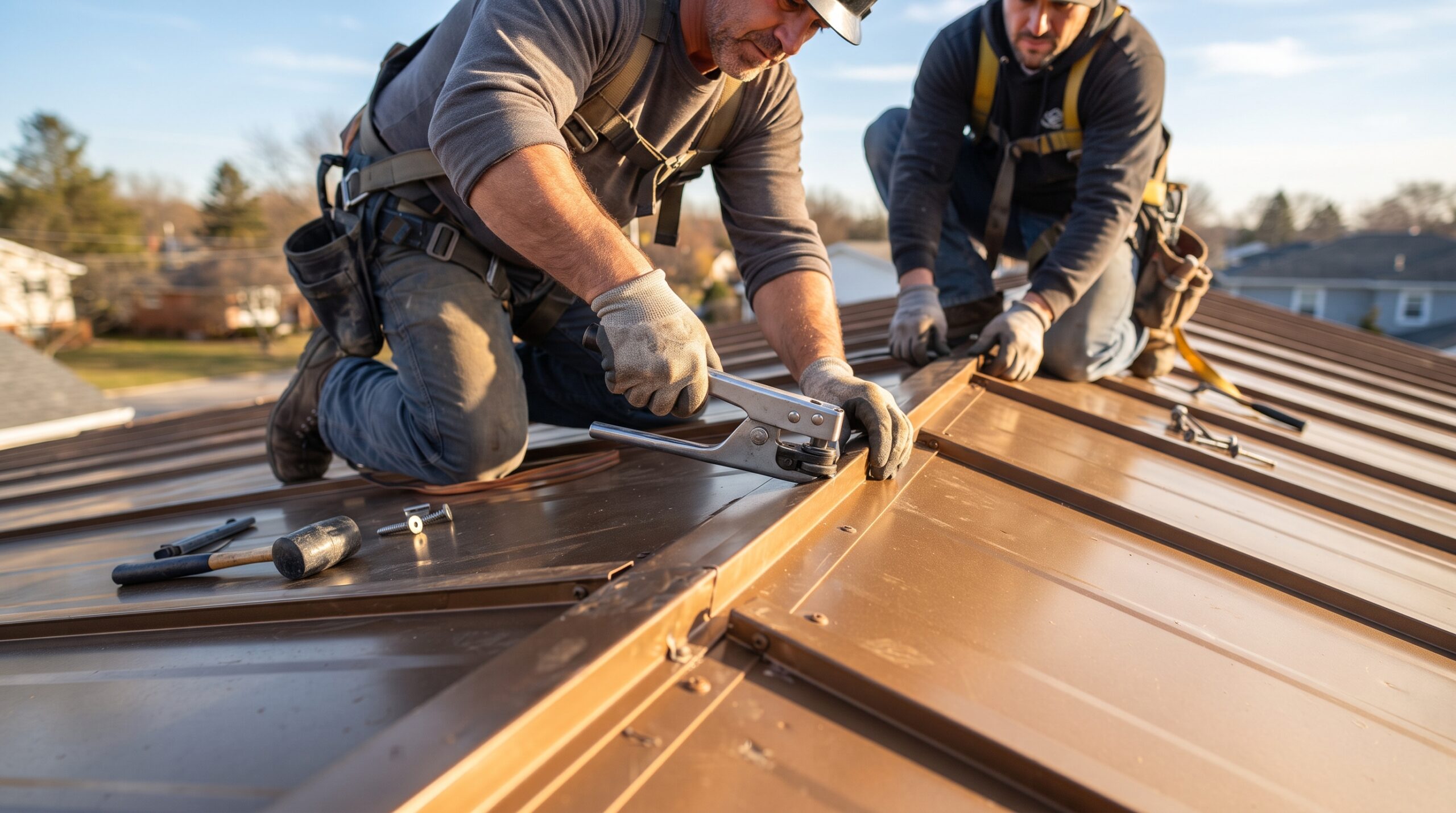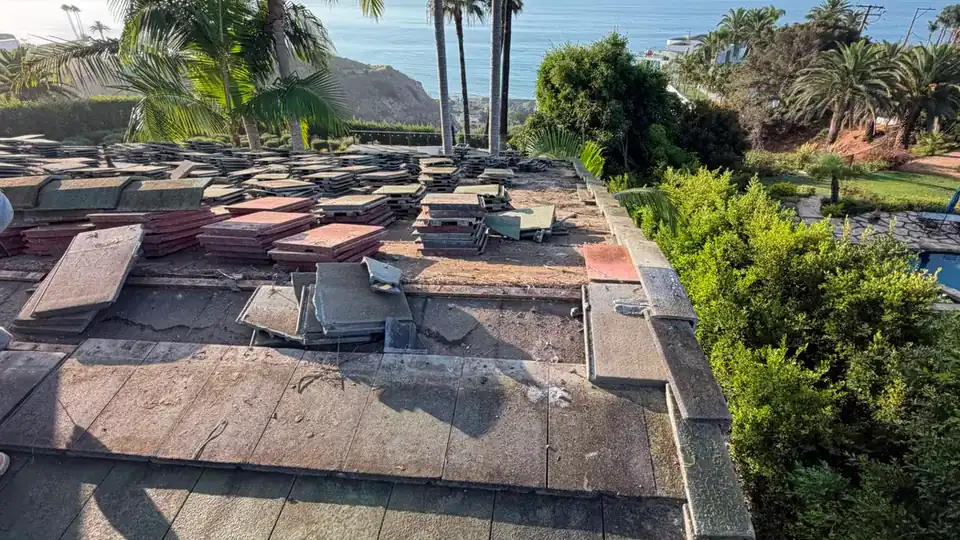
The cost of a roof replacement in Santa Barbara starts from about $6 per square foot of roof in 2026: about $600 per square, or from about $12,000 for 2,000 square feet of roof. That is the market’s starting figure from public cost guides, at the price level of asphalt shingles, and not a NEMA quote. Tile, metal, old layers, deck repair and the rules for your address raise it.
For the number on your own house, NEMA Roofing measures the roof during a free-of-charge consultation and inspection. Our Santa Barbara location is one of six that cover Santa Barbara, Ventura, Los Angeles, Riverside and San Bernardino counties; see how we handle roof replacement in Santa Barbara County, or call 805-977-5949.
Roof replacement cost per square foot in Santa Barbara: shingle, tile and metal
Roofers price the surface they cover, so the unit is the square foot of roof, or the square of 100 square feet, never the floor area of the house. Here is what the published figures support for Santa Barbara today.
| Roof | Market starting figure, Santa Barbara, 2026 | What pushes it up on a Santa Barbara house |
|---|---|---|
| Asphalt shingle, full tear-off | From about $6 per square foot of roof (about $600 per square) | A second old layer, deck repair, a steep pitch |
| Clay or concrete tile | No figure: fewer than three public sources price these for the city | Heavy tiles to strip and haul, new underlayment, Class A details in a fire zone. See tile roofing |
| Metal, standing seam | Panel metal and coating chosen for salt air, flashing at walls and valleys | |
| Flat or low-slope section | A cool-rated membrane or coating when more than half of the whole roof is replaced |
The $6 figure is the average of the low ends four cost guides publish for Santa Barbara, read in November 2026. Two price asphalt shingles specifically: Homeyou ($5 per square foot in its shingle table) and 3D Roofs ($5.44, from its architectural shingle row for 2,000 square feet of roof).
The other two, Opsite ($6) and Keystone Connect ($9), give one roof replacement range without splitting it by material, so their low end is taken as the price of the lowest-cost common roof, asphalt shingles. The figures spread partly for that reason and partly because those two quote a project or home size without saying whether the square feet are roof or floor. Every source that prices tile or metal separately puts it above asphalt shingles.
Those guides build their ranges from materials, labor, tear-off and disposal, underlayment, flashing and the permit. A quote adds what only the house shows:
- Deck repair: the boards or sheets to replace are unknown until tear-off, so ask for a unit price.
- Rotted eaves, rafter tails and fascia, the exposed wood at the roof edge.
- Gutters and downspouts, if they are replaced at the same time.
- A detached garage or studio, which is a second roof with its own squares.
- Skylights replaced rather than re-flashed.
What a 2,000 square foot house means in roof squares
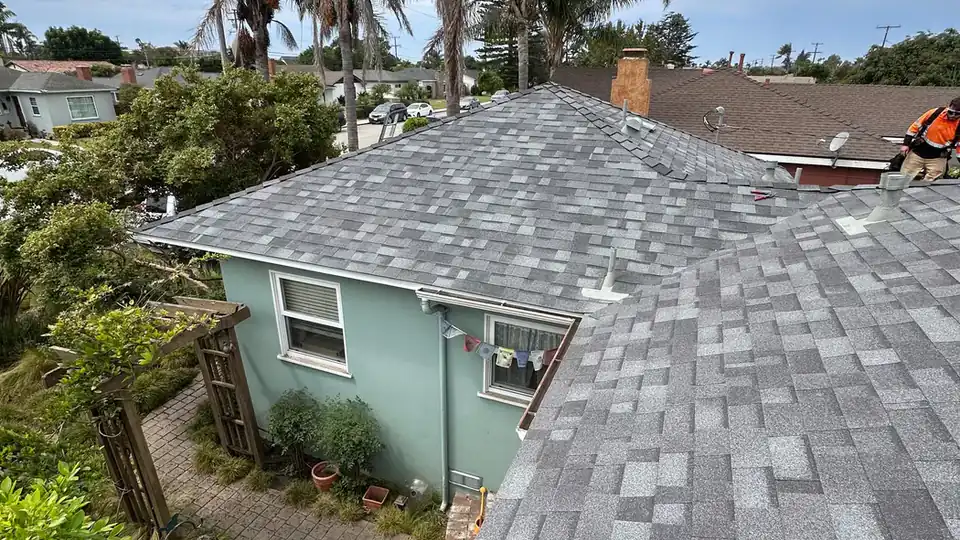
Floor area and roof area differ. A single-story house of 2,000 square feet carries more than 2,000 square feet of roof, because pitch adds surface and the eaves reach past the walls; an attached garage adds its own slopes. A two-story house with the same floor area usually stands on a smaller footprint, so its roof is usually smaller, though higher or steeper work can cost more per square.
At the market’s starting figure, each square of roof adds about $600. Ask every roofer for the measured number of squares and the pitch, and compare quotes on that, not on the house’s square footage.
Which Santa Barbara rules change the price of a new roof?
Four rules decide part of the scope before you pick a material. Each depends on the exact address, so check them first.
Cool roof in climate zone 6: low-slope parts only, once over half the roof is replaced
The California Energy Commission’s climate zone table puts every Santa Barbara-area ZIP code it lists from 93101 to 93111, Montecito’s 93108 included, in climate zone 6. The 2025 Energy Code’s re-roof rule starts only when more than 50 percent of the roof is replaced, and a new layer laid over the old surface counts. For sloped roofs it then asks for cool-rated values only in zones 4 and 8 through 15, so a pitched shingle, tile or metal roof here has no cool-roof requirement under that code.
Low-slope roofs are the exception. When more than half the roof is replaced, new roofing on its flat or low-slope parts needs an aged solar reflectance of at least 0.63 and a thermal emittance of at least 0.75 (or a solar reflectance index of 75), a rule that covers zones 4 and 6 through 15.
Three exceptions apply here: continuous insulation at the roof deck (in zone 6, R-10 removes the requirement and R-2 to R-8 lower it step by step), roof area under building-integrated solar panels, and a roof construction weighing at least 25 pounds per square foot. On a house that mixes a pitched roof and a flat one, make sure the quote names a rated product or the exception used for the flat part. Our cool roofing page explains the ratings.
Material and color can be limited elsewhere. Opsite, one of the cost guides above, says Santa Barbara’s architectural review board limits material choices, and Keystone Connect puts local totals about 30 percent above the Los Angeles County baseline partly because of historic-district review. Ask the city or the county whether your address falls under design review before you choose.
Class A roofing in the city’s High Fire Hazard Areas
The City of Santa Barbara maps its own High Fire Hazard Areas: Foothill and Extreme Foothill (the state’s High and Very High), plus Coastal and Coastal Interior zones near the shore. CAL FIRE’s maps for local land, released on 10 March 2025, added hazard zones in parts of the Mesa near Cliff Drive and Flora Vista and in the northern parts of San Roque and La Cumbre.
In April 2025 the city said it would merge these into its maps through a local ordinance. For what is in force on your parcel today, open the city’s MAPS viewer and turn on the Fire, High Fire Hazard Area layer.
Inside those areas, the city’s own handout, written for the 2019 codes, says roof coverings on existing buildings, and on additions or repairs to them, must be Class A or noncombustible fire-retardant materials, and it names no minimum share of the roof. Wood shakes or shingles are not allowed, except fire-retardant treated ones where less than 20 percent of an existing shake roof is replaced within two years. Ask the city’s Building & Safety Division whether that rule still reads the same today.
The state’s Wildland-Urban Interface Code covers High and Very High Fire Hazard Severity Zones and the wildland-urban interface areas cities designate. Under its section 507.1, a roof replaced, or 50 percent or more replaced within 12 months, must meet the roof rules for new construction, and any roofing applied in a repair must be at least Class A.
The cost sits in the layers. Where tile or profiled metal goes over a combustible deck, such as plywood or wood boards, and leaves an air space under it, those rules call for a 72-pound mineral-surfaced cap sheet over the deck (not needed where at least 1 inch of mineral wool board or another noncombustible layer lies between roofing and deck), bird stops at the eaves where the profile fits, and mudded hip and ridge caps.
A listed underlayment tested as part of a Class A assembly is the code’s other route. Ask whether the quote lists these items; our fire-resistant roofing guide compares the materials.
No recover over tile or over two layers
The California Residential Code, which governs houses, does not allow a new roof laid over clay or cement tile, over two or more existing layers, or over a roof too wet or worn to serve as a base (2025 edition, section R908.4). Tile cannot be covered over, but whole tiles may be lifted and relaid, while cracked or broken ones may not be reused (section R908.5), so the quote should say how many tiles it reuses. Laying new shingles over old ones is only an option over a single sound layer, and it leaves the deck unseen.
The permit: city or county
Inside city limits, the City of Santa Barbara runs construction permits through its online portal, Accela Citizen Access. A Santa Barbara mailing address does not prove the house is in the city: Hope Ranch and Mission Canyon, for example, are unincorporated communities. Ask the city or the county which of them issues the permit for your parcel, and have the quote say who pulls any permit and whether its fee is included.
Does a leaking tile roof need a full replacement?
Not always, and on a tile house the answer can change the whole budget. Clay tile usually lasts longer than the underlayment under it, so a tile roof that leaks while the tiles are whole often needs new underlayment under the same tiles rather than a new roof. Our tile roof underlayment replacement guide walks through that job.
The same thinking applies to a worn flat section on an otherwise sound roof: it can be replaced on its own. If that section is half of the whole roof or less, the Energy Code’s re-roof rule above is not triggered; if the work covers more than half, the cool-roof values apply to the flat part.
How do I get an exact price for my Santa Barbara roof?
- Look up the house’s permit history. On the city’s permit portal anyone can research recent permits for a property without an account, and the city says the portal’s record history starts in the 1990s. A past re-roof permit dates the current roof and helps a roofer judge how many layers to expect.
- Check your parcel’s fire layer in the city’s MAPS viewer, and note whether any part of the roof is flat.
- Get the roof measured and looked at, from the attic too. A written estimate should give the squares, the pitch, the layers to remove, the named product line, the underlayment and flashing, and deck repair as a unit price.
- Compare two quotes line by line, including who pulls any permit and which fire or cool-roof items are in. Our guide to the cost of roofing replacement lists what each line covers.
NEMA Roofing holds CSLB license #1083283 (roofing C-39 and general building B). We look at the roof and the attic, measure it, check the fire and energy-code rules for your address, and put the system, underlayment, flashing, ventilation and disposal in writing. Call 805-977-5949 or send us your address to book a free-of-charge consultation and inspection.