
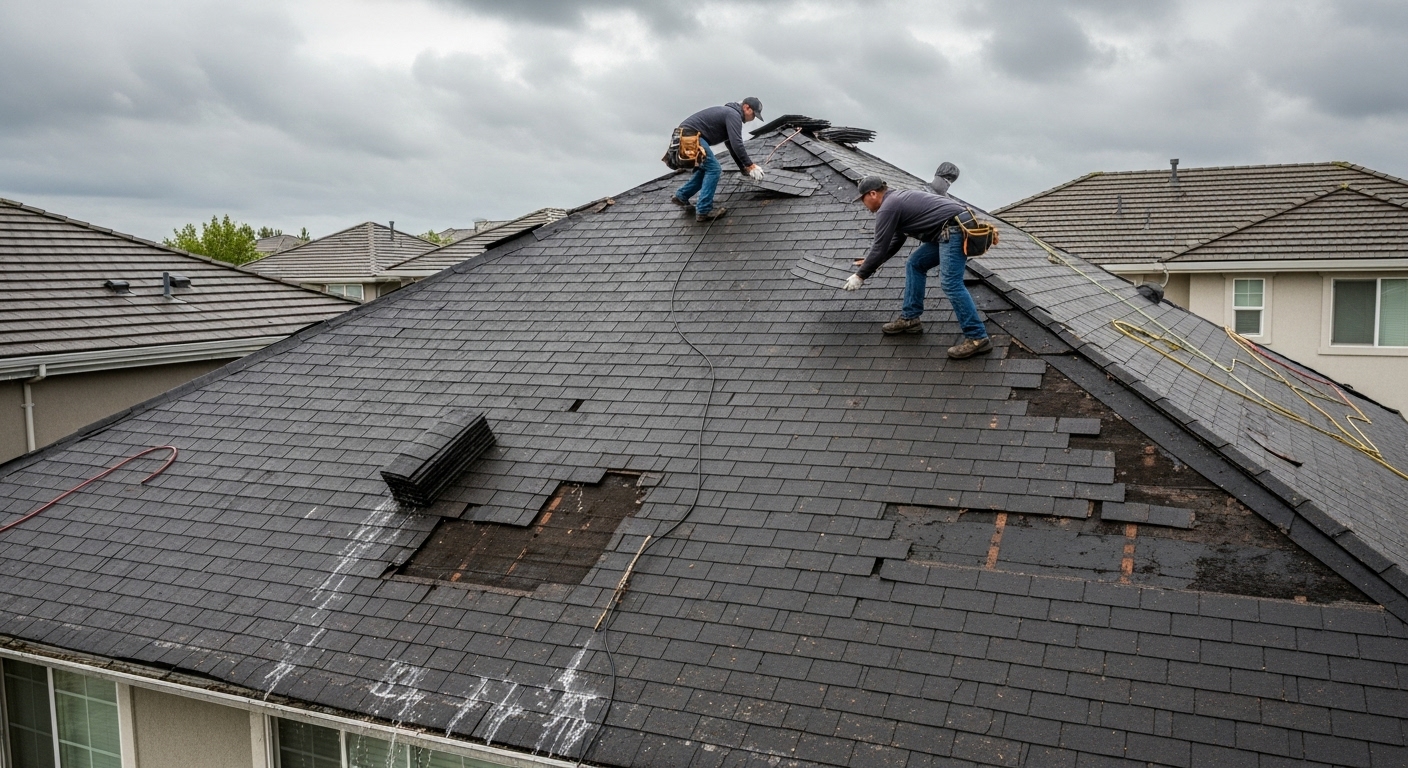
When a roof keeps leaking after repair, the repair usually treated the stain rather than the entry point, or the cause runs across the whole roof: aged underlayment, flashing that was reused instead of replaced, or a soft deck. Water travels along underlayment and framing before it shows on a ceiling, so a patch placed right above the stain can miss the entry point entirely. The way out is to find the true entry first, then decide between a targeted repair and a replacement. If water is coming in now, call NEMA Roofing at 866-631-3366.
Why does a leak come back after it was fixed?
- The patch went where the stain was. Water that gets past the roof covering runs down the underlayment, along a rafter or across the top of the drywall before it drips. The stain marks where it fell, not where it entered.
- Sealant instead of a real repair. Caulk or roof cement smeared over a joint can hold for a season, then cracks as the roof heats and cools.
- Flashing was reused. Step flashing along a wall, chimney flashing and skylight flashing are woven into the roofing. A repair that works around old, rusted or bent pieces leaves the weak point in place.
- More than one entry point. Fixing the first source reveals the second, which feels like the same leak returning.
- The waterproof layer is worn out. On tile roofs especially, the tiles shed most of the water and the underlayment beneath them does the rest. The Tile Roofing Industry Alliance’s installation manual notes that most problems with water-shedding roofs come from water that migrates past improper flashing or from wind-driven rain, which is why the underlayment is critical. Tiles can look perfect over underlayment that has failed.
- It is not a roof leak. Condensation in a poorly ventilated attic, a plumbing vent, an HVAC line or a window above a lower roof can all drip where a roof leak would.
How do you find where the water really gets in?
- Go into the attic with a flashlight during or right after rain, and look at the underside of the deck and rafters for wet wood, dark stains and drip trails. Follow the trail uphill; the entry is usually above and upslope of the ceiling stain.
- Match the spot to what is on the roof above it: a wall, chimney, skylight, vent pipe, valley or a change in roof pitch.
- Water test in sections. A roofer runs a hose low on the suspect area first and works upward, one section at a time, while someone watches inside. Starting at the top makes every section below look guilty.
- Open the roof at the suspect detail. On shingles, that means lifting courses to see the flashing; on tile, lifting tiles to see the underlayment and the pans.
Our guide to roof leak detection covers the methods in more depth.
When does a recurring leak mean the roof should be replaced?
| What the investigation finds | Likely answer |
|---|---|
| One failed pipe boot, vent or skylight flashing | Repair that detail properly, with new flashing |
| Step flashing failed along one wall | Repair: remove the roofing along that wall and install new flashing |
| Leaks at several unrelated spots, or granule-bare, brittle shingles | Replace: the covering is at the end of its life, and each patch buys less time |
| Tile in good shape over dry-rotted or torn underlayment in many places | Lift the tile, lay new underlayment and flashing, reset the sound tile; or replace |
| Soft or delaminated deck in more than one area | Replace, with deck repair after tear-off |
| Two or more roof layers already | Tear-off: the California Residential Code (R908.4) does not allow another layer over two or more existing ones |
For the full comparison, read partial repair versus full roof replacement, and signs of a bad roof repair if a recent fix is already failing.
What does a leak do while you wait?
A slow leak does most of its harm out of sight. The U.S. EPA advises drying water-damaged materials within 24 to 48 hours to prevent mold growth, and lists roof materials above ceiling tiles, wetted by roof leaks, among the places where mold hides. Insulation that has been soaked or matted down insulates poorly and should be dried or replaced, and deck wood that stays wet can rot. Every rain on an unsolved leak adds to the list of what has to be repaired when the roof is finally opened.
What to do today if the roof is leaking
- Catch the water and move belongings and electronics out of the way.
- Photograph the ceiling, the attic and any damage for your records and your insurer.
- Stay off a wet roof; a roofer can tarp the area safely.
- Keep notes on when it leaks: every rain, only in wind-driven storms, or only when the sprinklers or the AC run. That pattern often points to the source.
For water coming in now, our emergency roof repair team can tarp and stabilize the roof.
Ending the cycle with NEMA Roofing
In our work, the worry that comes back with every forecast often traces to a roof that is past its reliable years, and a proper diagnosis tells you whether one detail or the whole roof is the problem. When it is the whole roof, a roof replacement with new underlayment, flashing and deck repair removes every old weak point at once. NEMA Roofing Solutions is licensed by the CSLB (#1083283) and works from five locations: Oxnard, Santa Barbara, Tarzana, Downey and Woodland Hills. Homeowners anywhere in Ventura, Los Angeles, Santa Barbara, San Bernardino and Riverside counties can reach a crew near them; see our service areas. Call 866-631-3366 to have the leak traced to its source.




