
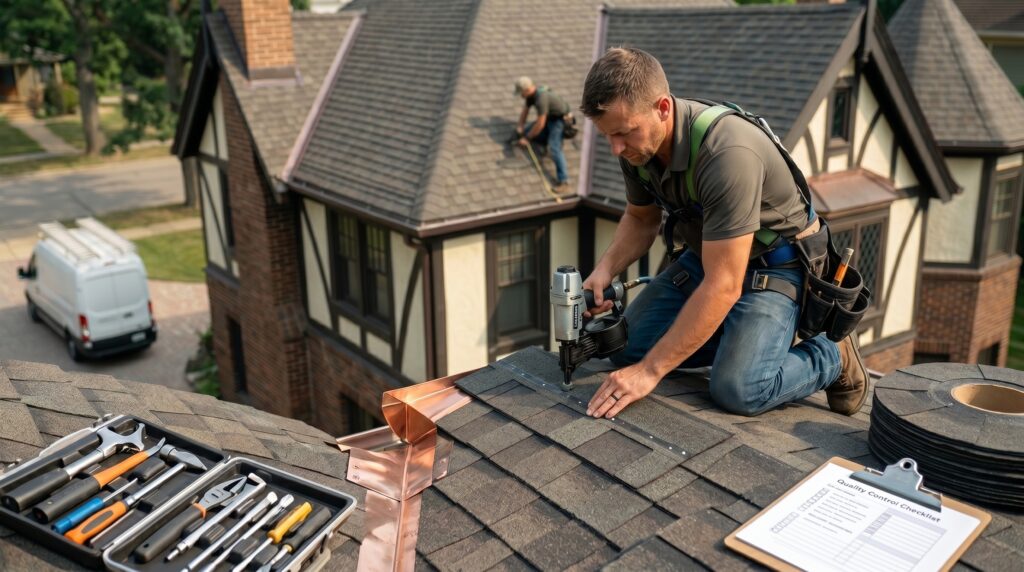
The signs of a bad roof repair are sealant smeared over the problem instead of new parts, exposed nail heads, mismatched or cracked pieces left in place, old rusted flashing put back, and a leak that returns with the first real rain. A quality repair replaces the failed part, laps new material under the old so water runs over it, matches the roof, and comes with photos and a written scope. To have a repair checked or done right, call NEMA Roofing at 866-631-3366.
Quality repair or shortcut: part by part
Most failed repairs share one habit: they treat the symptom on the surface and leave the failed part underneath. Here is what each common repair should look like, and the shortcut to watch for.
| Repair | Done right | Shortcut that fails |
|---|---|---|
| Missing or torn shingles | New shingles slid under the course above, nailed where the next course covers the nails, sealed down, color as close as the roof allows | Shingles nailed through the face with the nail heads exposed, or a dab of roof cement on top of a torn tab |
| Wall and chimney flashing | New step flashing woven in with each course, new counterflashing over it, set into the mortar joint or siding | A bead of roof cement or caulk along the wall line with the old flashing left behind |
| Pipe boots and vents | A new boot with its upper edge tucked under the shingles above, so water runs over it | Caulk around a cracked rubber collar, or a new boot laid on top of the shingles |
| Tile | Matching tiles that interlock and seat with their neighbors, the underlayment below repaired, fastened like the rest | Cracked tiles glued or foamed together, mismatched tiles that do not seat, the torn underlayment left under them |
| Metal | New, slightly larger corrosion-resistant screws with new washers; rusted-through panels or trim replaced | Sealant painted over every screw head |
| Flat roof membrane | A patch of compatible membrane, surface cleaned and primed, overlapping sound material on every side | Coating or cement spread over a wet or blistered area |
The California Building Code backs part of this for reroofing: damaged, cracked or broken tile may not be reinstalled, and vent flashing, metal edgings, collars and counterflashing may not be reinstalled where rusted, damaged or deteriorated. The Tile Roofing Industry Alliance warns that a replacement tile that does not properly interlock and seat can lead to leaks and breakage.
Why sealant-only repairs keep failing
Roof sealants and cements are made to back up a mechanical detail, not to replace one. On a roof in full sun they harden, shrink and crack; the roof moves with heat every day and the bead pulls away at its edges. Water then gets behind the sealant and stays there, soaking the wood beneath while the repair still looks fine from the ground. A repair that relies on a bead of caulk at a wall, a vent or a screw line is one to expect back.
The same goes for any fix that only works while it is dry. The test of a repair is how water flows over it: every new piece should lap under the piece above it and over the piece below, so water runs off without needing any seal at all.
How to check a repair yourself
- Before and after photos. Ask for them. They show whether parts were replaced or covered over, and you cannot see most of the work from the ground.
- From the ground, with binoculars: look for shiny smears of sealant, exposed nail heads, tiles sitting higher than their neighbors, and shingles a very different color from the slope around them.
- In the attic after the first real rain: the wood under the repair should be dry, with no new stains or drips.
- Inside: an old ceiling stain should stop growing. Mark its edge in pencil after the repair to be sure.
- Around the house: no nails, tile pieces or scrap in the yard, and gutters cleared of repair debris.
Paperwork that goes with a quality repair
- A written estimate that names the parts being replaced (“new step flashing and counterflashing at the chimney”), not a line that says “seal leak”.
- An invoice that matches the estimate, with any change agreed in writing first.
- Photos of the problem, the work in progress and the finished repair.
- A permit where your city or county requires one; some require it for any repair that reaches the underlayment or the roof structure.
- The workmanship warranty terms, in writing.
For how to compare two repair estimates line by line, see comparing roof repair estimates.
What to do if a repair has already failed
- Photograph the leak and the repaired area, with dates.
- Call the contractor who did the work first; a company that stands behind its work will come back and trace the cause.
- If it does not, get a second inspection that finds the entry point before anything is resealed. How leak detection works explains what that tracing involves.
- If a licensed contractor will not resolve a problem with its work, the Contractors State License Board accepts complaints from homeowners.
Sometimes a failed repair is a sign that the roof needs more than a repair; partial vs full roof replacement covers that decision.
Repairs built to last, in five counties
Ask us for the photos and the part-by-part written scope described above with any repair we quote. Our crews work from five Google-verified locations (Santa Barbara, Oxnard, Woodland Hills, Tarzana and Downey) and repair roofs in every part of Santa Barbara, Ventura, Los Angeles, Riverside and San Bernardino counties; see where we work. Learn more about our roof repair service, or call 866-631-3366.




