
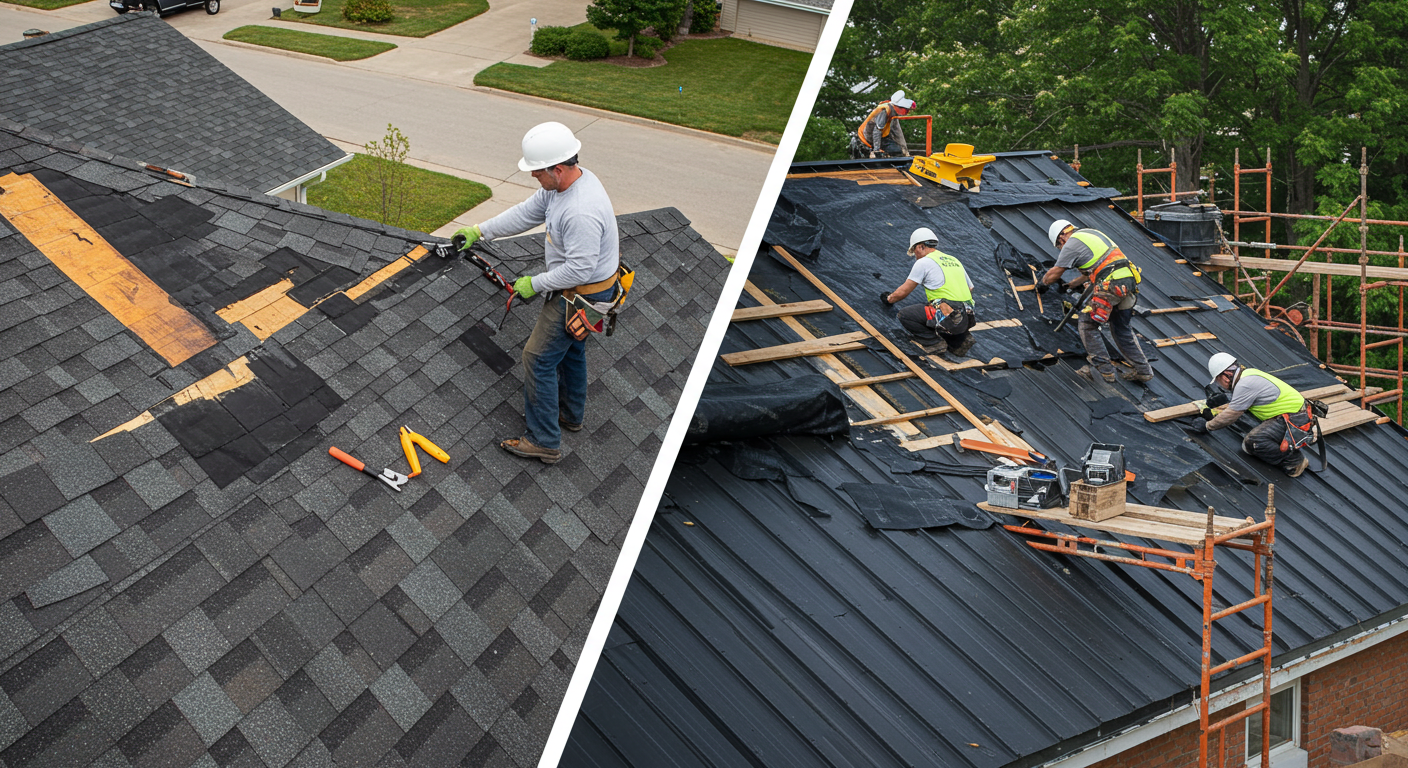
Partial vs full roof replacement: a partial replacement strips and rebuilds one section of the roof (a slope, a wing or a flat section) down to the deck, while a full replacement redoes the whole roof at once. A partial job fits when the damage is confined and the rest of the roof has years left; a full one fits when wear is roof-wide or when more than half the roof would be replaced anyway, because California then applies new-roof rules to the work. For an inspection that tells you which one your roof needs, call NEMA Roofing at 866-631-3366.
Repair, partial replacement or full replacement at a glance
| Option | What is replaced | Fits when | Main trade-off |
|---|---|---|---|
| Repair | Individual shingles or tiles, a flashing detail, a pipe boot, a patch of membrane | One defect with a clear cause; the covering around it is sound | Fixes one point; does nothing for the age of the rest |
| Partial replacement | Covering, underlayment and damaged deck on one section | Damage limited to one slope or area, for example after a tree fall, wind or a long-running leak | A seam between old and new, and two parts of the roof aging on different clocks |
| Full replacement | Everything down to the deck, plus flashing and ventilation details | Wear on every slope, repeated leaks in different places, or failed underlayment across the roof | Highest one-time cost; one age, one system, one warranty |
Small, single-point problems belong on the repair side; our roof repair service covers those.
When a partial roof replacement makes sense
A section replacement is a good answer when all of these are true:
- The damage has an edge. A single slope took the wind, a branch came through one area, or water ran under one section long enough to soften the deck there and nowhere else.
- The rest of the roof checks out. The inspector finds the other slopes flat, fastened and dry, with no widespread granule loss, cracking or brittle underlayment.
- The section is a natural unit. A whole slope, a porch roof or a flat roof over an addition can be rebuilt and flashed as a piece. A patch in the middle of a slope leaves seams on every side.
- The material can be matched. The same shingle line, tile profile or metal panel is still available, or the section is separate enough that a visible difference does not matter.
Where old meets new: the tie-in, the match and the warranty
The weak point of any partial job is the line where the new section meets the old one. The new underlayment has to lap correctly under the existing roof, and the covering has to interlock or overlap without forcing the old material. Three things to settle before you agree to a section replacement:
- Color and profile match. Shingles fade and weather, so even the same product will look different next to an older slope. Tile is harder: the Tile Roofing Industry Alliance notes that some concrete tile products are no longer made, and a replacement tile that does not interlock and seat with the existing tiles can lead to leaks and breakage. Its options include moving tiles from a less visible slope, salvage tiles, custom tiles or, when nothing fits, a complete replacement.
- Underlayment condition. On a tile roof the underlayment under the tiles does the waterproofing, and the same TRI brief advises checking the components beyond the tiles, since heat, moisture and sun can damage them. If the old underlayment is brittle at the edge of the new section, it is likely brittle elsewhere too.
- Two warranties. A manufacturer warranty on the new section covers only the new materials; the old section keeps whatever coverage and age it had. Ask the contractor to state in writing what is covered on each part.
The 50 percent line in California
How much of the roof you replace can change which rules apply to the job:
- Fire rating. Health and Safety Code section 13132.7 requires the entire roof covering of an existing building to meet a minimum fire classification when more than 50 percent of the total roof area is replaced within one year. The class depends on the fire hazard zone. In wildland-urban interface areas under the 2025 California Wildland-Urban Interface Code, replacing 50 percent or more within 12 months means the roof covering must meet the rule for new construction (Class A), and any covering added in a repair must be Class A too.
- Cool roof. The 2025 state energy code (Title 24, Part 6, in effect since January 1, 2026) applies cool-roof requirements to a home reroof when more than 50 percent of the roof is replaced: steep roofs in climate zones 4 and 8 through 15 and low-slope roofs in zones 4 and 6 through 15, unless an exception applies.
- Recover or tear-off. The 2025 California Building Code does not allow a new covering over an existing roof that is water-soaked or deteriorated, over clay, concrete or slate tile, or where two or more layers already exist. Those roofs are torn off to the deck.
Two partial jobs on the same roof within a year can add up past the line, so plan them together. Your local building department has the final word on permits for your address.
Signs the whole roof is due
- Leaks or stains appear in more than one room, on different slopes.
- Shingles are curling, cracking or shedding granules on every side, including the shady slopes.
- Tiles are sound but the underlayment is brittle or torn wherever it is checked.
- The deck feels soft in several places, or the roof line sags.
- The roof has had several repairs in recent years and each one found a new problem.
For the full list of warning signs, see signs it’s time to call a roofer.
How cost compares without a price list
A partial replacement costs less today, but it rarely costs a proportional share of a full roof. Each job pays for setting up (permit, delivery, safety equipment, disposal bin) whatever its size, and the tie-in to the old roof adds labor a full replacement does not have. If the rest of the roof will need replacing within a few years, you pay the setup twice and may tear off the newer section to keep the roof uniform. A written estimate for both options, with the same scope lines, is the fairest way to compare. Our roof replacement service page explains what a full job includes.
Questions to ask at the inspection
- Roughly what share of the roof is affected, and how is the rest?
- Can the existing material be matched, and how will the seam be flashed?
- Would this job, alone or with other work this year, cross the 50 percent line?
- What warranty applies to the new section, and what happens to the old one?
- If I replace a section now, how long before the rest is likely to need work?
Getting an answer for your roof
NEMA Roofing inspects and replaces roofs through five Google-verified locations (Santa Barbara, Oxnard, Woodland Hills, Tarzana and Downey), with crews across every town in Santa Barbara, Ventura, Los Angeles, Riverside and San Bernardino counties. We will tell you whether a repair, a section or the full roof is the right call and put it in writing. Call 866-631-3366.




