Flat roof water damage usually reaches further than the stain on the ceiling: water that gets past the membrane spreads through the insulation and along the deck before it drips, so by the time it shows inside, the insulation may be soaked, a wood deck softening or a steel deck rusting. The steps that limit the damage are the same every time: stop the water, dry the interior quickly, find out how far the moisture has spread, and repair the roof and whatever lies under it. If water is coming in now, call NEMA Roofing at 866-631-3366.
How water moves inside a flat roof
On a sloped roof, a leak tends to show up somewhere below the hole. A flat roof is different. Water that enters at a split seam or a loose flashing runs sideways over the top of the deck or through the insulation boards until it finds a joint, a fastener or a low spot, and only then drips into the building. The drip inside can be several framing bays away from the actual opening.
Not every wet ceiling under a flat roof is the roof’s fault, either. U.S. Department of Defense roofing criteria (UFC 3-110-03) warn that water reported as a roof leak can come from nearby walls, windows or mechanical units, and ask for the source to be traced before any repair. A good roofer measures from the interior stain to a fixed point, checks the same spot on the roof, and keeps looking at parapets, window heads and rooftop units if the membrane there is sound.
What gets damaged, layer by layer
| Layer | What water does to it | What it means for the repair |
|---|---|---|
| Insulation boards | Absorb water, lose most of their insulating value, can crumble or lose their bond to the deck | Wet boards are cut out and replaced; they rarely dry in place under a sealed membrane |
| Cover board | Gypsum-based boards soften; wood fiber boards swell | Replaced along with the insulation in the wet area |
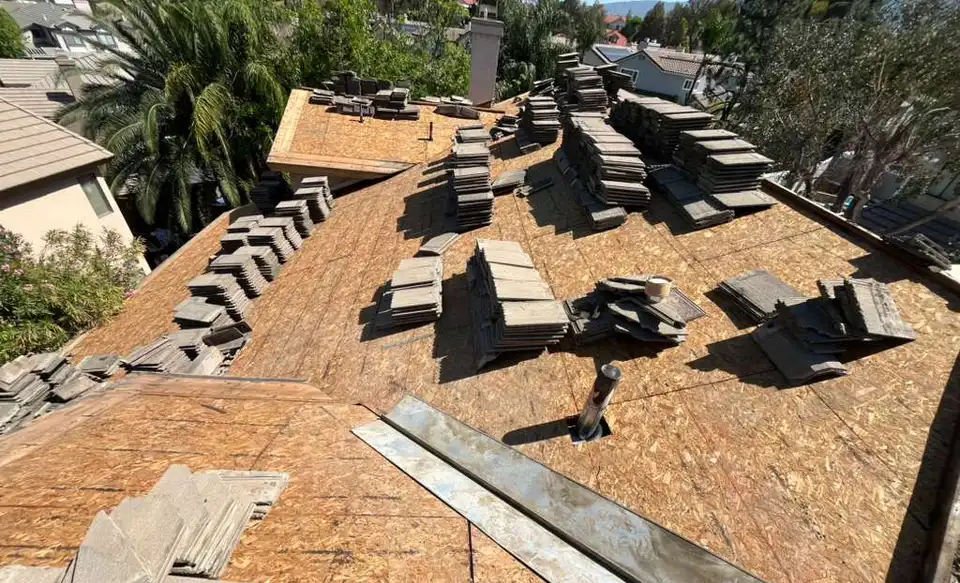
| Wood deck (plywood or planks) | Stains, delaminates, then rots; fasteners lose their hold | Soft or rotted sections are replaced before any new roofing goes on |
| Steel deck | Rusts at the laps and fasteners, eventually perforates | Surface rust is treated; thinned or holed panels are replaced |
| Ceilings and walls | Drywall stains, sags and grows mold if it stays damp; ceiling tiles hold water on top | Dried quickly, or removed and replaced if wet too long or moldy |
| Electrical and contents | Water in light fixtures and ceiling boxes, damaged stock and furniture | Power to affected fixtures is shut off until an electrician checks them |
What to do in the first 48 hours
- Catch and contain the water. Buckets, tarps over furniture and stock, and a small hole poked in a bulging ceiling (with a bucket under it) to drain it in one place instead of letting it collapse.
- Make it safe. Turn off power at the breaker to any fixture or outlet near the water.
- Record everything. Photos and video of the ceiling, the contents and, if safe, the roof. The California Department of Insurance advises keeping a written claim diary of every conversation with your insurer or adjuster.
- Get the roof covered. A roofer can add temporary protection over the leak area; the permanent repair follows once the roof is dry. What happens during that visit is covered in the flat roof leak repair process.
- Start drying. The U.S. EPA’s mold guidance says that damp materials dried within 24 to 48 hours of a leak usually will not grow mold. Fans, dehumidifiers and removing soaked carpet or ceiling tiles all help. Porous materials that have already grown mold may have to be thrown away.
Signs of hidden water damage from a flat roof
- A ceiling stain that grows or darkens after each rain, or a new one that appears weeks after the last storm.
- Paint peeling or bubbling at the top of exterior walls, below parapets.
- A musty smell in upper rooms, or mold on the back of drywall or the top of ceiling tiles (the EPA lists both as common hidden spots).
- On the roof: spongy areas underfoot, blisters, or ridges in the membrane over board joints.
- Rust stains on the underside of a steel deck in a warehouse or garage.
- Rooms under the roof getting harder to cool, because wet insulation no longer insulates.
How far has the water spread?
You cannot see wet insulation from above or below. Roofers map it with moisture surveys: an infrared scan after a sunny day picks up wet areas because they hold heat longer (ASTM C1153 is the standard practice for this), while capacitance and nuclear meters take readings on a grid. Every reading that looks wet is confirmed with a small core cut through the roof, which is then patched. The map decides the scope: a few wet boards around one flashing, or a roof that is wet across much of its area. How a full inspection is carried out is explained in what a professional flat roof inspection covers.
Can a new roof go over wet insulation?
No. The California Residential Code does not allow a new roof covering over an existing roof that is water soaked or so deteriorated that it is not an adequate base (section R908.4). Sealing wet material under a new membrane also traps the water: on the first hot day it turns to vapor and lifts the new sheet into blisters. The wet area is opened, the soaked insulation and any damaged deck are replaced, and only then is the roof closed up. Where the survey shows the damage is limited, that is a repair; where it runs across the roof, it is a replacement, and recover versus replacement explains the choice.
Water damage and insurance
Policies usually treat sudden damage differently from damage that built up slowly over months, and the roof’s condition before the leak can come into it. Read your policy, report the damage promptly, and keep the photos, the roofer’s written findings and the repair invoice together. A written inspection report that names the cause of the leak is often the most useful document you can give an adjuster.
Keeping water out for the long term
Most water damage under flat roofs starts small: a flashing that opened, a drain that clogged, a seam nobody looked at. An inspection after each rainy season, clear drains and prompt repair of small defects keep it that way; the flat roof maintenance checklist lists what to look at. A roof that keeps leaking after repeated repairs is telling you it is due for replacement.
Leak and water damage help from NEMA Roofing
NEMA Roofing (CSLB license #1083283, bonded and insured) repairs and replaces flat roofs on homes and commercial buildings. We are not a single-office roofer: there are six NEMA locations, in Santa Barbara, Oxnard, Woodland Hills, Tarzana, Downey and San Bernardino, and our coverage takes in the whole of Santa Barbara, Ventura, Los Angeles, Riverside and San Bernardino counties, as the list of service areas shows. See our flat roofing services, or call 866-631-3366 to have the leak traced and the damage mapped.