
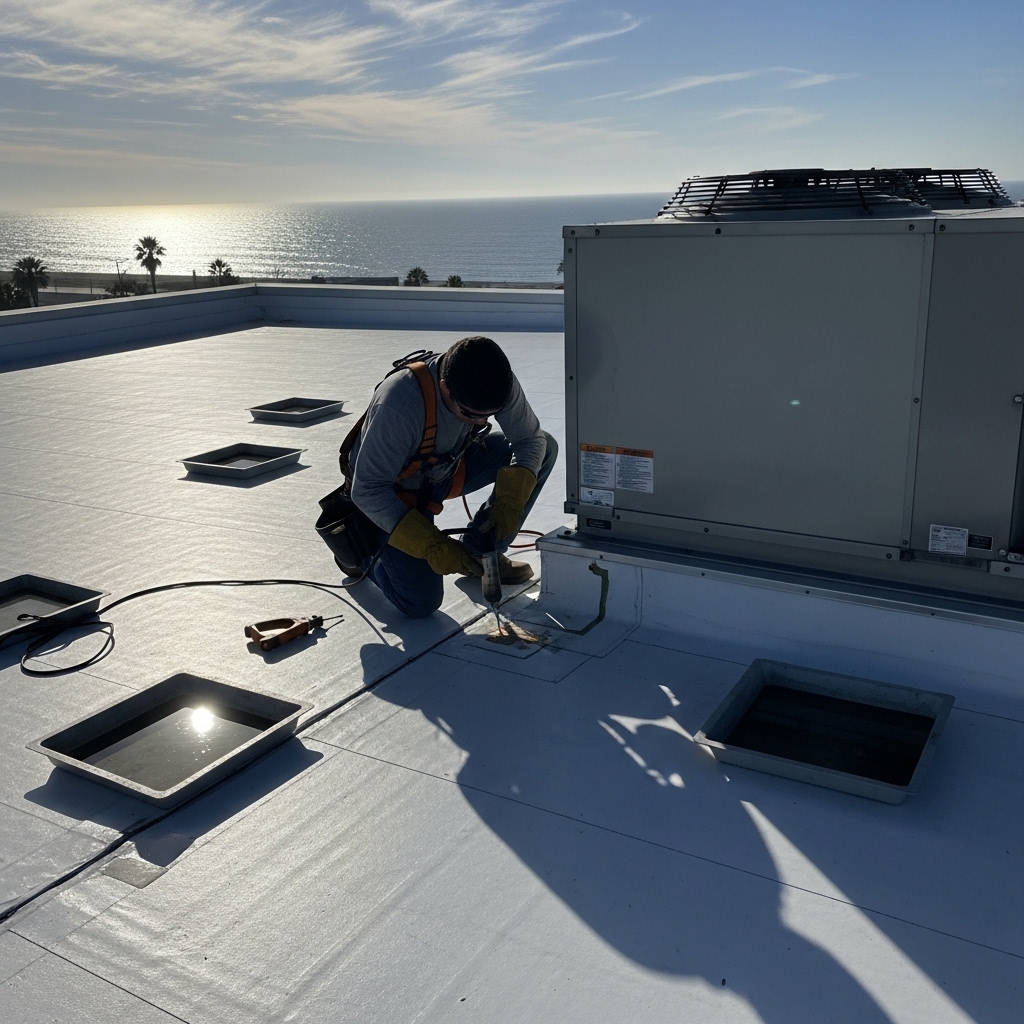
The flat roof leak repair process has five stages: you protect the room and record when the leak shows, the roofer traces where the water actually enters, the damaged area is repaired with material that matches your membrane, the repair and nearby drains are checked, and the result is confirmed after the next rain. On a flat roof the entry point is rarely right above the drip, so most of the work goes into the tracing. Here is what each stage looks like on an Oxnard building and what you can do to speed it up. To report a leak, call NEMA Roofing at 805-977-5949.
What should you do before the roofer arrives?
- Protect the room. Move furniture and electronics, put down plastic and a bucket, and if the ceiling is bulging with water, keep people out from under it.
- Record the pattern. Note when it leaks: only in heavy rain, only when rain comes with wind from one side, after fog, or when the air conditioner runs. The pattern narrows the search more than anything else.
- Take photos of the stain and mark its edges in pencil, so everyone can see later whether it has grown or dried.
- Stay off a wet roof and skip the caulk tube. Sealant smeared on the wrong spot hides the evidence, and many sealants do not bond to TPO or PVC.
- Gather history: earlier repairs, the roof’s age and material, and any recent rooftop work such as HVAC service or a solar install.
How is the source of a flat roof leak traced?
Water that gets through a flat roof can run along the top of the insulation, a seam or the flutes of a metal deck before it finds a way down, so the drip inside can be well away from the hole. Tracing works from the outside in, in this order:
- Map the inside. The roofer measures where the stain sits relative to walls, vents and skylights so it can be matched to the roof above.
- Walk the roof above and upslope of the stain. Water flows toward the drains, so the entry is usually on the high side of the drip, not beyond it.
- Check the usual suspects: seams (probed with a tool on welded membranes), flashing where the roof meets parapets and walls, pipe boots, curbs under HVAC units and skylights, and the drains themselves.
- Test for hidden water with a moisture meter or thermal camera when nothing is visible; our article on flat roof repair cost in Oxnard explains how these readings set the size of the repair.
- Water test in sections if the source still hides: a hose runs on one suspect area at a time, starting low and working up, while someone watches inside.
Is it a roof leak at all?
Some ceiling stains under a flat roof start somewhere else. Before paying for roof work, rule these out:
- Air conditioner condensate. A clogged drain line or cracked pan on a rooftop unit leaks on dry, hot days, with no rain at all.
- Parapet walls and coping. Cracks in the stucco or open joints in the metal cap let water into the wall, and it shows up at the top of the wall inside.
- Windows and doors above a roof deck. Water gets behind a door threshold or window frame and runs down onto the ceiling below.
- Plumbing. A vent pipe or a supply line in the ceiling space can drip regardless of the weather.
- Condensation. Warm, damp indoor air meeting a cold roof deck can wet insulation from below, which points to ventilation rather than a hole.
What happens during the repair?
- The damaged area is cut back to sound material. If the insulation underneath is wet, that section comes out and is replaced; a patch over wet insulation traps the water.
- The surface around it is cleaned and prepared the way the membrane maker requires.
- The patch goes on with the method that belongs to that membrane: hot-air welded for TPO and PVC, seam tape and adhesive for EPDM, a torch-applied or cold-applied ply for modified bitumen, and new plies with surfacing for built-up roofs. It extends past the damage on every side.
- Flashing that caused the leak is rebuilt rather than coated over, and loose or rusted edge metal is refastened or replaced.
- The drains near the repair are cleared so water leaves the area, and the new work is probed and photographed.
When the source is clear and the roof is dry, the repair can follow the diagnosis directly. Wet insulation, a large area or rain on the day adds a second visit.
When is a temporary repair used?
Most of Oxnard’s rain falls in winter: NOAA’s 1991 to 2020 normals for the Oxnard Airport station put about 82 percent of the yearly total in December through March. A leak found in the middle of that season, on a roof that is still wet, often gets a temporary seal or cover first to stop the water, then the permanent repair once the surface and insulation have dried. A temporary patch is meant to be replaced; ask for the return date when it goes on.
Does a leak repair in Oxnard need a permit?
Only a larger one. Oxnard’s building division asks for a reroof permit once a repair passes 40 square feet, or as soon as the work goes below the roof covering into underlayment or framing, however small. A patch that stays within the membrane and under that size needs no permit. If your roofer finds rotted decking, the job becomes a permitted repair with a city inspection.
How do you know the leak repair worked?
- After the next real rain, check the pencil marks on the stain: a repaired leak leaves the stain dry and no larger.
- If the same spot gets wet again, the water had more than one way in, or the entry was elsewhere. Call the roofer back while the pattern is fresh.
- Keep the photos, the description of the work and the written repair warranty with your roof records.
Leaks often start from skipped upkeep, so the next step is a routine; see flat roof maintenance in Oxnard’s coastal weather. For the full service, see our flat roofing repair and replacement page, and for water coming in right now, our emergency roof repair service. NEMA Roofing’s Oxnard location is one of five, with Santa Barbara, Woodland Hills, Tarzana and Downey, so leak calls are covered across all of Ventura County as well as Santa Barbara, Los Angeles, Riverside and San Bernardino counties; details are on our Oxnard roofing page. Call 805-977-5949 to schedule a leak inspection.




