
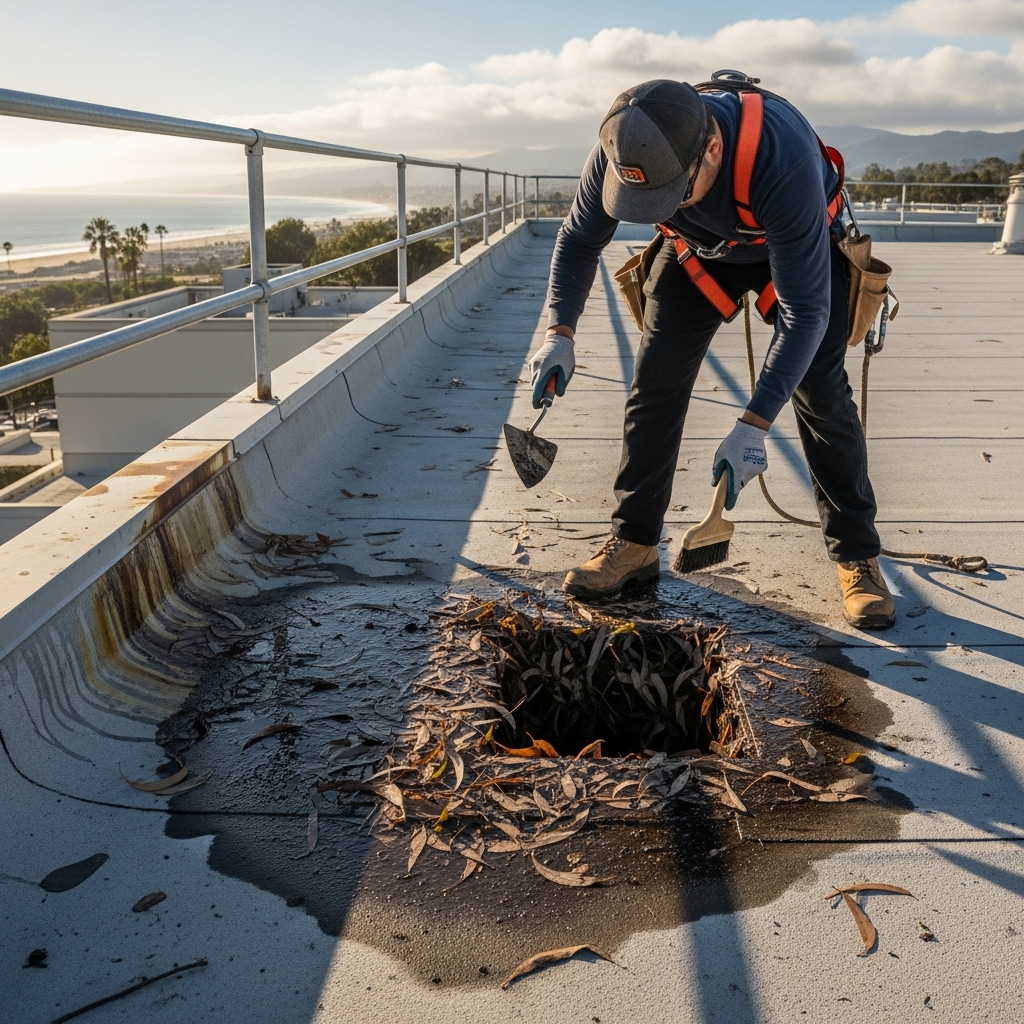
Flat roof maintenance in Oxnard should be timed around a short, concentrated rain season and aimed at what the coast does to a roof. Nearly all of the year’s rain falls from December through March, so the main service belongs in October or November: clear drains and scuppers, close open seams and check flashing before the first storm. The rest of the year, the priorities are salt air on metal edges and fasteners, damp spots that never fully dry, and damage from rooftop traffic. For a maintenance visit, call NEMA Roofing at 805-977-5949.
When should an Oxnard flat roof be serviced?
NOAA’s 1991 to 2020 climate normals for the Oxnard Airport station give a clear calendar. Of about 12.9 inches of rain in an average year, 10.6 fall in December through March, while June through September together average less than 0.2 inches.
| Months | Average rain at Oxnard Airport | What the roof needs |
|---|---|---|
| June to September | 0.17 in (all four months) | The window for anything that needs dry days: recoating, seam and flashing repairs, drain rebuilds, replacement of worn sections |
| October and November | 0.46 in and 0.71 in | The pre-season service: clear drains, scuppers and gutters, test them with a hose, fix open seams, reseal penetrations |
| December to March | 2.08, 2.92, 3.26 and 2.30 in | Storm checks: look for standing water and blocked drains a day or two after each heavy rain, and watch ceilings |
| April and May | 0.69 in and 0.34 in | The post-season inspection: find what winter opened up and schedule it for the dry months |
Because the dry season is long, a problem spotted in April can wait for a planned repair in summer. A problem found in January usually cannot, which is the practical reason for doing the fall service every year.
What does salt air do to a flat roof?
The membrane itself (TPO, PVC, EPDM, modified bitumen) does not rust. The metal around it does, and on a flat roof that metal holds the membrane edges down and seals every opening:
- Edge trim, gravel stops and parapet coping
- Counterflashing and termination bars along walls
- Drain clamping rings, strainers and scupper boxes
- Screws, plates and straps holding equipment and curbs
The U.S. Department of Defense roofing criteria note that aluminum-zinc coated steel performs less well in direct contact with salt spray and warn against mixing dissimilar metals, which corrode each other. On a coastal roof, maintenance means checking these parts for rust bloom, loose fasteners and gaps at joints, and replacing a corroded piece with a compatible metal rather than painting over it. A loose edge is where wind gets under a membrane.
Which flat roof problems does Oxnard’s mild weather bring?
Oxnard rarely gets hot: the NOAA normals for the Oxnard station show average highs between about 66 and 76 degrees across the year and fewer than two days a year at 90 or above. Heat-driven failures that inland roofs see are less of a concern here. What shows up instead:
- Surfaces that stay damp. The shaded side of a parapet, the area under HVAC units and low spots can stay wet long after rain. Dirt and growth collect there and hold water against seams, so clean them during each visit.
- Drains overloaded in winter. With most of the rain packed into four months, drains carry their heaviest loads then. A drain that is half blocked copes with drizzle and fails in a downpour, leaving water ponded against seams.
- Sun on exposed surfaces. Mild temperatures do not stop ultraviolet wear. Worn coatings, bare spots on cap sheets and exposed gravel-roof membrane still need attention.
What should a professional maintenance visit include?
- Drains, scuppers, gutters and downspouts cleared and flow-tested.
- Seams probed and laps checked across the whole roof, not just near the last leak.
- Flashing at walls, parapets, curbs and pipes inspected, and failed sealant replaced.
- Edge metal, coping and fasteners checked for corrosion and tightness.
- The surface checked for blisters, cracks, punctures and worn coating.
- A short written report with photos, marked on a roof plan, and repairs priced separately.
For the full part-by-part list you can use between visits, see our flat roof maintenance checklist.
How can building owners cut down rooftop damage?
On commercial and multi-unit buildings, many punctures come from people, not weather: HVAC technicians, solar crews and satellite installers crossing the roof. Three habits prevent most of it:
- Walkway pads on the routes to equipment, so traffic stays on protected paths.
- A sign-off after other trades work up there: someone checks for dropped screws, cut membrane and new penetrations left unsealed.
- Keeping the roof clear of stored materials, which hold water and hide damage.
When is it time to recoat instead of patch?
When a coating has worn thin across much of the roof, or a cap sheet is losing its granules in wide areas, spot repairs stop keeping up. Under the California Building Code, recoating an existing membrane or foam roof does not require a tear-off; what decides whether it works is a sound, dry roof underneath. A reflective coating also cuts the heat the roof absorbs. If the insulation is wet or the membrane is failing at the seams, a coating is not the answer; see what decides flat roof repair cost in Oxnard.
NEMA Roofing has five locations, in Oxnard, Santa Barbara, Woodland Hills, Tarzana and Downey, and our crews maintain flat roofs throughout Ventura County (see the Ventura County service area) and across Santa Barbara, Los Angeles, Riverside and San Bernardino counties. Read more on our Oxnard roofing page and our flat roofing service. To set up a fall service or an inspection, call 805-977-5949.




