
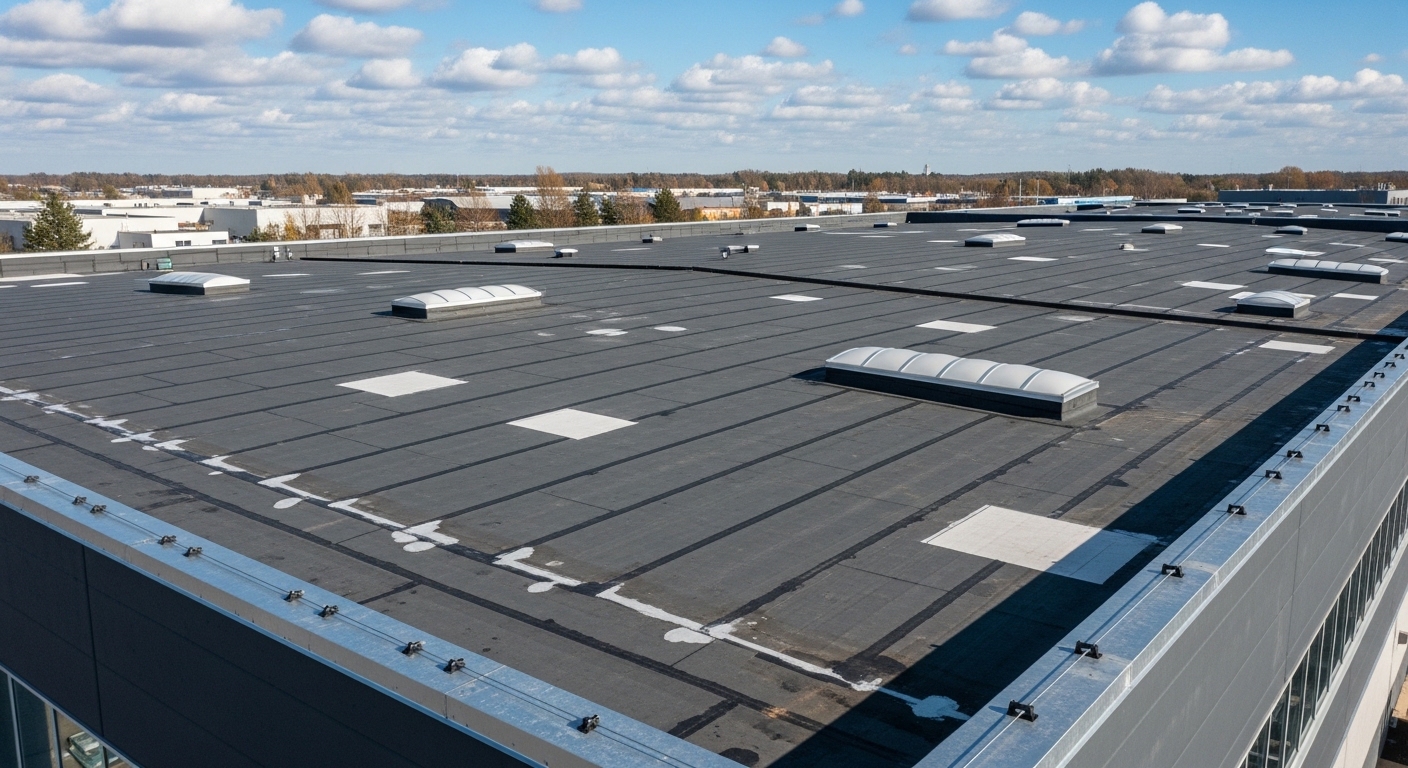
Flat roof wind uplift is the suction that wind creates as it passes over a low-slope roof, pulling the membrane, insulation and edge metal upward; it is strongest at the corners and along the perimeter. A flat roof resists it through how each layer is attached to the deck, a tested metal edge, and tighter fastening where the pressure peaks. To have a flat roof’s attachment and edges checked, call NEMA Roofing at 866-631-3366.
What causes wind uplift on a flat roof?
When wind hits a wall and rises over the roof edge, the airflow separates from the roof surface and leaves low pressure above it. The roof is pulled up from the top. At the same time, air that gets into the building through open doors, vents or gaps in the walls pushes up from underneath. The two forces add together, and every layer of the roof has to hold against their sum.
A flat roof does not blow off in one piece. Failures start small: a loose piece of edge metal, a lifted seam, a corner where a few fasteners pulled out. Once wind gets under the membrane, each gust peels a little more, which is why edge and corner details decide how a roof comes through a storm.
Why do corners and edges carry the highest loads?
The swirling airflow is most intense where two edges meet. Roof wind design therefore divides a roof into zones: corners, perimeter and field (the middle). The U.S. Department of Defense roofing criteria (UFC 3-110-03) tell the designer to determine the uplift pressures and the dimensions of the corners, perimeter and field under ASCE 7, the national load standard, and to use roof systems independently tested and rated by bodies such as FM, UL and SPRI.
In practice this means a well-built flat roof is not attached the same way everywhere. The corners and perimeter get closer fastener spacing, extra rows of plates or heavier adhesive coverage than the field. A roof installed with the field pattern all the way to the edge is under-built exactly where it is most likely to fail.
How is each layer of a flat roof held down?
A roof is only as strong as its weakest bond. A membrane glued perfectly to an insulation board still lifts if the board itself is barely fastened to the deck. The main attachment methods:
| Method | How it resists uplift | What to watch |
|---|---|---|
| Mechanically attached | Screws and plates fix the membrane (usually in its seams) and the insulation through to the deck | Fastener rows must tighten at corners and perimeter; the deck must hold a screw |
| Fully adhered | Adhesive bonds the membrane over its whole area to a cover board or insulation that is itself fastened or glued | Surface must be clean and dry for the bond; adhesive coverage matters |
| Ballasted | Loose-laid membrane held down by stone or pavers | Heavy: the DoD criteria put ballast at 10 to 12 pounds per square foot, so the structure must carry it; stones can scour off corners in high wind |
| Torched, hot-mopped or self-adhered plies | Modified bitumen and built-up plies bond to a base sheet that is nailed or fastened to the deck | The base sheet fastening does the holding; a weak base sheet lets every ply above it lift |
For how these systems compare beyond wind (cost, life, repairability), see our guide to flat roofing systems.
What does California’s building code require?
For buildings under the 2025 California Building Code (commercial and most larger buildings; houses fall under the residential code), section 1504 sets the wind rules for low-slope roofs:
- Tested assemblies. Built-up, modified bitumen and single-ply systems, adhered or mechanically attached, must be tested under FM 4474, UL 580 or UL 1897 (1504.4.1), and designed for the component and cladding wind pressures of section 1609.6.2 (1504.4).
- Tested edge metal. Metal edge systems on built-up, modified bitumen and single-ply low-slope roofs must be designed for wind loads and tested to the ANSI/SPRI ES-1 methods RE-1, RE-2 and RE-3 (1504.6). Gutters that secure the membrane edge have their own test, SPRI GT-1 (1504.6.1).
- Ballast. Ballasted single-ply roofs are designed to ANSI/SPRI RP-4 (1504.5).
- Gravel roofs. Aggregate-surfaced roofs need parapets of a minimum height from Table 1504.8 (1504.8).
The practical question for an owner is simple: ask which tested assembly and which edge system the proposal is based on. A contractor who designs to these standards can name both.
Does wind matter for flat roofs in Southern California?
Yes. The National Weather Service describes Santa Ana winds as strong, hot, dust-bearing winds that descend to the Pacific Coast around Los Angeles from inland desert regions. They arrive dry, often after months of sun have aged sealants and edge flashing, and they carry grit and branches that scrape and puncture membranes. A roof that looked fine all summer can lose a length of coping or a lifted seam in one windy night, and the damage then waits for the first rain to show up inside. Checking the edges and seams after a strong wind event, before the rainy months, catches this early.
Signs a flat roof is losing its grip
- Edge metal, coping or gutters that are loose, bent or rattling.
- Fastener heads pushing up under the membrane, felt as bumps underfoot.
- Wrinkles or ridges in the membrane along the edges and corners.
- Open or lifted seams, especially near the perimeter.
- Gravel or ballast blown off the corners, leaving bare membrane.
- Cracks where the membrane meets the edge flashing.
Any of these is worth a repair visit before the next storm; our list of common flat roof problems and fixes covers what each repair involves.
How does a flat roof keep its wind resistance for years?
Strength on day one is only half the job. Fasteners can back out as the deck and insulation move with heat and cold, sealants harden, and edge metal loosens where it was nailed into wood that has dried and shrunk. A roof keeps its rating when:
- The edges, corners and seams are checked on a schedule and after strong winds.
- Loose items on the roof (panels, equipment covers, debris) are secured or removed before they become projectiles.
- A reroof gets new, tested edge metal instead of reusing old pieces.
- Repairs use the membrane maker’s materials and details, so the tested assembly stays intact.
How long each membrane type lasts when it is cared for this way is in our flat roof lifespan guide.
Wind-resistant flat roofs from NEMA Roofing
NEMA Roofing (CSLB license #1083283) installs, repairs and replaces flat roofs on homes and commercial buildings; see our flat roofing service for the systems we work with. The company runs five locations, in Santa Barbara, Oxnard, Woodland Hills, Tarzana and Downey, and serves the whole of Santa Barbara, Ventura, Los Angeles, Riverside and San Bernardino counties, from the coast to the inland valleys that take the Santa Ana winds; the Ventura County service area page lists the towns there. For an edge and attachment check, call 866-631-3366.




