A flat roof’s lifespan depends less on the membrane’s name than on how it was installed and kept up: the U.S. Department of Defense roofing criteria say properly built TPO and PVC systems may last 15 years or more, and rank aggregate-surfaced built-up roofs and multi-ply modified bitumen among the longer-lived low-slope systems. Any single flat roof life expectancy figure you see is an average from a mix of climates and workmanship. Below is what each material offers, what shortens or extends its life in Southern California, and how to tell when yours is near the end. For a flat roof inspection, call NEMA Roofing at 866-631-3366.
How long does each flat roof material last?
| Material | What the evidence says about service life | What most affects it |
|---|---|---|
| TPO (white thermoplastic single-ply) | Properly constructed thermoplastic systems may last 15 years or more; TPO and PVC have been used successfully for over 15 years (DoD Unified Facilities Criteria) | Heat-welded seams done right; membrane thickness (the DoD minimum for TPO is 72 mils) |
| PVC (thermoplastic single-ply) | Same thermoplastic class as TPO in the DoD criteria | Seam welding, compatibility with oils and chemicals near vents and kitchens |
| EPDM (“rubber roof”) | A long-used single-ply; published averages vary widely by source | Seam tape and adhesive quality, flashing at edges and penetrations |
| Modified bitumen | The DoD criteria say it must be considered when long service life is required, with low maintenance cost; at least two plies | Number of plies, reinforcement, surface protection from sun |
| Built-up roofing (BUR) | Aggregate-surfaced BUR tends to outlast mineral cap sheet BUR, because the gravel keeps the membrane cooler and protects it | Surfacing, drainage, keeping gravel in place |
| Coatings over an existing roof | A maintenance layer, not a new roof; its life depends on the roof beneath | Surface preparation, a sound substrate, recoating on schedule |
For comparison on steep roofs, a 2007 National Association of Home Builders survey of manufacturers and trade groups put asphalt shingles at about 20 years and clay, concrete and slate at over 50, and it stressed that a roof’s life depends on local weather, design, material quality and maintenance. The same caution applies to flat roofs.
How long does a TPO roof last?
TPO is the question people ask most. The honest answer is “15 years or more when built properly,” which is how the DoD criteria put it for thermoplastic systems. What pushes a TPO roof past that or cuts it short:
- Seams. TPO seams are heat-welded. A weld that looks fine but did not fuse is where early leaks start, so seams should be probed after welding.
- Thickness. Thicker membranes have more material to lose to weathering; the DoD specifies at least 72 mils for TPO on its own buildings.
- Ponding. Water that sits for days after rain stresses any membrane. Slope and drains matter as much as the sheet.
- Foot traffic and equipment. Solar installers, HVAC service and satellite mounts puncture membranes; walk pads protect the paths.
What shortens a flat roof’s life in Southern California?
- Sun and heat. Ultraviolet light breaks down unprotected surfaces, which is why cap sheets carry granules and BUR carries gravel.
- Poor drainage. Clogged scuppers and drains cause ponding and overflow at walls.
- Flashing failures. Walls, parapets, skylights and vents move differently from the membrane; each of these edges has to be sealed by hand, so it deserves the closest look.
- Salt air near the coast. Metal edge trim, drains and fasteners corrode faster by the ocean, and a failed edge lets wind and water under the membrane.
- Skipped maintenance. A split seam or cracked flashing caught early is a small repair; left through a rainy season, it wets the insulation and deck.
How do you know a flat roof is near the end?
- Leaks that return after repairs, or in more than one place.
- Soft spots underfoot, which point to wet insulation or deck.
- Seams opening along their length, not just at one spot.
- Widespread cracking, blistering or bare spots where the surface protection is gone.
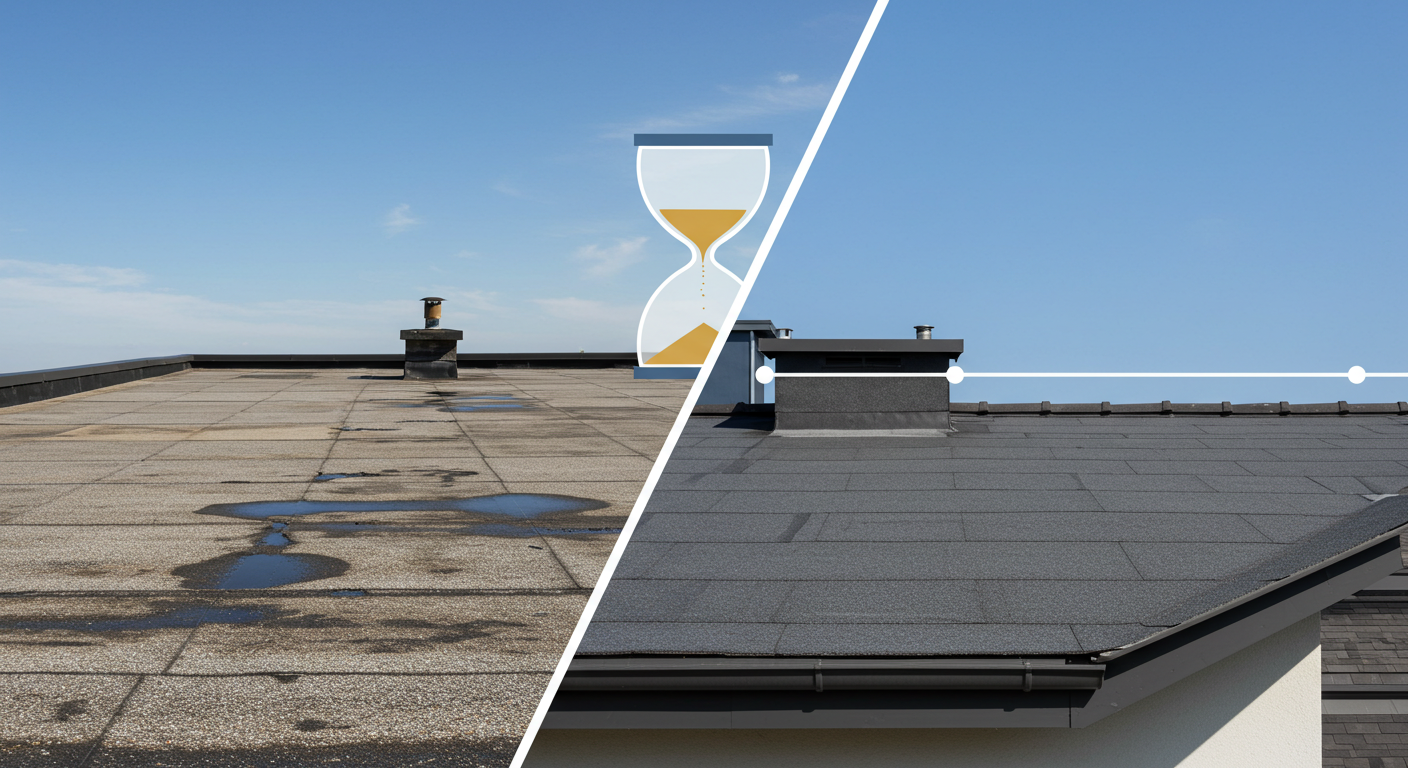
- Standing water that no longer drains after a day or two because the roof has sagged.
One or two of these can often be repaired. Several together usually mean a re-cover or replacement; how to repair a flat roof without replacing it explains where that line sits.
How can you make a flat roof last longer?
- Have it inspected at least once a year and after major storms.
- Keep drains, scuppers and gutters clear before the rainy season.
- Repair seams and flashing as soon as they open.
- Protect traffic paths with walk pads and keep equipment installers from cutting the membrane.
- Recoat coated roofs before the coating wears through.
Use the flat roof maintenance checklist to stay on schedule, and see flat roofing systems: everything you need to know to compare materials, or common flat roof problems. Our flat roofing service covers repair, re-cover and replacement, and NEMA’s six locations (Santa Barbara, Oxnard, Tarzana, Woodland Hills, Downey and San Bernardino) reach flat roofs across all five counties we serve, from Ventura County to San Bernardino County. To find out how much life your flat roof has left, call NEMA Roofing at 866-631-3366.