The most common commercial roofing problems in Santa Barbara are clogged drains and ponding when the first storms follow the long dry season, sun and UV wear on membranes and sealants, corrosion of metal parts in salt air, wind damage at roof edges during Sundowner wind events, and leaks around penetrations and rooftop equipment. Most start small at a detail and can be fixed before they reach tenants or inventory. For a commercial roof inspection or repair, call NEMA Roofing at 805-977-5949.
Why are Santa Barbara’s conditions hard on commercial roofs?
The climate is mild for people but uneven for roofs. NOAA’s 1991-2020 normals for the Santa Barbara station show about 19 inches of rain a year, with close to 87 percent of it falling from November through March and almost none from June through September. August and September average highs near 78 degrees. That pattern means months of sun and dust on the roof, then concentrated winter storms that test every drain and flashing at once.
| Local condition | What it does to a commercial roof |
|---|---|
| Long dry season, wet winter | Debris builds up in drains and scuppers for months; the first heavy rain backs up behind them |
| Year-round sun | Chalks coatings, dries sealants, wears granules and exposes membranes to UV |
| Salt air near the coast | Corrodes fasteners, edge metal, equipment stands and flashing |
| Sundowner winds | Downslope gusts off the Santa Ynez Mountains load roof edges and corners |
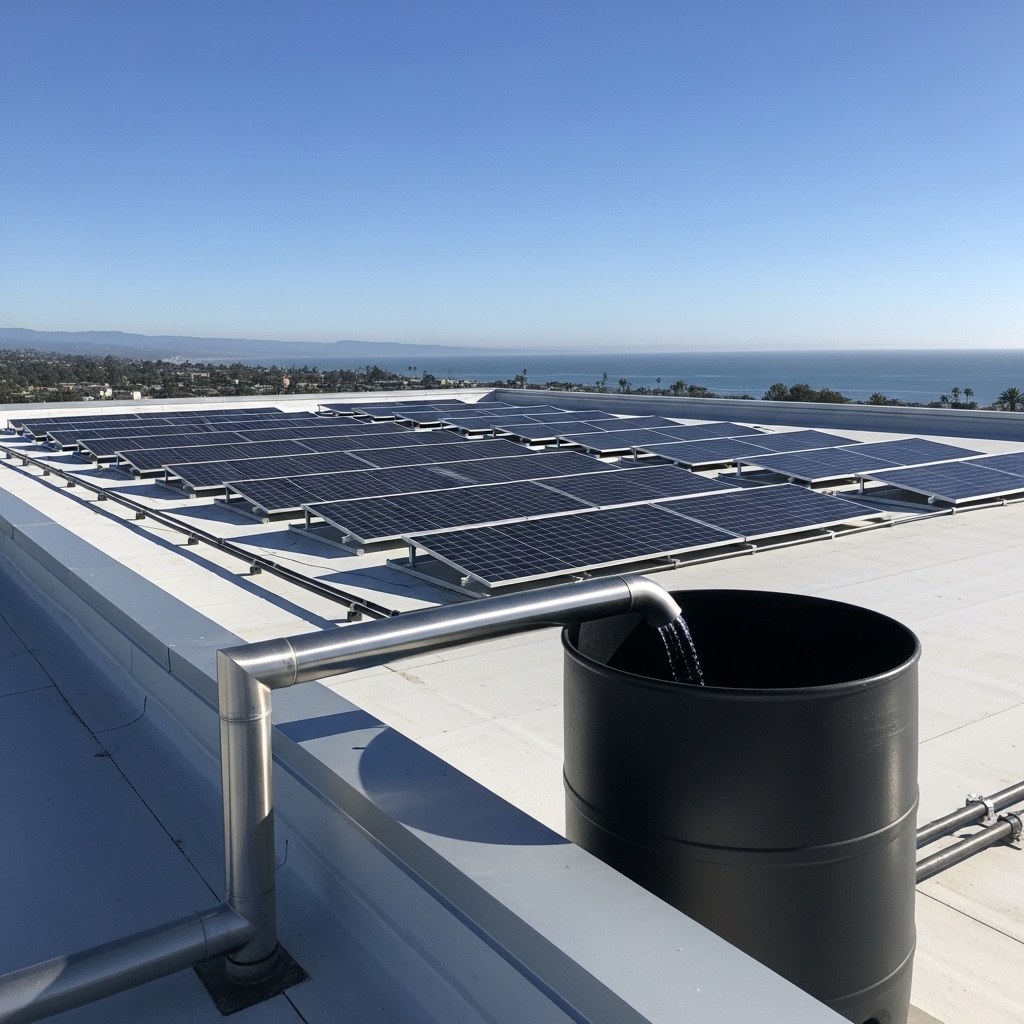
| Busy rooftops | HVAC, exhaust, solar and telecom equipment add penetrations and service traffic |
Ponding and clogged drains after the dry season
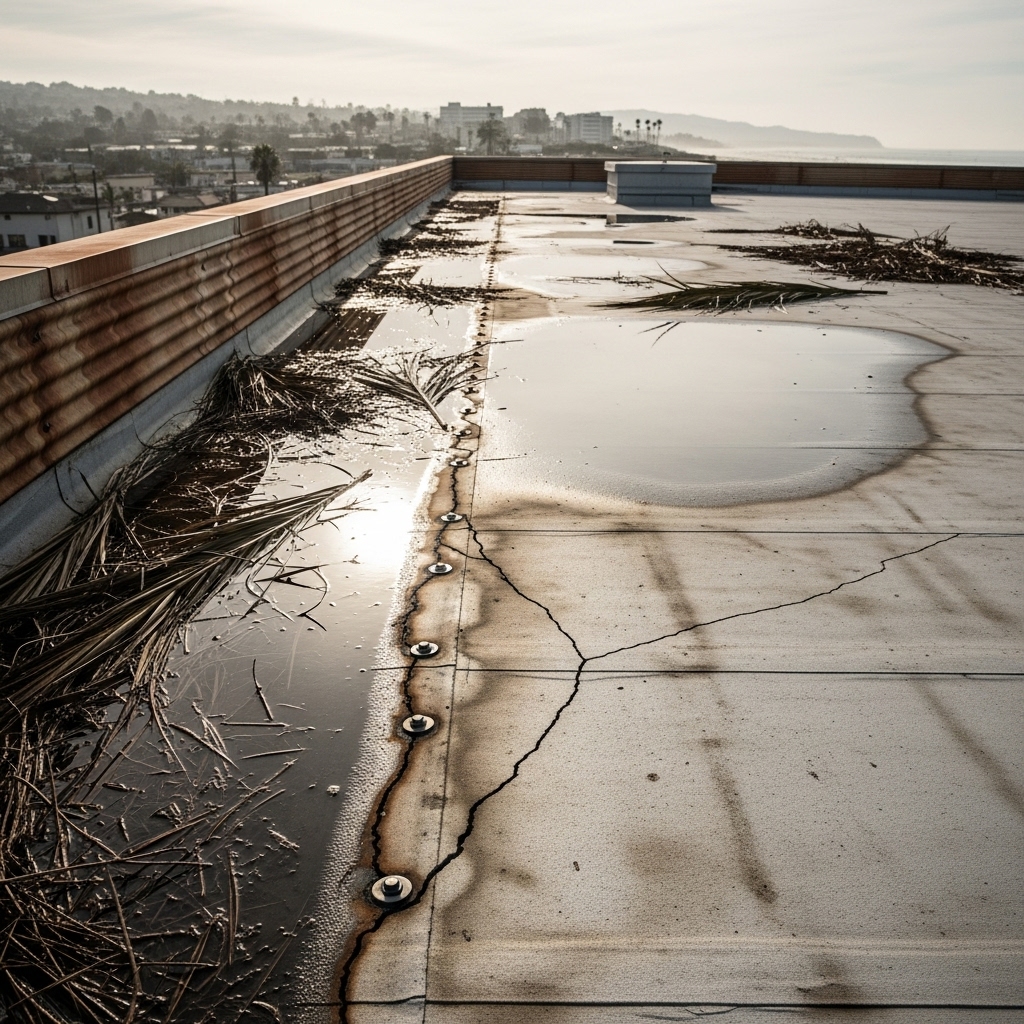
Ponding is the most persistent issue on low-slope roofs in the area. Leaves, palm debris and windblown grit collect in drains all summer; when the first storm arrives, water stands behind them. Standing water softens and stresses membranes and seams, leaves silt that abrades the surface under foot traffic, and speeds aging. Leaks often show up at the edges of the low area or around poorly supported equipment pads.
Older buildings with nearly flat decks make it worse, and any settlement or patched decking creates new low spots. The fixes are a cleaning schedule before the rainy season, adding or resizing drains and scuppers, and tapered insulation to restore flow to the drains. Our guide to commercial roof drainage explains the code rules for overflow drains and slope.
Sun, UV and daily temperature swings
Sun chalks coatings, embrittles some membranes and weakens exposed sealants. The daily cycle of heating and cooling moves materials at seams, corners and transitions. Look for small cracks at outside corners, lifted laps where adhesives have aged, and crazing on older coatings. Water that gets in through these defects can travel under the membrane and appear inside far from the source.
Materials made for high exposure and a maintained reflective surface are the defense. South- and west-facing edges take the most afternoon sun and deserve the closest look. A recoat or reinforcement at known stress points often restores performance without a larger project.
Salt air and corrosion at metal parts
Near the coast, corrosion at fasteners, edge metal and equipment rails is common when components are not properly coated or made from compatible alloys. Rust stains parapet walls, weakens fasteners and opens paths for water at terminations. Contact between dissimilar metals, such as copper against galvanized steel or aluminum against steel without isolation, speeds the damage. Stainless or suitably coated fasteners, isolated dissimilar metals, and routine cleaning and spot-coating keep edges tight.
Sundowner winds and edge failures
Sundowners are downslope windstorms off the Santa Ynez Mountains, which the National Center for Atmospheric Research’s Sundowner Winds Experiment describes as gusty winds that peak from early evening to mid-morning. Wind uplift concentrates at a roof’s edges and corners, exactly where fastening is often lighter and sealants older. Warning signs are a membrane edge that flutters, loose gravel stop, rattling gutters and, in severe cases, peeled-back material at the perimeter. Strong edge metal, fastening patterns verified in the field, and a check of terminations, gutters and downspouts before the windy months prevent most of it. In retrofits, upgrading edge metal and reinforcing corners gives an immediate improvement.
Leaks at penetrations, curbs and rooftop equipment
Commercial roofs here carry a lot of equipment. Every pipe, conduit, drain and curb for HVAC or exhaust is a place where movement, vibration and service traffic stress the membrane. Kitchen exhaust adds grease, which degrades some membranes, and solar or telecom installations can add dozens of small penetrations. Typical failures are cracked counterflashing, poorly sealed pitch pockets and displaced storm collars.
Many of the leaks we troubleshoot trace back to people rather than weather: a dropped fastener, a tool scuff near a curb, a vendor crossing the membrane with no walk pads. Marked access routes, walk pads, and a rule that other trades group and seal their penetrations once keep this category of damage down.
Building movement, wet insulation and coatings used as a cover-up
- Movement. Thermal expansion and small seismic shifts tug at seams and flashings. A split that returns at the same parapet corner, or a seam that opens every summer, means the detail needs room to move, not another patch.
- Wet insulation. Near long-standing ponding or old leaks, insulation under the membrane is often saturated. It loses insulating value and keeps feeding leaks until the wet sections are cut out and replaced.
- Coatings over problems. A reflective coating extends the life of a sound roof. Over dirt, grease, salt or standing water it blisters and peels, and over a failing roof it only hides the problem for a while.
Which problems can wait, and which cannot?
| What you see | How soon | Usual fix |
|---|---|---|
| Active leak, peeled edge, loose sheet metal | Now, before the next rain or wind | Temporary seal, then permanent edge or flashing repair |
| Clogged drain or scupper, water standing after rain | Before the rainy season | Clean, then correct slope or add drains if it returns |
| Open flashing seams, cracked sealant, rusted fasteners | Within the season | Reseal, replace fasteners, coat or replace corroded metal |
| Chalky coating, granule loss, minor crazing | Plan and budget | Clean and recoat if the roof underneath is sound |
| Repeated leaks in the same areas, wet insulation found | Plan a larger project | Section replacement, recover or full replacement |
Which permits and rules apply to repairs in Santa Barbara?
Inside city limits, the City of Santa Barbara’s Building & Safety division is the permit office; in unincorporated Santa Barbara County, the county’s Building & Safety Division exempts roof repairs under 100 square feet in a twelve-month period and the application of an approved roof coating to an existing roof (with fire-resistant materials required in high fire hazard areas). A bigger job is a different matter: Santa Barbara’s ZIP codes are in California climate zone 6, and a commercial low-slope reroof there has to use a surface that, after aging, still tests at 0.63 or higher for solar reflectance and 0.75 or higher for thermal emittance (a qualifying solar reflectance index can stand in for the pair) once more than half the roof or more than 2,000 square feet, whichever is less, is replaced, recovered or recoated, unless the insulation trade-off is used.
For the problems every commercial roof shares, see our guide to common commercial roofing problems and fixes, and for what a local inspection covers, read commercial roofing inspection expectations in Santa Barbara. Santa Barbara is one of NEMA Roofing’s six locations, alongside Oxnard, Woodland Hills, Tarzana, Downey and San Bernardino, and our crews cover Santa Barbara, Ventura, Los Angeles, Riverside and San Bernardino counties (see all service areas). Our commercial roofing service handles repair, maintenance and replacement. To fix a problem before the rainy season, call 805-977-5949.