
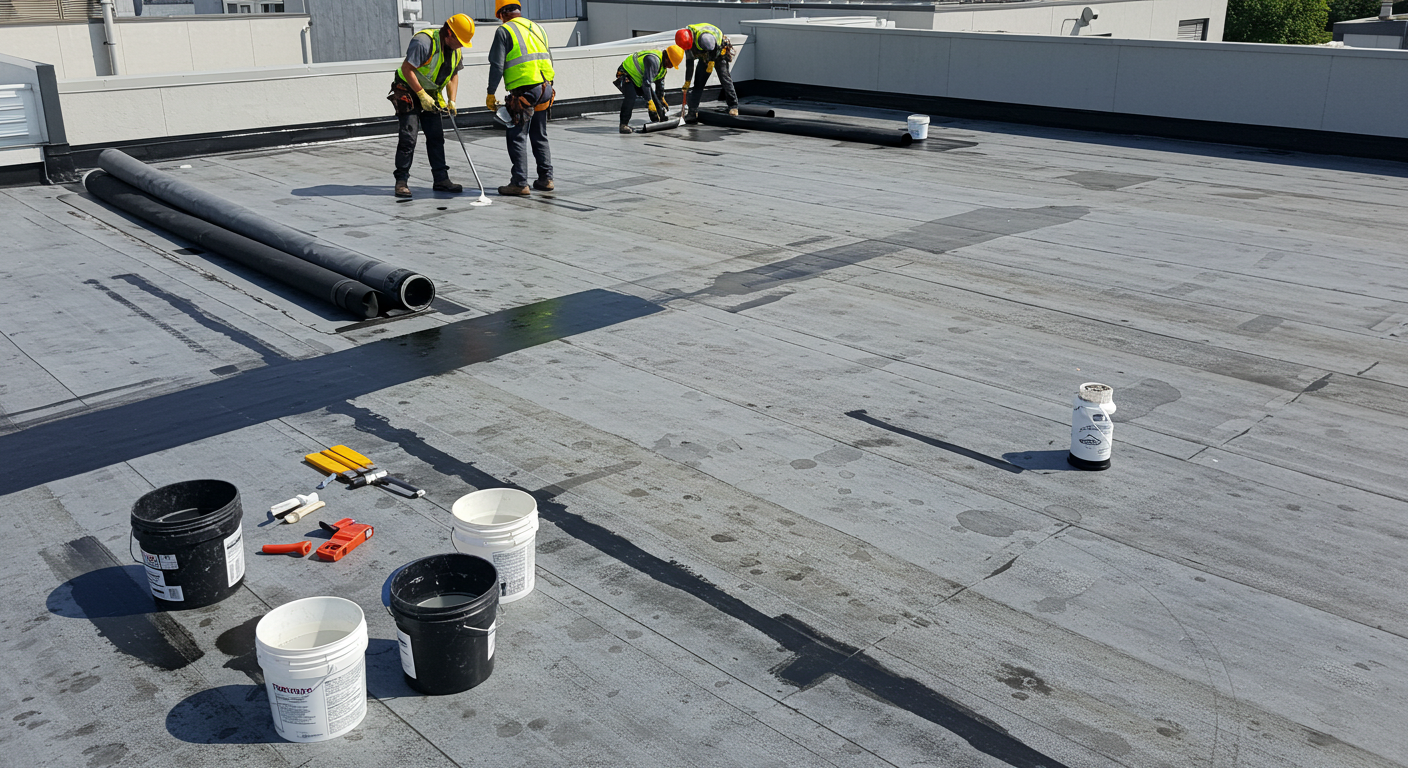
Flat roof waterproofing is the continuous membrane, together with the flashing at every edge and opening, that keeps water out even when it sits on the roof. When that barrier fails, the fix that lasts depends on what is underneath: a sound, dry roof can be sealed at the seams, reflashed or given a liquid-applied coating, while a roof with wet insulation or several old layers needs a new membrane. Below are the options, when each one holds up, and what to ask a flat roof repair company near you. For an inspection, call NEMA Roofing at 866-631-3366.
What makes up the water barrier on a flat roof?
A low-slope roof is a stack of layers, and only one of them is meant to stop water:
- Deck: wood, metal or concrete, the structure everything sits on.
- Insulation and cover board: thermal layers that must stay dry to work; wet insulation also rots wood decks and rusts metal ones.
- Membrane: the water barrier itself, a single-ply sheet (TPO, PVC, EPDM), plies of modified bitumen or built-up felt and asphalt, or sprayed foam with a coating.
- Flashing: strips of membrane and metal that carry the barrier up walls, parapets, curbs and pipes. Most leaks start here, where the flat surface meets something vertical.
- Drains, scuppers and edge metal: they move water off and hold the membrane edge down against wind.
The barrier is only as good as its weakest joint. A new-looking membrane with one failed pipe boot still leaks, which is why waterproofing work starts by finding every opening, not by coating the whole surface.
Which flat roof waterproofing option fits your roof?
| Option | What it does | Holds up when | Wrong choice when |
|---|---|---|---|
| Patch | Covers a puncture or small split with the same membrane | The damage is local and the insulation below is dry | Water has spread under the membrane |
| Seam repair | Rewelds, re-adheres or strips over an open seam | The seam failed in spots | Seams are opening across the roof |
| Reflashing | Rebuilds the membrane and metal at a wall, curb or pipe | The leak is at a joint, which is the most common case | The field membrane is also failing |
| Liquid-applied coating | Adds a continuous waterproof and often reflective layer over the whole surface | The roof is sound, dry and well bonded, with seams and flashing repaired first | Insulation is wet, the membrane is loose, or the coating is not rated for water that ponds on your roof |
| Recover | A new membrane over the existing roof | The old roof is dry and has only one layer | The old roof is water-soaked or already has two or more layers (the building code does not allow it) |
| Replacement | Everything off to the deck, new insulation and membrane | The roof is at the end of its life or wet in many places | The problem is one local defect |
Do waterproof coatings on flat roofs last?
A coating is a maintenance layer, not a new roof. The California Building Code allows a new protective coating over an existing single-ply, modified bitumen, built-up, metal or spray foam roof without tearing it off, and when the base is sound a coating can extend the roof’s service and cut the heat it absorbs. How long it lasts depends on three things:
- The base. A coating bonds to the surface it goes on. Over wet insulation or a loose membrane it fails with that surface, and it can hide the damage while it spreads.
- Preparation. Cleaning, repairing seams and flashing, and priming where the maker requires it come before any coating goes on.
- Thickness and recoating. Each product has a specified thickness and a recoat schedule. A coat applied too thin, or never renewed, wears through.
If your roof holds water after rain, choose a coating the maker rates for ponding, or fix the drainage first.
Why does sealant from a tube rarely fix a flat roof leak?
Caulk and roof cement stop water for a while, then crack as the roof heats and cools. Many are also incompatible with the membrane: asphalt-based products do not bond to TPO or PVC and can damage some single-ply sheets. Sealant smeared over a leak also hides where the water was getting in, which makes the permanent repair harder to find. A lasting repair uses the membrane’s own material and method (a welded patch on TPO, a matching ply on modified bitumen) and fixes the joint that failed. For the full list of what goes wrong and the right fix for each, see common flat roof problems and how to fix them.
What should you ask a flat roof repair company near you?
- Which flat roof membranes do you install and repair? A crew that works on low-slope systems every week carries the welders, primers and materials each one needs.
- How will you find the source of the leak, and will I get photos of it?
- Is the insulation under the leak dry? If not, what will you remove?
- Are you recommending a patch, coating, recover or replacement, and why that one over the others?
- Is the repair written up with materials, area and warranty terms?
- What is your state license number? Check it on the Contractors State License Board site. NEMA Roofing’s is CSLB license #1083283, and it is a Polyglass Preferred Contractor and a GAF Master Elite contractor.
“Near me” should mean a crew that can get to your roof when it leaks. NEMA Roofing keeps five locations (Downey, Tarzana, Woodland Hills, Oxnard and Santa Barbara), and its crews fully cover five counties: Los Angeles, Ventura, Santa Barbara, San Bernardino and Riverside; find yours on our service areas page. Learn more on our flat roofing service page, our general roof repair service, and in how long each flat roof material lasts. To have your roof’s water barrier inspected, call 866-631-3366.




