
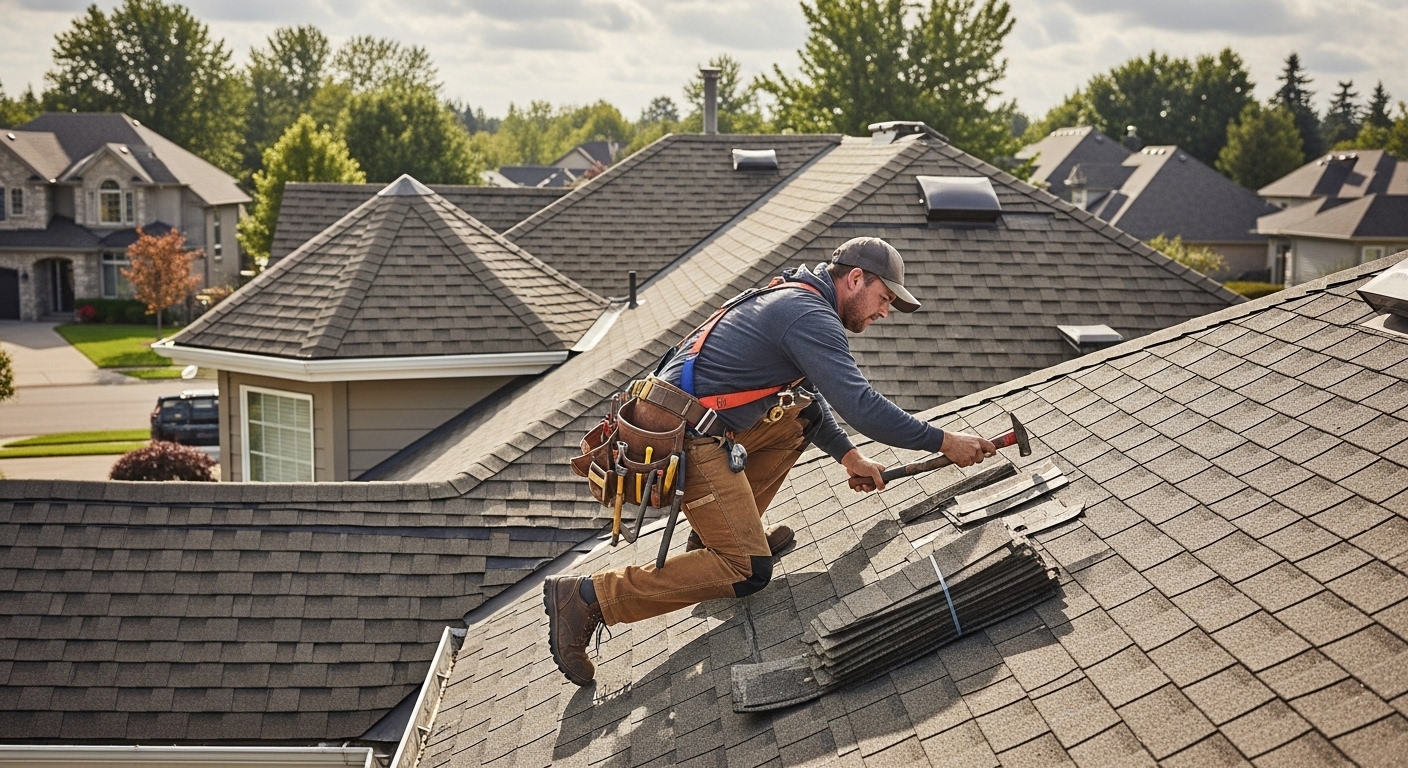
Roof workmanship is how a roof is put together, as opposed to what it is made of: the fastening, the underlayment laps, the flashing at every wall, chimney and vent, the ventilation and the edges. Good materials installed badly still leak, and a manufacturer’s standard warranty covers defects in its product, not installation mistakes. Here is what professional workmanship looks like and how to check it. To talk to a roofer about your roof, call NEMA Roofing at 866-631-3366.
Where workmanship shows on a new roof
California’s residential code requires roof coverings to be applied according to the code and the manufacturer’s installation instructions (2025 CRC section R905.1). Most of what separates a professional installation from a quick one happens in the layers you will never see once the job is done:
| Part of the roof | Professional workmanship | Common shortcut |
|---|---|---|
| Deck (sheathing) | Soft or rotted boards replaced after tear-off, loose boards re-nailed | New roof laid over damaged wood |
| Underlayment | Laid in the right direction with the laps the manufacturer specifies, so water runs over each seam, not into it | Short laps, tears left open, reverse laps |
| Fastening | The number and position of nails the manufacturer requires; for asphalt strip shingles the code sets a floor of four per shingle | Too few nails, nails outside the nailing zone, nails driven crooked or too deep |
| Wall and chimney flashing | Step or continuous flashing at sidewalls, at least 4 by 4 inches, tucked under the siding; a diverter where an eave meets a wall | Old flashing reused, gaps filled with caulk |
| Vents and pipes | New pipe boots and vent flashings set into the courses | Old boots left in place, sealed on top |
| Valleys and edges | Valley lining and drip edge installed per the instructions, clean straight lines | Valleys cut ragged, drip edge missing |
| Ventilation | Intake at the eaves and exhaust near the ridge sized to the attic | Vents blocked by insulation, or exhaust with no intake |
The code backs several of these: flashing is required at every wall and roof intersection, change of slope and roof opening (CRC R903.2.1), and an attic generally needs net free vent area of at least 1/150 of the vented space, or 1/300 when conditions are met that include placing 40 to 50 percent of it high in the attic (CRC R806.2).
Workmanship on a repair
A repair is workmanship at small scale, and the same rules apply. A professional repair:
- finds where the water enters, which is often uphill of the ceiling stain;
- replaces the failed piece (the flashing, the boot, the torn underlayment) instead of coating it with sealant;
- weaves new material into the old courses so each layer still sheds water onto the one below;
- matches the material and fastening of the roof around it.
For the warning signs of a repair done badly, see signs of a bad roof repair; for the parts a lasting repair should use, see roof repair materials.
Workmanship warranty and materials warranty are not the same
Two different promises can come with a roof, and it pays to know which one you have:
- Materials warranty: the manufacturer’s coverage for defects in the product. On its own it does not pay for mistakes made during installation.
- Workmanship coverage: protection against installation errors. It comes from the contractor’s own promise, or from an enhanced manufacturer warranty that adds it.
Some enhanced warranties with workmanship coverage are only available through certified contractors. GAF Master Elite contractors can register all of GAF’s enhanced warranties, and GAF’s Golden Pledge, available only through them, adds GAF-backed coverage for installation workmanship. Owens Corning’s Preferred Protection warranty includes workmanship coverage and must be installed by an Owens Corning Platinum or Preferred contractor, while its System Protection warranty has no workmanship coverage. NEMA Roofing is a GAF Master Elite contractor and an Owens Corning Preferred Contractor. Ask any roofer, in writing, which warranty you will get and who registers it.
How to check the workmanship before final payment
- Ask for photos during the job: the bare deck after tear-off, the underlayment, and the flashing before the covering goes over it. Those are the only views of the hidden work.
- Look at the walls and chimney: new metal flashing should be visible; a bead of caulk where metal should be is a shortcut.
- Look at the pipes and vents: boots should be new and sit flat.
- Check the edges and valleys from the ground: straight lines, drip edge in place, no lifted pieces.
- Check the attic after the first rain: no daylight through nail holes, no damp spots.
- Get the paperwork: the permit final inspection, the warranty registration and a list of the materials used.
- Walk the yard: nails and scraps should be gone, including from lawns and gutters.
Workmanship you can check with NEMA Roofing
Our crews install and repair roofs out of five Google-verified locations (Downey, Tarzana, Woodland Hills, Oxnard and Santa Barbara), which between them reach every part of Los Angeles, Ventura, Santa Barbara, Riverside and San Bernardino counties. Ask us for the photos and paperwork above on your job. For our installation work, see the roof installation service; for everything else, our roofing contractor services. Call 866-631-3366.




