
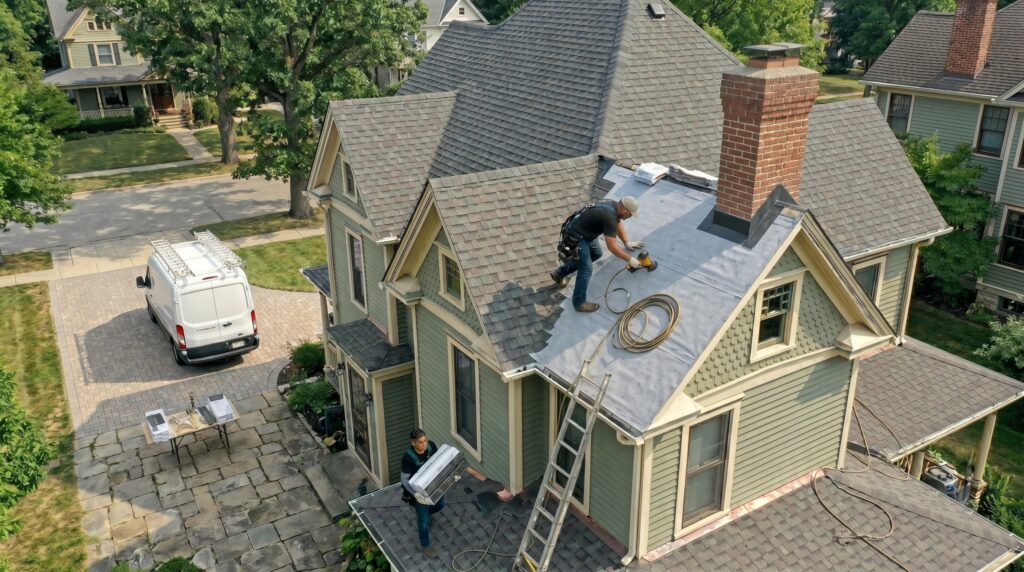
Roof repair materials decide how long a repair lasts: the covering has to match the roof (same shingle line, tile profile or panel), the underlayment beneath has to be renewed and suited to the covering, flashing metal and fasteners have to resist corrosion where the house sits, and flat roof patches have to be the same membrane as the roof. Sealant is a backup, never the repair. For a repair specified this way, call NEMA Roofing at 866-631-3366.
The covering: match first
A repair patch that is a different product from the roof around it is the first place the roof will fail again, because the pieces do not overlap, interlock or move the same way.
- Asphalt shingles: the same manufacturer and line where it is still made, since shingle sizes and nailing zones differ between lines. Even an exact match will look newer than a slope that has weathered for years; the repair is judged by how it sheds water first.
- Clay and concrete tile: the tile must interlock and seat with the tiles around it. The Tile Roofing Industry Alliance notes that some concrete tile products are discontinued, and suggests checking with the manufacturer, reusing tiles from a less visible slope, salvage tiles or custom tiles before resorting to a complete replacement.
- Metal: the same panel profile, thickness and coating. Mixing metals is a corrosion risk: the Department of Defense roofing criteria (UFC 3-110-03) say to avoid dissimilar metals and to use fasteners compatible with the main material.
Underlayment: the layer that actually keeps water out
On shingle and tile roofs, the underlayment under the covering is the waterproofing layer; the covering protects it from sun and sheds most of the water. A lasting repair replaces the underlayment across the repaired area and laps the new material under the old at the top and sides, so water running down the slope stays on top.
- Under tile: the underlayment is often the part that has worn out while the tiles look fine, so a tile repair that does not look underneath is incomplete.
- Under metal: the same federal criteria require a continuous high-temperature self-adhering underlayment under metal roofs whose seams and laps are not watertight on their own.
- At valleys, walls and penetrations: self-adhering membrane is commonly added where water concentrates, under the flashing.
Flashing metal and the coast
Flashing is sheet metal, and the metal chosen matters most near the ocean. UFC 3-110-03 lists pre-finished aluminum, pre-finished galvanized steel, aluminum-zinc coated steel (such as Galvalume) and stainless steel as sheet metal types. It also notes that Galvalume steel does not perform as well in direct contact with salt spray, and that in some environments aluminum may be the better choice, at a higher cost and with greater thermal expansion. Two more rules from the same criteria are worth asking about on any repair:
- keep sheet metal from touching pressure-treated wood, whose preservatives corrode it;
- do not mix copper with other roofing metals where its runoff can reach them.
Rusted flashing is replaced, not reused: the 2025 California Building Code bars reinstalling vent flashing, metal edgings, collars and counterflashing that are rusted, damaged or deteriorated when a roof is recovered or replaced.
Fasteners: small parts, long life
- Tile: the California Building Code requires tile fasteners to be corrosion resistant.
- Metal: exposed screws need sealing washers; replacement screws are corrosion-resistant and sized to bite into sound material, and the criteria above call for fasteners compatible with the panel metal.
- Shingles: nails go in the manufacturer’s nailing zone, where the next course covers them. A nail left exposed is a future leak.
Flat roof patches: same membrane, same method
A flat roof repair lasts only when the patch bonds to the roof as one piece:
| Existing roof | Lasting patch | Avoid |
|---|---|---|
| TPO or PVC single-ply | The same membrane, heat-welded to cleaned, sound membrane | Asphalt-based cement or tape on a thermoplastic |
| EPDM (rubber) | EPDM patch with primer and seam tape or adhesive made for EPDM | Asphalt products, which do not bond to rubber |
| Modified bitumen | Modified bitumen patch, torched or adhered per the product | Patching over wet or blistered areas |
| Built-up roof | Plies and surfacing rebuilt over the damaged area | A skim of cement over cracks |
| Coated roof | A coating compatible with the existing coating, over a clean, dry surface | A coating over trapped moisture or an incompatible coating |
Wet insulation under a membrane is cut out and replaced before patching; a patch over wet insulation traps the water in.
Sealant’s real job
Roof sealants and cements close small gaps that a mechanical detail already protects: the top edge of counterflashing, a nail head under a shingle tab, the joint at a pipe boot collar. Used in place of the flashing or the part itself, they fail as the roof heats and cools. For how to spot a repair that leaned on sealant, see signs of a bad roof repair.
Fire and energy rules also apply to repair materials
In wildland-urban interface areas covered by the 2025 California Wildland-Urban Interface Code, any roof covering applied in a repair must meet at least a Class A fire classification, so a repair cannot bring a lower-rated product onto the roof. If repairs grow past half the roof, reroof rules for fire rating and cool roofs apply as well; partial vs full roof replacement explains that line.
Keeping a repair lasting
The best materials still need an eye kept on them. A yearly check before the rainy season, with gutters and valleys cleared, sealant joints inspected and any backed-out fasteners reset, keeps a repair working for as long as the roof around it. Our roof maintenance service covers that visit.
Repairs specified to last
NEMA Roofing is a GAF Master Elite contractor, an Owens Corning Preferred Contractor and a Polyglass Preferred Contractor, and our crews repair roofs of every type throughout the five counties we cover (Ventura, Santa Barbara, Los Angeles, San Bernardino and Riverside), working from Google-verified locations in Oxnard, Santa Barbara, Tarzana, Woodland Hills and Downey. See how our roof repair service works, or call 866-631-3366 for an inspection and a written scope that names the materials.




