
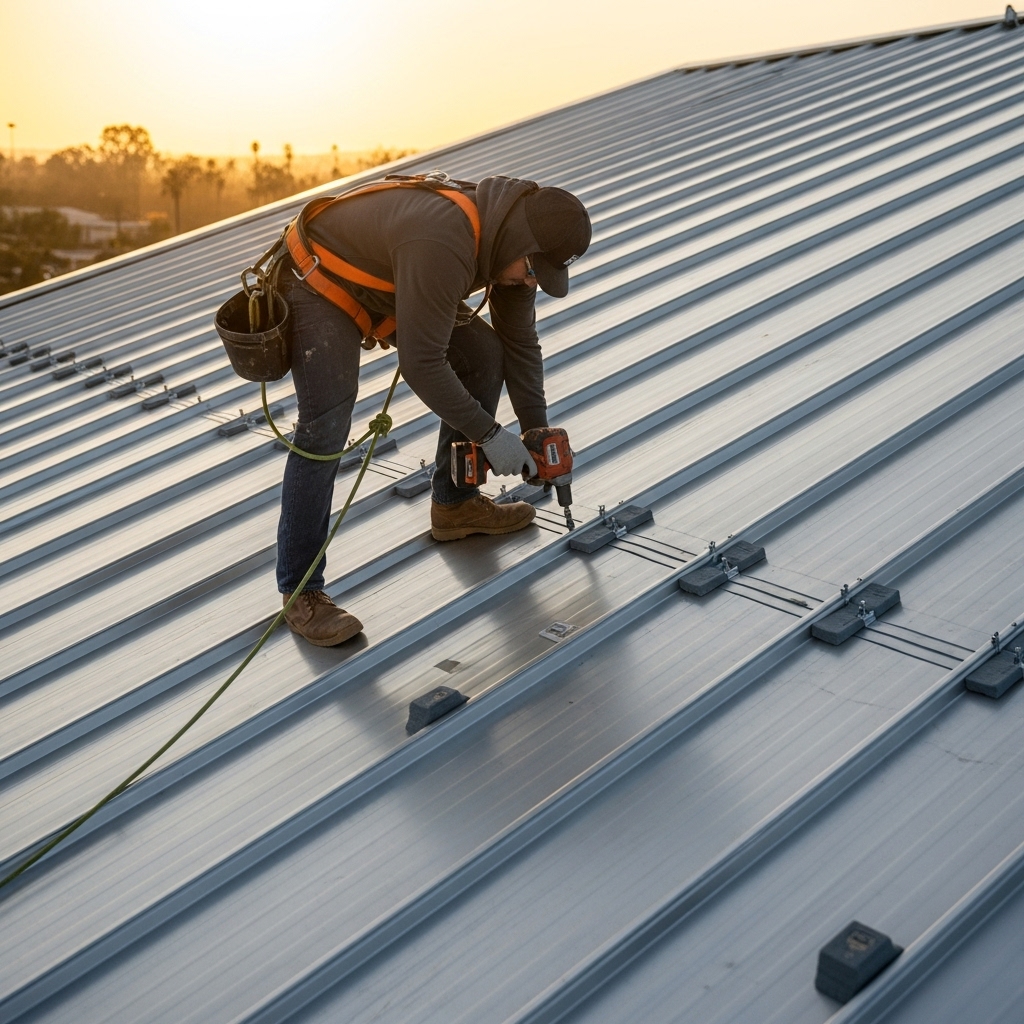
Metal roof repair in Tarzana is mostly about the details that daily heat works loose: screws that back out and washers that flatten on exposed-fastener panels, open seams, loose clips and worn closures on standing seam roofs, cracked boots and hardened sealant at vents and curbs, and rust around fasteners. A durable repair restores the mechanical fastening and the flashing instead of coating over the problem, then keeps the roof on a simple twice-a-year check. To book an assessment, call NEMA Roofing at 818-528-6412.
Why heat is behind most metal roof leaks in Tarzana
NOAA’s 1991 to 2020 normals for the Woodland Hills Pierce College weather station, about 2 km from Tarzana, put an average August day at 97.4 F in the afternoon and 60.8 F at night. Sunlit metal runs hotter than the air, so a panel grows every afternoon and shrinks after sunset, day after day through the summer. Metal roofs, especially standing seam systems, are built to move. The trouble starts when small details are overlooked or patched with materials that cannot flex the way metal does.
On through-fastened panels, that movement can back screws out by fractions of an inch, flattening the washers and leaving tiny openings that wind-driven rain will find. On standing seam roofs, movement concentrates at the clips and along the seams, testing sealant beads and factory hems. Penetrations such as plumbing vents, skylight curbs and solar mounts add different materials and angles. A durable repair works with this movement rather than trying to glue it still.
How the assessment finds the real problem
We walk the roof looking for patterns, not isolated spots. Fasteners backing out across an entire slope call for a different fix than one problem at a roof-to-wall transition. We note the panel type and seam type and check for oil canning or subtle deformation that can reveal hidden stress. At penetrations we look for cracked rubber boots, sealant that has hardened and lost its stretch, and metal flashing that has pulled away from curbs. Where there is rust, we decide whether it is surface oxidation that can be treated or deeper damage that needs a panel or flashing replaced.
Fixing exposed-fastener panels
Fastener problems on through-fastened roofs respond well to systematic work:
- Compromised screws are replaced with slightly larger, corrosion-resistant fasteners with new sealing washers, driven in a consistent pattern so the panels seat evenly.
- Where the wood underneath has lost its grip, new fasteners go into solid structure, and stitch screws can be added along the laps to tighten the assembly.
- Screw lines are not buried under sealant. Sealant films crack under heat; what works is restoring proper compression at the washer and letting the panel shed water as designed.
Fixing standing seam seams, clips and closures
On standing seam roofs, the work shifts to the seams and the transitions. We check for open vertical seams, loose clips and end-lap joints that need renewal. At walls, the Z-closures and foam closures under the flashing must be in place and intact; degraded or missing closures are replaced to block wind-driven rain. At skylights and curbs, the pan and head flashings are rebuilt with hemmed edges and correct overlap, upper piece over lower. Sealants rated for high movement and sun exposure are used as a secondary defense, never as the main waterproofing.
Rust near screws: treat it or replace it?
Light surface rust can be wire-brushed, treated, primed with a compatible coating and finished to match the roof’s metal. If rust has pitted or thinned the metal near fasteners, the affected panel or accessory is replaced so the fix is more than cosmetic. Caught early, rust is a small repair; left alone around a fastener hole, it becomes a leak.
When a coating helps, and when it does not
An elastomeric or silicone coating over a metal roof can bridge small gaps and reflect heat, lowering the roof’s temperature on hot days. It is not a cure for loose fasteners or missing closures. Before any coating, we tighten or replace fasteners, renew flashings and replace failed sealant. The coating then goes on a clean, prepared surface at the manufacturer’s thickness, with reinforcement at seams, screws and penetrations. Done in that order, it adds flexibility and helps the roof ride out heat cycles with less stress.
Leaks that show up only after hot days or after sunset
A drip that appears in the evening, with no rain, usually has two causes working together. Expansion and contraction open small gaps at fasteners and seams, and when the roof cools quickly after a hot day, condensation can form on the underside and find those gaps. Tightening or replacing fasteners, renewing closures and correcting detail work typically solves it; where condensation keeps forming, ventilation and the underlayment are checked as well.
Wind, foot traffic and other trades
When Santa Ana winds push across the Valley, uplift works at end laps, eaves and rakes. Edges are strengthened with added mechanical fastening where the panel system allows it, sealant beads that serve as a secondary defense are renewed, and rake closures are confirmed intact. The goal is to stop today’s leak and leave the roof quiet enough to ride out the next wind without new rattles or openings.
Heating and cooling, solar and satellite technicians also walk metal roofs, not always knowing where it is safe to step. We regularly see scuffs and flattened ribs that open paths for water. Metal roofs can be walked on with the right technique: on the flats or over structural supports, never on rib peaks, in soft-soled shoes. Where traffic is regular, walk pads protect the surface and show other trades where to step.
Keeping the repair tight: a twice-a-year check
Checks in spring and fall catch movement-related problems before they become leaks during windy rain or after a run of hot days. A typical visit tightens or replaces a handful of fasteners, clears gutters and valleys, and refreshes a few sealant beads. We document these visits with photos, so you can see what changed from season to season and what stayed solid. For the problems these checks look for on Tarzana homes, see common metal roofing issues in Tarzana.
Does a leaking metal roof need replacing?
Usually not. Most leaks come from details, not from the panels themselves. Fixing those details with materials that move the way metal moves restores the roof’s performance and extends its service life, so replacement becomes a planned choice rather than a reaction to a storm. Panels thinned by rust over wide areas, or a roof that needs new fasteners across every slope year after year, are the exceptions worth a replacement conversation.
Other roof types in the area have their own repair patterns: see shingle roof repair in Tarzana after Santa Ana winds and flat roof repair for Tarzana commercial buildings.
Book a metal roof repair
NEMA Roofing runs five Google-verified locations, Tarzana among them along with Santa Barbara, Oxnard, Woodland Hills and Downey, and our crews cover all of Los Angeles, Ventura, Santa Barbara, Riverside and San Bernardino counties (see our service areas). From fastener upgrades to seam renewal and selective coating, our roof repair service fixes the cause and puts the roof on a maintenance path. Call 818-528-6412 to schedule an assessment.




