
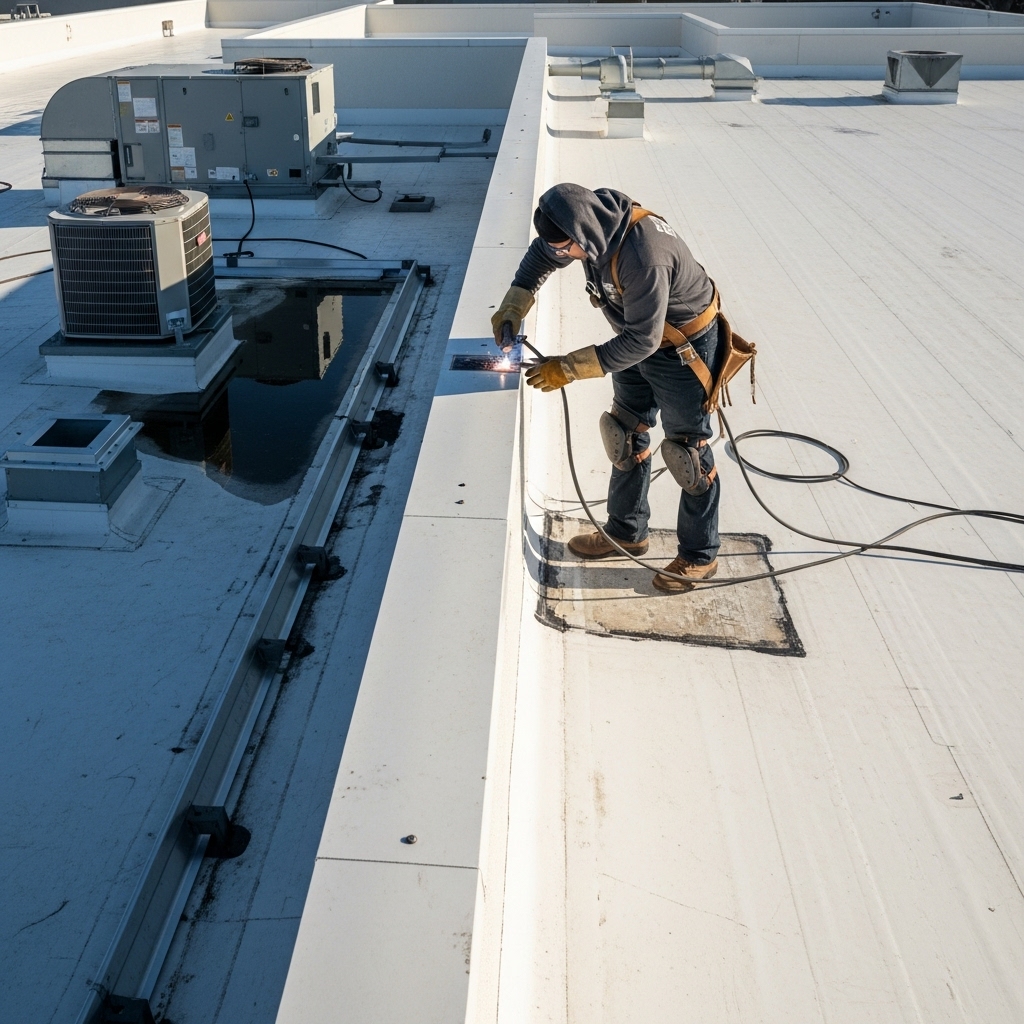
Commercial flat roof repair in Tarzana usually means tracing a leak to a drain, a seam, a parapet flashing or an equipment curb on a TPO, PVC, modified bitumen or built-up roof, then fixing that detail with matching materials while the business stays open. For a roof inspection and a written repair plan for your building, call NEMA Roofing at 818-528-6412.
Why flat roofs on Tarzana buildings fail where they do
Tarzana’s weather works on a commercial roof in two long seasons. At the NOAA station at Pierce College in Woodland Hills, about two kilometers away, the 1991 to 2020 normals show an average August high of 97.4 degrees Fahrenheit, about 115 days a year at 90 degrees or hotter and about 35 at 100 or hotter. Months of that heat and ultraviolet light dry out membranes and sealants, and the damage shows first at seams, corners and flashings.
Then the rain arrives in a short window: the same station records a normal of 16.4 inches a year, and more than four fifths of it falls from December through March. Summer is almost dry. That pattern is why a flat roof can look fine for months and then leak in the first real storm of winter, when water finally finds the openings the summer created.
Rooftop traffic adds the third stress. Buildings along the Ventura Boulevard corridor carry HVAC units, restaurant exhaust fans, dishes and parapets, and every technician visit crosses the membrane.
What are the most common flat roof leaks on commercial buildings?
- Ponding at drains and scuppers. Debris or displaced gravel holds water, and standing water magnifies small defects.
- Low or loose parapet flashings. Base flashing that stops short, or coping joints that have opened, let wind-driven rain behind the membrane.
- Seam failure on aged TPO or PVC. Welds that were marginal when new open up as the sheet ages in the sun.
- Curb corners around HVAC units. Corner cracks, “fishmouths” and terminations that rely on sealant instead of height.
- Foot traffic and grease. Crushed insulation and scuffed membrane where there are no walkway pads; kitchen exhaust that makes many membranes brittle.
Not every drip comes through the roof. Condensation inside rooftop ducts, or air pressure that pulls rain in at doors and vents, can produce stains far from any opening, so we check ducts and seals before we cut into a roof.
How each roof type is repaired
| Roof system | How it usually fails | How the repair is done |
|---|---|---|
| TPO or PVC single-ply | Seams and flashings, as the sheet loses flexibility with age and UV | Clean, prime where the maker requires it, heat-weld a patch with rounded corners; add a cover strip where a seam shows movement |
| Modified bitumen | Splits where the roof flexes near curbs and at parapet transitions | Cut back to sound material, install reinforced plies in compatible adhesive or asphalt, fasten the terminations |
| Built-up with gravel | Hidden wet areas and blisters, gravel dams at drains | Open the wet or blistered area, dry the deck if safe, rebuild the plies, restore the gravel so water drains |
At parapets we confirm that base flashing climbs high enough and is held with termination bar, that coping cleats are secure, and that cracked masonry gets a flexible joint so the roof does not tear at the corner.
Can the roof be repaired without shutting down the business?
In most cases, yes. Work is staged around peak hours, entrances stay clear, and any short HVAC or power shutdown is announced in advance so tenants can plan. Access is part of the plan too: many buildings have a roof hatch in a back corridor or a narrow exterior ladder, and the crew sets up where staff and customers are not walking.
What property managers get after a repair
- Before-and-after photos of each repaired detail.
- Short notes on what was found and what was done, written so a manager can answer tenant questions.
- On multi-tenant roofs, a map of each tenant’s equipment, so responsibility for curbs, exhaust fans and grease containment is clear.
When is a coating worth it, and what rules apply?
A reflective coating can extend the life of some membranes, but only over a sound substrate with stable seams; leaks are repaired first. Size matters under California’s energy code: when a nonresidential low-slope roof is replaced, recovered or recoated over more than 50 percent of its area or more than 2,000 square feet, whichever is less, the new surface must meet the cool-roof requirements (an aged solar reflectance of at least 0.63 and thermal emittance of at least 0.75, or an SRI of at least 75), unless an exception such as the insulation trade-off applies. A coating plan should name a product rated by the Cool Roof Rating Council.
Because Tarzana belongs to the City of Los Angeles, a larger reroof or recover goes through the Los Angeles Department of Building and Safety (LADBS). Check the fire map as well: some of ZIP 91356 is mapped as a Very High Fire Hazard Severity Zone, and a building there needs a Class A covering when it is reroofed.
Repair now, or plan a replacement?
If the leaks sit in one area or at a handful of details, such as a row of poorly flashed curbs, targeted repairs are usually the better value and can keep the roof in service for years. If the membrane is tired across the whole roof, with seam failure in many places or shrinkage pulling at the perimeter, we lay out the choices, which can include a recover or a replacement phased section by section so tenants stay open. Our flat roofing service covers those larger options, and how long each flat roof material lasts helps with the timing.
What to do before the rainy season
Because nearly all of Tarzana’s rain falls in a few winter months, a walkthrough in the fall pays for itself: clear debris, test every drain and scupper, tighten loose terminations, check curbs and exhaust fans, and photograph the roof so new problems are easy to spot next time. A second look after the wet season catches what the storms opened. See our roof maintenance program for scheduled visits.
Getting a repair scheduled
One of NEMA Roofing’s five locations is on Ventura Boulevard in Tarzana; the others are in Woodland Hills, Downey, Oxnard and Santa Barbara, and together they cover commercial buildings across Los Angeles, Ventura, Santa Barbara, Riverside and San Bernardino counties. Read more on our Tarzana roofing page and our roof repair service, then call 818-528-6412 to book an inspection.




