
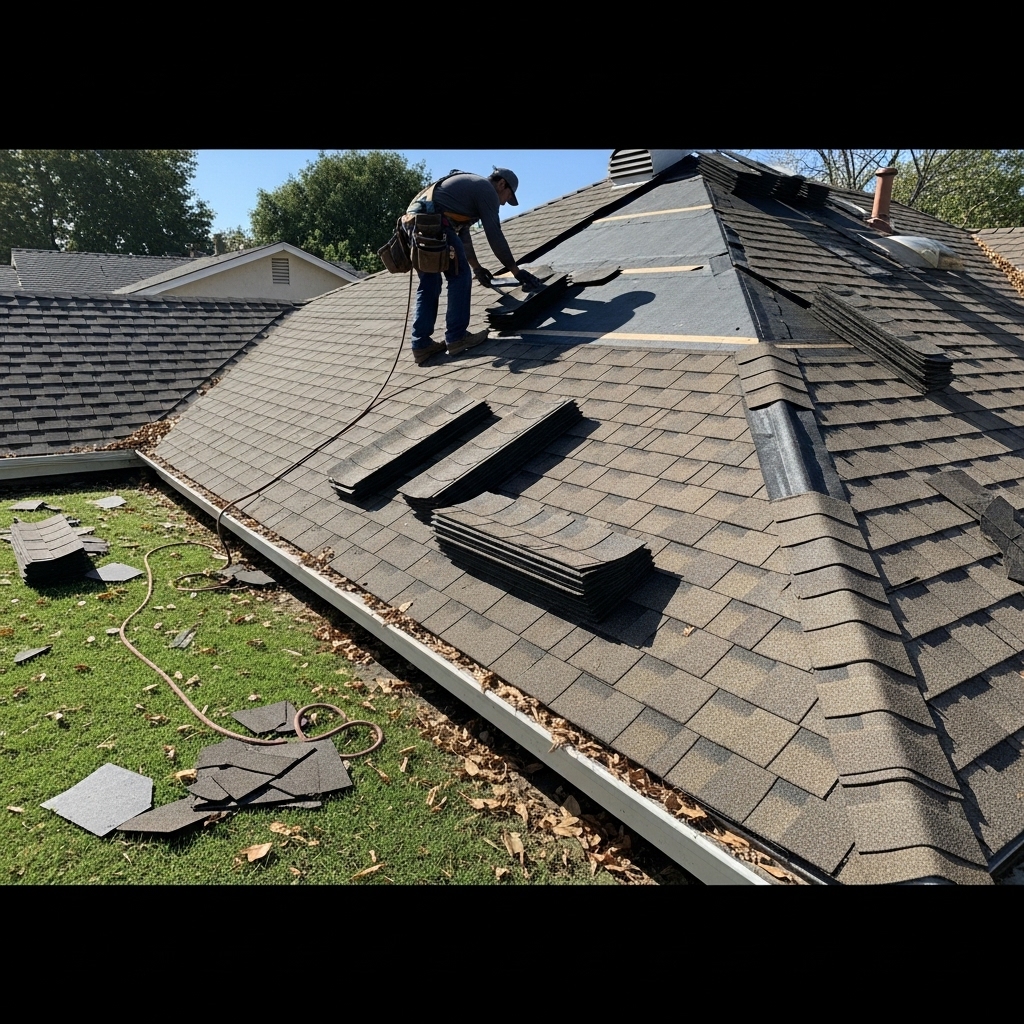
Shingle roof repair in Tarzana after Santa Ana winds starts with finding every shingle whose seal the gusts broke, including the ones still on the roof, then replacing torn tabs with matching shingles, re-nailing at the correct line, rebuilding ridge caps and resetting lifted flashing before the winter rain arrives. For an inspection after a wind event, call NEMA Roofing at 818-528-6412.
How Santa Ana gusts damage a shingle roof
An asphalt shingle roof works as a layered system: each course covers the nails and laps of the one below, and a sealant strip bonds each shingle to the one beneath it once the sun warms it. Strong dry gusts attack that bond. When wind gets under a tab it can break the seal and then flex the shingle again and again until the mat tears or the nails pull through. Shingles nailed too high or with overdriven nails lift first. Ridge caps and hips take direct pressure and crack along their bends, and a loose drip edge at the eaves gives the wind a place to pry.
The debris the wind carries does its own damage: branches scrape granules off, and leaves and twigs pack into valleys and gutters.
Why the damage often shows up weeks later in Tarzana
Santa Ana events are dry, so a broken seal gives no sign until it rains, and in Tarzana that can be months later. NOAA’s 1991 to 2020 climate normals for Pierce College, the weather station about two kilometers from Tarzana, list 16.4 inches of precipitation a year, over 13 of them between December and March. A shingle loosened by a fall wind can stay quiet until the first winter storm and then let water in, long after anyone connects it to the wind. That is the reason to have the roof checked after the wind, not after the ceiling stain.
Summer heat sets the roof up for it. Pierce College’s normals count about 115 days a year at or above 90 degrees, with August highs averaging 97.4. That sun dries the asphalt and loosens the granules over the years, which is why an older roof sheds more shingles in the same gust than a young one.
What to check yourself after a windy night
- Shingles, tabs or ridge pieces on the ground, in the gutters or in the yard.
- From the ground, with binoculars if you have them: tabs that sit raised, lines of shingles that look wavy, bare spots where the granules are gone.
- Lifted metal at the edges, around the chimney or where a lower roof meets a second-story wall.
- Inside: new stains on ceilings, especially under valleys and wall junctions, and daylight in the attic around pipes and vents.
Do not climb onto a steep roof after a wind event; loose shingles slide underfoot. Our roof inspection checklist shows what else can be checked safely from the ground and the attic.
How wind-damaged shingles are repaired
- Map the whole slope. Broken seals rarely stay in one spot, so the survey marks every loose shingle across the slope, then checks valleys, dormer sides, roof-to-wall flashing, pipe boots and skylight flashing, which can separate under vibration.
- Replace, do not glue. Torn or missing tabs are replaced with matching shingles, lifting the surrounding courses carefully so sound seals are not broken.
- Nail at the right line. Nails go where the manufacturer specifies, at a depth that holds without cutting the mat. High nailing from an earlier repair is a common reason tabs peel.
- Hand-seal where it helps. Where a wider area has lost adhesion, a compatible roofing cement is added in small amounts under the tabs, as the manufacturer allows, in addition to correct nailing, never instead of it.
- Rebuild ridges and edges. New ridge caps at the correct exposure; drip edge and starter strip made tight so the wind cannot get under the first course.
- Restore the flashing sequence. Step flashing against stucco walls is re-layered course by course and the counterflashing reset, so wind-blown rain cannot curl behind it.
Valleys and gutters are cleared and the valley metal checked for scrapes. If the attic is safe to enter, we look for daylight at penetrations and check that intake and exhaust vents are balanced so the deck stays dry.
Buying replacement shingles: check the wind label
The 2025 California Building Code (section 1504.2) requires asphalt shingles to be wind-tested to ASTM D7158 (or ASTM D3161 for shingles outside that standard’s scope), and the bundle wrapper must carry the classification. When a repair calls for new shingles, check that label and ask for the closest color and profile match to your roof; sun exposure evens out small color differences over time.
Can a few shingles be fixed, or does a larger section need replacing?
It depends on the roof’s age and the pattern of damage. On a younger roof with sound shingles around the damage, replacing the affected tabs is enough. If seals failed across a wide area, a section repair holds better and looks better. If the survey finds widespread granule loss, curling or brittle shingles, the honest answer is to repair today’s damage and plan a replacement, rather than chase wind damage every season.
Replacement brings in city and state rules. Reroof permits in Tarzana come from the Los Angeles Department of Building and Safety (LADBS), since Tarzana sits inside the City of Los Angeles; for a house inside the Very High Fire Hazard Severity Zone mapped over part of ZIP 91356, the new covering must be Class A. The ZIP is also in California climate zone 9, where replacing more than half of a steep-slope roof requires a shingle that meets the state’s cool-roof values unless an exception applies. Our roof replacement service covers that side.
Should the whole roof be resealed after wind season?
No. Whole-roof sealing traps moisture and dust, stops shingles bonding properly and makes future repairs harder. Precise fastening, correct exposure and selective hand-sealing near edges and ridges, where the lift is strongest, perform better.
Getting ready for the next wind season
- Trim branches that hang over or rub the roof.
- Clear gutters and valleys before the fall.
- Have loose shingles, ridge caps and edge metal fixed before the winds, and have the roof looked at again after a strong event.
After a repair you should get photos of what was done and notes on what to watch as the season changes.
Wind repair across the Valley and beyond
Tarzana is one of NEMA Roofing’s five locations, alongside Santa Barbara, Oxnard, Downey and Woodland Hills, and our crews repair wind-damaged roofs throughout Los Angeles, Ventura, Santa Barbara, Riverside and San Bernardino counties. See our Tarzana roofing page and our roof repair service, or call 818-528-6412 to book an inspection.




