
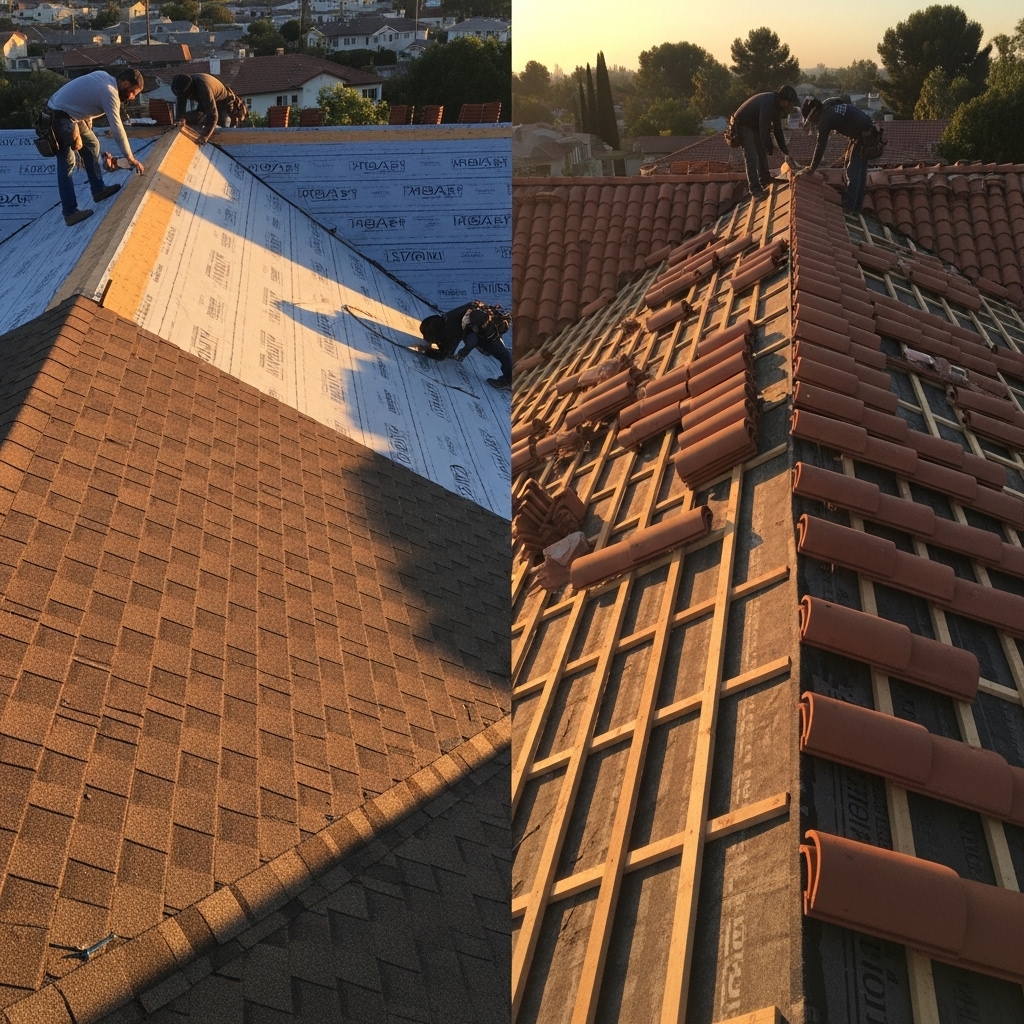
Asphalt vs tile roof in Tarzana: architectural asphalt shingles are lighter, faster to install and usually fit an LADBS Express Permit, while clay or concrete tile lasts far longer and suits the Valley’s Spanish and ranch homes but needs a structural check for its weight. Either way, a full replacement in Tarzana must meet the city’s cool-roof rule, and homes in the Very High fire zone need a Class A roof. To talk through asphalt or tile for your house, call NEMA Roofing at 818-528-6412.
Asphalt or tile: how they compare in Tarzana
| Architectural asphalt shingles | Clay or concrete tile | |
|---|---|---|
| Expected life | About 20 years (National Association of Home Builders estimate) | Over 50 years for the tile itself (same study); the underlayment beneath ages sooner |
| Weight | Light; suits framing that was never built for a heavy roof | Heavy; framing and sheathing need a check, and sometimes reinforcement |
| LADBS permit | Shingle reroofs usually fit the Express Permit, which covers Class A or B coverings under 6 pounds per square foot over solid sheathing | Check the tile’s weight on its data sheet: a covering of 6 pounds per square foot or more falls outside that Express Permit. Lifting the existing tiles, replacing the underlayment and resetting them is its own Express Permit item |
| Heat | Cool-rated shingles reflect more sun and cut attic heat | Mass and the air space under the tiles slow heat transfer to the deck |
| Look | Dimensional shadow lines that suit ranch and traditional homes | Barrel to flat profiles for Spanish, Mediterranean and contemporary styles |
| Repairs | Shingles are easy to replace; color matching gets harder as the roof ages | Broken tiles are replaced one by one; discontinued profiles can be hard to match |
Architectural asphalt shingles in the Valley
Asphalt shingles have come a long way. Today’s architectural profiles give dimensional shadow lines and a refined look that complements Tarzana’s mix of ranch, traditional and updated homes. Formulations resist algae streaking and come in reflective options that help tame attic temperatures. Shingles are lighter than tile, which matters on the many homes here that were not engineered for heavier loads, and they install quickly, so your property spends less time as a job site.
Their performance still depends on the layers beneath: starter courses, drip edge, underlayment and precise nailing patterns that keep every shingle in place when wind pushes across the Valley. For wind damage specifically, see shingle roof repair in Tarzana after Santa Ana winds.
Clay and concrete tile: weight, underlayment and longevity
Tile brings a different kind of beauty and a longer life. Clay and concrete tiles suit Spanish, Mediterranean and contemporary styles, in profiles from barrel to flat. The tile sheds most of the water, but the system underneath does the waterproofing: underlayment built to handle heat, battens that set the right elevation, and flashing that accounts for the tile’s thickness decide how well the roof resists wind-driven rain.
That is why many tile roofs in Tarzana do not need new tile at all. When the tiles are sound and the underlayment has worn out, the job is to lift the tiles, lay new underlayment and reset them, which LADBS treats as its own Express Permit item without the cool-roof requirement. The weight of a new tile roof, on the other hand, calls for a check of the framing and sheathing and sometimes reinforcement, especially on older homes.
What Tarzana’s heat, fire zones and housing age mean for the choice
- Heat. The NOAA weather station at Pierce College, about 2 km from Tarzana, averages 115 days a year at 90°F or hotter and an August normal high of 97.4°F (1991-2020 normals). Underlayments, fasteners and sealants rated for high temperatures hold up better, and light or cool-rated colors lower attic heat.
- Cool roof rule. Tarzana (ZIP 91356) is in California climate zone 9, and LADBS requires a product certified by the Cool Roof Rating Council when more than half of a home’s roof is replaced. Both cool-rated shingles and rated tile colors exist; ask for the aged values of the exact product.
- Fire zones. Parts of Tarzana (ZIP 91356) lie in a Very High Fire Hazard Severity Zone on the City of Los Angeles map, and there LADBS requires a Class A roof covering. Ask for the Class A listing of the whole assembly (tile or shingle, underlayment and deck), not only the top layer.
- Older homes. About 78 percent of Tarzana’s homes were built before 1980, according to Census estimates. Many were framed for lighter roofs, which is why the structural check comes first when a shingle home is being considered for tile.
For a wider view of materials, including metal and low-slope roofs, see roof replacement materials for Tarzana homes.
Details that decide whether either roof leaks
Underlayment choice matters for both materials in this climate. Synthetic options often outperform traditional felt under Tarzana’s UV and heat, keeping their strength through long exposure during installation. In tile assemblies, a high-grade underlayment is the secondary waterproofing layer that matters when debris collects and slows water under the tiles. Your contractor should explain why a specific product fits your roof’s slope and exposure.
Ventilation is just as basic. Balanced airflow, with intake at the eaves and exhaust at the ridge or off-ridge vents, preserves underlayment and shingles, reduces heat in the living space and helps control moisture. Tile roofs benefit too, because air moving through the assembly keeps heat from building up at the deck. A contractor who measures existing vents, inspects soffits and calculates airflow as part of the proposal is thinking about performance, not only looks.
Flashing is where expertise shows. Valleys, skylights, chimneys and wall transitions are the first places leaks appear when details are skipped. On asphalt roofs, woven or cut valleys, the valley metal and end-lap sequencing decide how the roof sheds water in heavy rain. On tile roofs, pan-and-cover valleys or W-valley metal, set high enough to keep water above the underlayment laps, are critical. Chimney counterflashing should be stepped and sealed, and skylight curbs must tie into both the underlayment and the surface material.
Color, HOA review and solar
Asphalt shingles come in palettes that shift under bright sun, and tile colors run from earthy tones to modern grays. Take samples outside and view them at different times of day, next to your fascia, stucco and trim. Some neighborhoods have homeowners association guidelines; your contractor should help with the submittal by providing photos and technical data.
If you have solar or plan to add it, coordinate it with the roof. Penetrations should be planned, flashed with compatible systems and mapped for future maintenance. On tile roofs, mounts often replace some tiles with flashing-and-pan assemblies designed for a watertight seal; on asphalt, flashing kits integrate with the shingles. Planning this with the reroof protects warranties and keeps the roof watertight.
What a good asphalt and tile contractor does on site
Preparation influences the result as much as the product. Protecting landscaping, covering pool surfaces, shielding outdoor kitchens and planning debris paths show respect for your property. Tear-off reveals the truth about the deck, and any damaged sheathing is replaced before anything goes on top. With tile, battens are laid out to match the tile profile and channel water; with asphalt, starter courses and drip edge set a clean baseline for the courses that follow.
Replace aging skylights during a reroof to avoid mismatched flashing and future leaks, and plan low-profile vents, attic fans and solar-ready flashing so the finished roof stays clean. Good communication carries the plan: a clear schedule, regular updates and progress photos. If a surprise appears, such as a hidden gap at a chimney or rotted fascia, the team should show you, explain the options and move forward. Final detailing (aligned ridge caps, flashing painted where appropriate, a cleaned yard) is what you inspect at the end.
Read warranties closely. Manufacturers back materials installed to their specification, and contractors with higher-tier manufacturer credentials can offer enhanced coverage; the workmanship warranty covers the installation itself. Ask how warranty service works in practice.
Why local expertise matters in Tarzana
Valley heat cycles, the angle of the sun and periodic winds put a particular kind of stress on roofs. A local roofer knows which underlayments stand up to UV, which tile profiles resist wind uplift on certain slopes, and how to detail eaves for fast, heavy rain. They also plan for hillside access and staging and for HOA review cycles, which keeps the project moving.
Craftsmanship culture matters just as much. A contractor who trains crews thoroughly and supervises each stage gets consistent results, and a good foreman can explain why a valley metal sits at a certain height or how a ridge vent’s airflow is calculated. That kind of openness usually goes with roofs that look as good up close as from the street. For the steps of picking a contractor, read finding a roof contractor in Tarzana.
Frequently asked questions
Which lasts longer in Tarzana, asphalt shingles or tile?
Tile, when the underlayment, flashing and battens are installed correctly and maintained: the National Association of Home Builders puts clay and concrete roofs at over 50 years and asphalt shingles at about 20. The underlayment under tile ages sooner than the tile and is replaced by lifting and resetting the tiles. The right choice also depends on your home’s structure, style and maintenance preferences.
Will a cool-rated shingle make a noticeable difference?
Yes. Reflective shingles lower attic temperatures and ease the load on air conditioning. Combined with balanced ventilation, they make the home more comfortable and help the roof last. On a full replacement in Tarzana, a rated cool product is required anyway.
Do tile roofs require more maintenance?
The tile itself is durable, but the system benefits from periodic checks to clear debris from valleys and replace any broken tiles. Flashing should be kept clear, and the eaves watched for birds and pests.
Can my home handle the weight of tile?
Many homes can, but it has to be verified. A contractor should evaluate the framing and sheathing and recommend reinforcement if needed. When switching from shingles to tile, also check the tile’s weight against the LADBS Express Permit limit.
What are the biggest differences in installation between shingles and tile?
Shingles rely on precise nailing patterns, underlayment laps and edge details to resist wind and shed water. Tile adds battens, specialized flashing and attention to weight and airflow beneath the tiles. Both demand careful work at valleys, walls and penetrations.
How long does installation take?
It depends on size, complexity and inspection timing. Asphalt installations are usually faster; tile involves more staging and detailing, particularly on complex rooflines.
What kind of upkeep extends roof life?
Seasonal inspections, clearing debris, checking sealants and dealing promptly with any movement or damage after a storm keep both asphalt and tile roofs performing. For asphalt, check for lifted shingles after wind; for tile, replace broken tiles and keep flashing clear.
Asphalt and tile roofing with NEMA Roofing
Tarzana is one of NEMA Roofing’s five locations, with Santa Barbara, Oxnard, Woodland Hills and Downey, and our teams install and repair asphalt and tile roofs in every part of Los Angeles, Ventura, Santa Barbara, Riverside and San Bernardino counties. See the Tarzana roofing page for local services, or our roofing contractor near me page for how a first visit works. To plan an asphalt or tile roof, call NEMA Roofing at 818-528-6412.




