
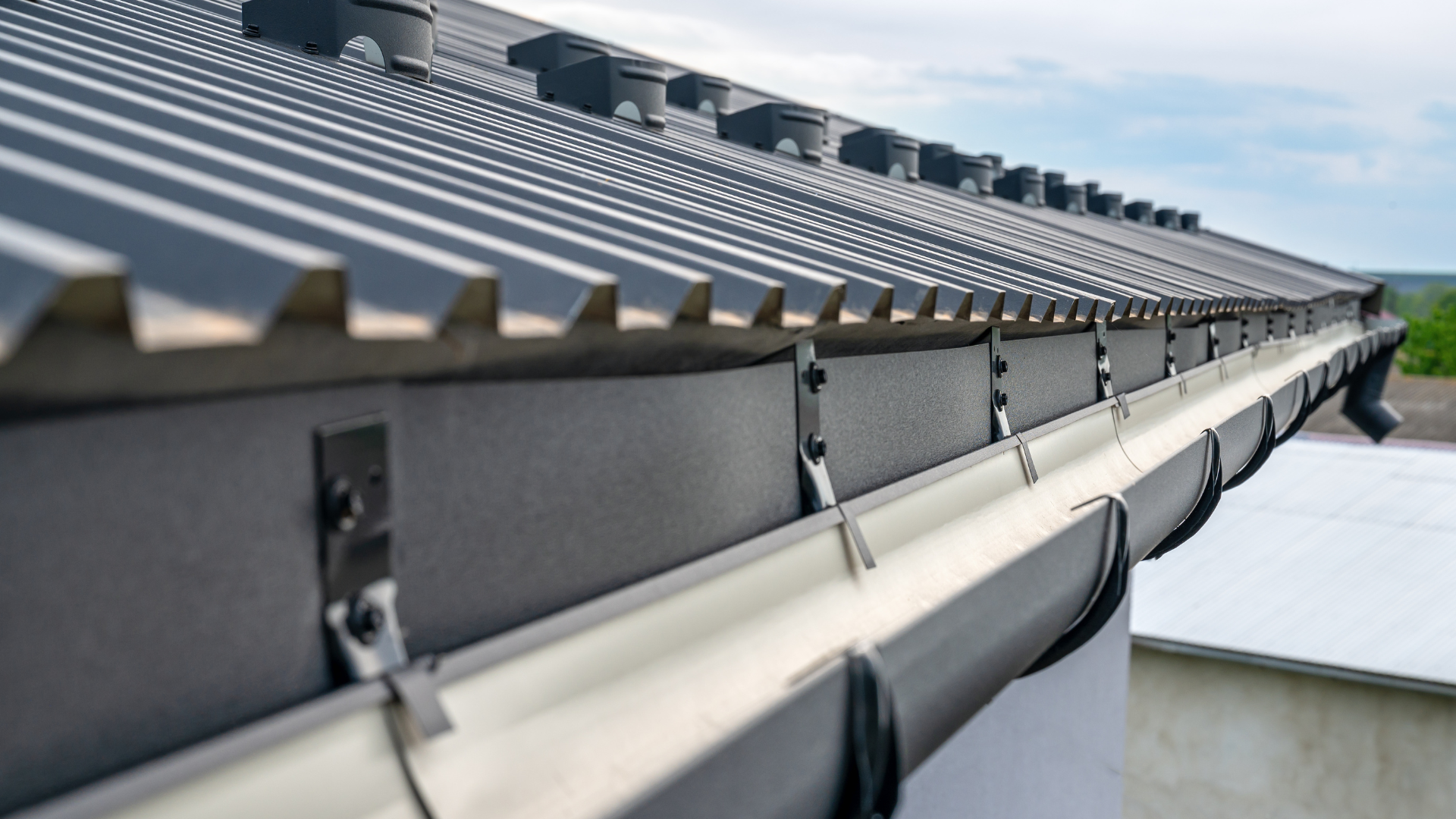
The main metal roofing advantages are a long service life, a finish that can reflect heat, good fire performance, light weight, low upkeep, easy solar mounting and a material that is recycled at the end of its life. The trade-offs are a higher installed price than asphalt shingles, the need for skilled detailing, and a few metal-specific issues such as salt air, dents and waviness in flat panels. This quick guide maps each feature to what it does for you and what to check. Questions: call NEMA Roofing at 866-631-3366.
Metal roofing features and advantages at a glance
| Feature | Advantage | What to check |
|---|---|---|
| Metal panel under a factory finish | Long life: the Metal Roofing Alliance puts it at 30 to 50-plus years; the NAHB study puts asphalt shingles at about 20 | Coating and paint system; finish and panel warranties |
| Reflective or cool-colored paint | Less heat into the attic in summer | The color’s rated values in the Cool Roof Rating Council directory |
| Noncombustible surface | Good fire performance; metal on a noncombustible deck counts as Class A under California’s wildland-urban interface rules | On a wood deck, the listed Class A assembly (panel plus underlayment) |
| Light weight | Less load on the framing than tile; can be allowed over one existing layer | Recover rules and the condition of the old roof |
| Concealed clips (standing seam) | Few holes through the roof; handles heat expansion | Clip type and spacing from the manufacturer |
| Raised seams | Solar racks clamp to the seams without drilling | Clamp compatibility with your panel profile |
| Recyclable metal | Old panels and trim go to metal recycling, not the landfill | Ask where tear-off metal goes |
How long does the advantage last?
Longer than most people expect, because the metal usually outlives its paint. Federal roofing criteria (UFC 3-110-03) expect aluminum-zinc coated steel to outlive its paint, and the Metal Roofing Alliance points out that an aging metal roof can often be refinished instead of torn off. Details by metal are in how long a metal roof lasts.
Is a metal roof really cooler?
It can be, if the finish is chosen for it. A cool roof needs high solar reflectance and high thermal emittance, and Lawrence Berkeley National Laboratory’s Heat Island Group notes that cool-colored pigments let darker colors reflect much of the sun’s invisible near-infrared light. In much of inland California, a steep-slope reroof over half the roof must meet rated cool-roof values anyway. Climate by climate, see how metal roofs perform in each climate zone.
Does metal help in wildfire areas?
Metal does not burn, and California’s wildland-urban interface code lists metal sheets and shingles on noncombustible decks among the roof assemblies treated as Class A. Most homes have a wood deck, so there the whole assembly needs a Class A listing, which the manufacturer states for specific underlayments. Class A is the requirement in Very High Fire Hazard Severity Zones, so this is worth confirming in hillside and canyon neighborhoods.
What are the disadvantages of metal roofing?
- Higher upfront cost. Metal usually costs more to install than asphalt shingles; the case for it rests on the longer life.
- Skilled installation. Clips, fixed points, flashing and trim have to allow for the metal’s movement; poor detailing causes leaks and noise.
- Waviness (oil-canning). Flat pans can look wavy in strong light. The Defense Department criteria note that striations or pencil ribs and heavier gauges reduce it.
- Dents. Thinner panels and softer metals can dent from falling branches or foot traffic.
- Salt air. Coated steel ages faster in direct salt spray; aluminum can be the better pick close to the ocean, though it costs more.
- Exposed screws. Ribbed and corrugated panels are fastened through the face, and the washers need checking over the years.
- Color matching. A repair years later may not match a weathered finish exactly, so keep the product and color name.
Noise is often listed as a drawback, but the Metal Roofing Alliance notes there is little difference between metal and other materials in noise from rain or hail.
Which type of metal roof gives which advantages?
- Standing seam: concealed fasteners, lowest allowed slope (1/4 in 12 under California’s building code), cleanest look, best for solar clamps. See standing seam options.
- Ribbed or corrugated panels: lower cost, span purlins on barns and sheds, fasteners exposed. See corrugated metal for shops and barns.
- Metal shingles and tiles: the look of shingle, shake or tile with metal’s weight and fire performance; they need a slope of at least 3 in 12.
Who installs metal roofs near you?
NEMA Roofing has five locations, in Santa Barbara, Oxnard, Woodland Hills, Tarzana and Downey, and installs metal roofing on homes and commercial buildings in every part of Santa Barbara, Ventura, Los Angeles, Riverside and San Bernardino counties; find your area on our service areas page. Start with our metal roofing service, and for a written estimate call 866-631-3366.




