
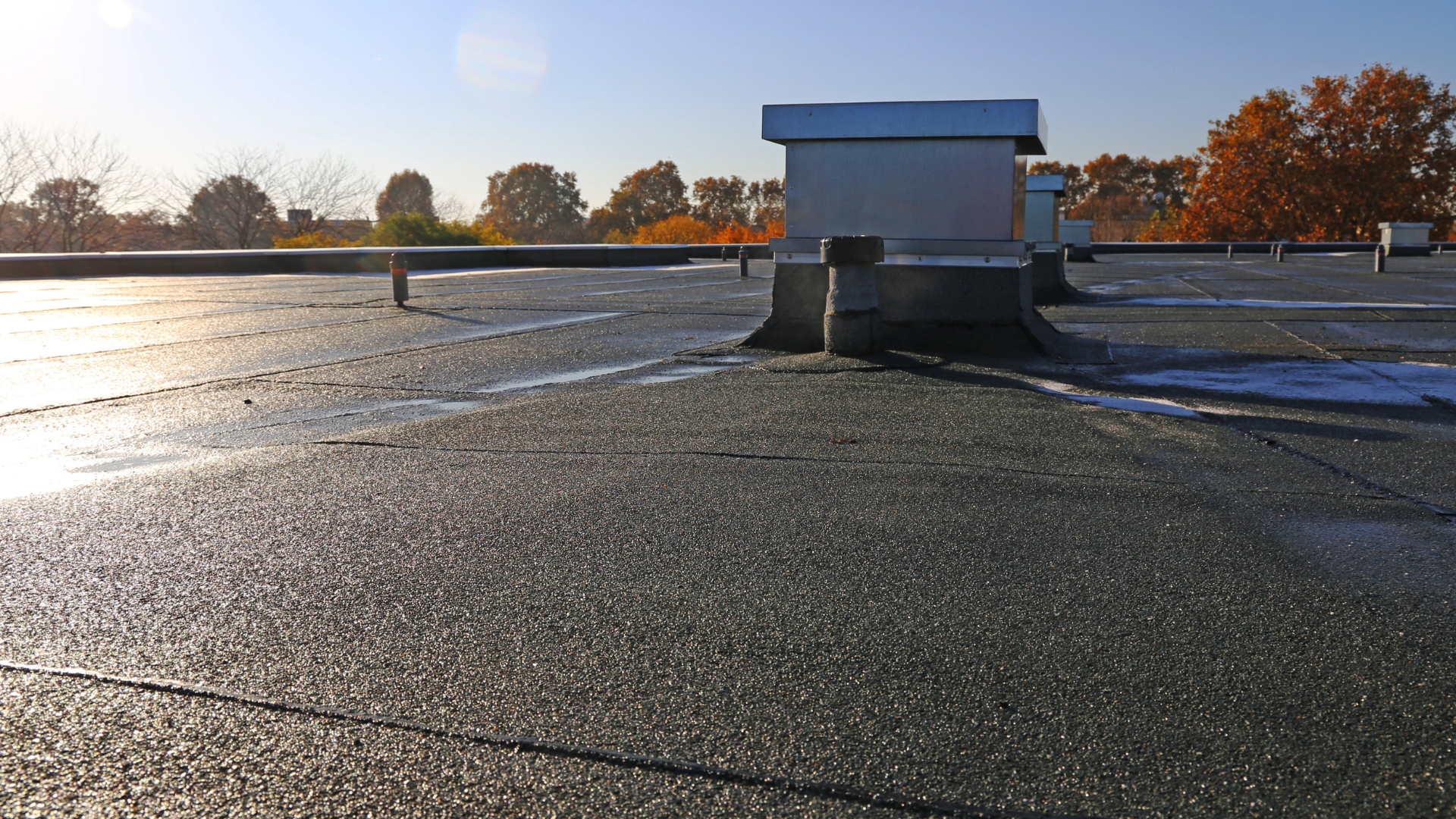
Flat roofing solutions for homes and businesses draw on the same membrane systems (TPO, PVC, EPDM, modified bitumen, built-up roofing and coated spray foam), but each building type asks different things of them. A business needs a roof that covers a large area economically, carries equipment and service traffic, and meets commercial energy rules. A home needs careful detailing at parapets, roof decks and small drains, and a surface that suits the house. A flat roof is the right choice when the building’s design calls for one, and it rewards regular upkeep more than a pitched roof. For advice on your building, call NEMA Roofing at 866-631-3366.
Why do so many commercial buildings have flat roofs?
- Large footprints. A pitched roof over a wide store or warehouse would need tall framing and far more roof area. A low-slope roof covers the same floor with a flat plane and a small drainage slope.
- A place for equipment. Air conditioning units, exhaust fans and solar arrays sit on the roof instead of taking up ground space, and technicians can reach them safely.
- Easy to inspect and service. Every part of the roof can be walked and checked, which makes planned maintenance practical.
- Energy rules built around it. California’s energy code treats low-slope commercial roofs as a category of their own, with reflectance and insulation minimums whenever a large share of the roof is replaced.
When does a flat roof make sense for a home?
For houses, a flat or low-slope roof is mostly a design choice. It fits modern and mid-century homes with clean horizontal lines, additions, porches and garages tucked behind a parapet, and homes where the owner wants a roof deck or room for solar panels out of sight from the street. It is less suited to a house where the owner wants the lowest-maintenance roof possible and has no reason for the flat profile, since a flat roof asks for regular drain clearing and seam and flashing checks. The details that cause most trouble on houses, such as parapet walls, scuppers and doors onto roof decks, are covered in our article on common flat roof problems.
What are the trade-offs of a flat roof?
| Advantage | The trade-off that comes with it |
|---|---|
| Usable space for decks, equipment and solar | Every use adds load and penetrations, and the membrane under it needs protection |
| Easy, safe access for service | Foot traffic punctures and scuffs membranes unless walkway pads mark the routes |
| Less roof area and simpler framing | Water drains slowly: the building code’s minimum design slope for membrane roofs is 1/4 inch per foot (2 percent), so drains must stay clear |
| Clean, modern look | Parapet walls and their caps become part of the roof to maintain |
| Reflective membranes are widely available | A dark surface cannot meet California’s cool-roof values on a replacement, which narrows color choices |
Which flat roof system suits which building?
| Building or roof area | What it needs | Systems often chosen |
|---|---|---|
| Small house roof, porch or garage | Neat edges, few seams, a light surface | White TPO or PVC, or a modified bitumen cap sheet with reflective granules |
| Roof deck over living space | A fully waterproof layer that can be protected by pavers or decking and inspected | A fully adhered membrane with the walking surface raised above it |
| Office or retail with HVAC units | Durable seams, walkway protection, flashing at many curbs | TPO or PVC single-ply |
| Restaurant | Resistance to grease and oils from kitchen exhaust | PVC |
| Large warehouse or industrial roof | Covering a big area efficiently on a metal deck | Mechanically attached single-ply |
| Older roof that needs more insulation | Adding insulation without a full tear-off, where the code allows a recover | Spray foam with coating, or new insulation boards and a membrane over the old roof |
The layer-by-layer makeup of each system is explained in our guide to flat roofing systems, and the energy side in energy efficient flat roof options.
How is a flat roof project different for a business than for a home?
For a business, the roof work has to fit around the building’s operations: planning when noisy tear-off happens, protecting the interior and stock below open areas, coordinating with HVAC contractors when units must be lifted, and keeping tenants informed. Commercial owners also tend to ask for a manufacturer’s system warranty, which manufacturers typically issue only on roofs installed by contractors they have approved.
For a home, the concerns are closer to the family: where materials and the dumpster go, how the landscaping and walls are protected, how a roof deck or solar array is handled, and whether the chosen color fits the house and the energy code.
In both cases, check the contractor’s license. NEMA Roofing is a licensed roofing (C-39) and general building (B) contractor, CSLB license #1083283, and a Polyglass Preferred Contractor, GAF Master Elite contractor and Owens Corning Preferred Contractor. With five locations (Santa Barbara, Oxnard, Woodland Hills, Tarzana and Downey), we serve homes and businesses in all of Santa Barbara, Ventura, Los Angeles, Riverside and San Bernardino counties; see where we work. Read more about our flat roofing service and commercial roofing, or call 866-631-3366 to discuss your building.




