
Flat roof installation follows a set process: permit, tear-off to the deck, deck repair, insulation and tapered slope to the drains, a cover board where the system calls for one, the membrane (TPO, PVC, modified bitumen or built-up), flashing at every wall, curb and drain, then a final inspection. What to expect as a homeowner or building owner is noise and limited access while the crew works, decisions on material and color up front, and a roof that has to meet California’s slope, drainage and cool-roof rules. For a flat roof installation estimate, call NEMA Roofing at 866-631-3366.
What happens during a flat roof installation, step by step?
- Permit and plan. The contractor pulls the permit from the city or county and confirms the membrane, insulation, drainage changes and any cool-roof rating the job needs.
- Protection and access. Rooftop equipment is disconnected or lifted where needed, and the area below the work is protected.
- Tear-off. The old roofing and wet insulation come off down to the deck, one section at a time so the building is never left open to weather overnight.
- Deck repair. Rotted or damaged deck is replaced so the new system has a sound base.
- Slope and insulation. Tapered insulation or crickets build the fall toward drains and scuppers. The California Building Code requires a design slope of at least 1/4 unit in 12 for single-ply, modified bitumen, built-up, spray foam and liquid-applied roofs.
- Cover board. Many systems add a rigid board over the insulation for a firm, even surface.
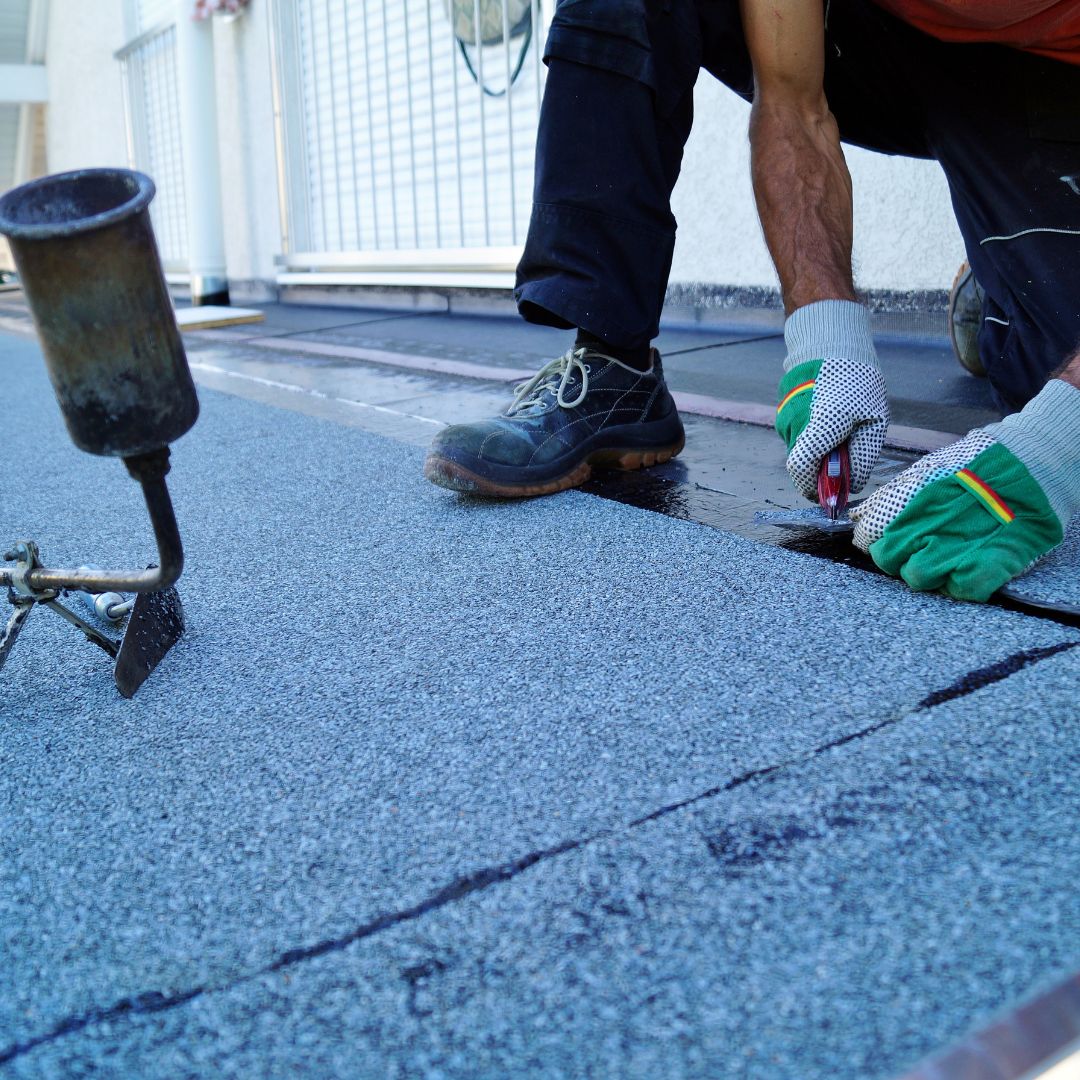
- Membrane. The roofing goes down by the system’s method: mechanically fastened, fully adhered, heat-welded seams for TPO and PVC, torched or cold-applied plies for modified bitumen, or multiple plies for built-up roofing.
- Flashing and edges. Walls, parapets, curbs, pipes, skylights and roof edges are flashed with membrane and metal; this is where most of the skilled work sits.
- Drains and overflow. Drains are clamped into the membrane, and secondary overflow drains or scuppers are provided where parapets would otherwise trap water.
- Inspection and closeout. Seams are probed, the site is cleaned, the building department signs off the permit, and warranty paperwork is registered.
New flat roof construction on an addition or patio cover follows the same sequence without the tear-off, starting from the new deck.
Which flat roof materials are installed most, and how do they differ?
| System | How it is installed | What to know |
|---|---|---|
| TPO | Single ply, seams heat-welded; fastened or adhered | White and reflective; the DoD roofing criteria call for at least 72 mils on its own buildings |
| PVC | Single ply, seams heat-welded | Suited to roofs with grease or chemical exposure |
| Modified bitumen | Two or more plies, torched, cold-applied or self-adhered | Tough multi-ply surface; torch work needs fire precautions |
| Built-up roofing | Several plies of felt and bitumen, often with gravel | Heavy; gravel protects the membrane and keeps it cooler |
For a fuller comparison, read flat roofing systems: everything you need to know and how long each flat roof material lasts.
Does a new flat roof have to be a cool roof?
Often, yes. Under the 2025 California Energy Code (in force since January 1, 2026), a home’s low-slope reroof that replaces more than half of the roof in climate zones 4 and 6 through 15 must meet an aged solar reflectance of at least 0.63 and a thermal emittance of at least 0.75, or an equivalent solar reflectance index, unless an insulation trade-off is used. That covers coastal Santa Barbara and Ventura (zone 6) as well as the inland valleys (zone 9). For commercial buildings, the low-slope reroof rule applies in every climate zone. In practice most new flat roofs here are white or light membranes, or carry a rated reflective surface.
How should you prepare for the installation?
- Clear the driveway or loading area for the dumpster and material delivery.
- Move vehicles, outdoor furniture and anything fragile near the building edge.
- Plan for noise and vibration during tear-off; take down wall hangings on the floor below.
- Arrange rooftop equipment service (HVAC, solar) with the roofer’s schedule.
- For businesses, agree on work hours and which entrances stay open.
What should you check when it is done?
- The permit shows a passed final inspection.
- Water runs to the drains after the first rain or a hose test, with no standing water left behind.
- Flashing at walls and curbs is new and terminated with metal, not just sealant.
- Walk pads protect paths to equipment.
- You have the product names, the warranty registration and any cool-roof rating label.
With five locations, in Santa Barbara, Oxnard, Tarzana, Woodland Hills and Downey, NEMA Roofing installs flat roofs across Santa Barbara, Ventura, Los Angeles, Riverside and San Bernardino counties. Our flat roofing service covers installation, repair and replacement, and how to repair a flat roof without replacing it helps if a new roof may not be needed yet. To plan a flat roof installation, call NEMA Roofing at 866-631-3366.




