
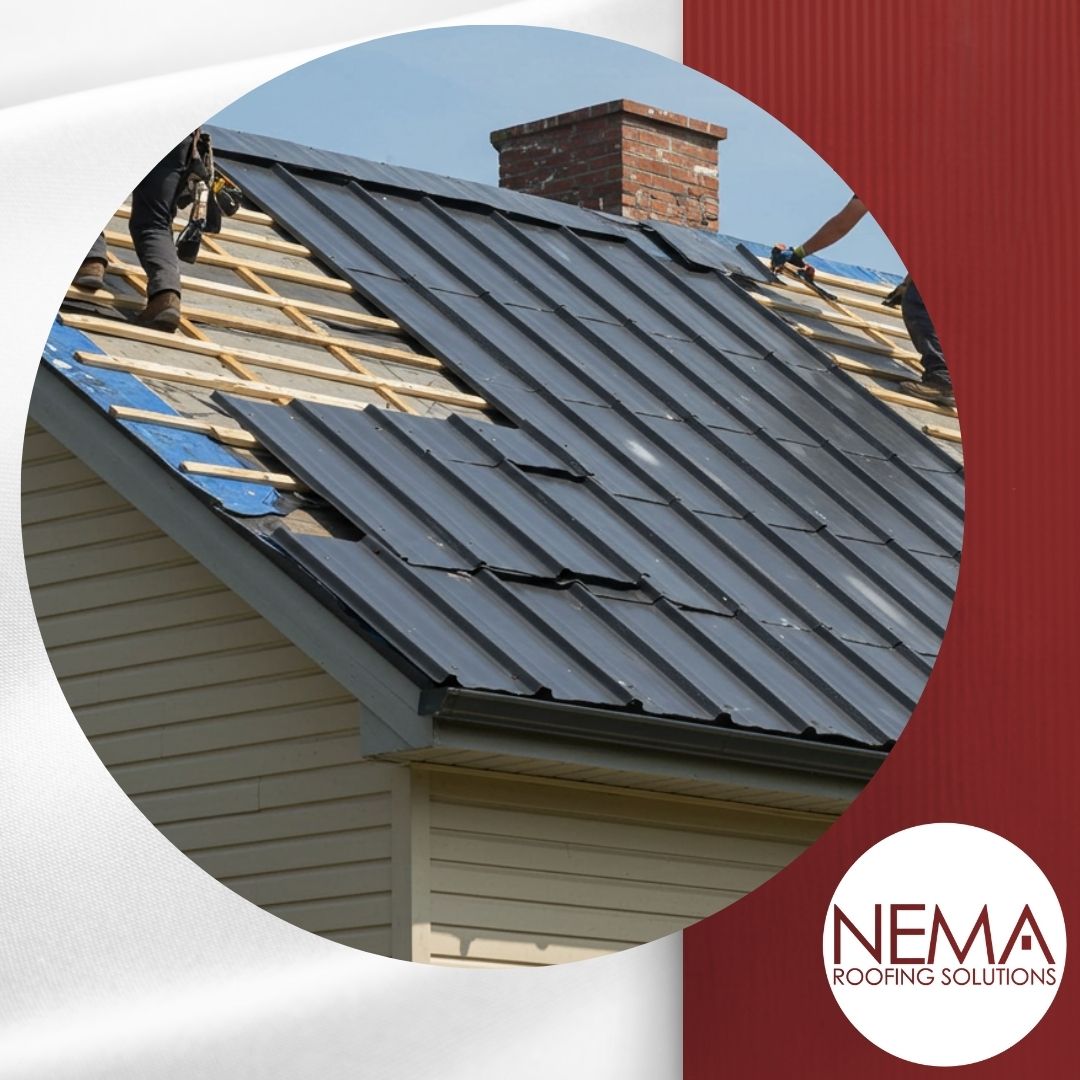
The roof replacement upgrades worth making are the ones hidden under the new covering: balanced attic ventilation, better underlayment with self-adhered membrane at eaves and valleys, new flashing and edge metal, deck repair, attic insulation or a radiant barrier, and preparation for solar or skylights. Each costs least while the old roof is off and becomes a separate project once the new roof is on. To plan upgrades into your replacement estimate, call NEMA Roofing at 866-631-3366.
Which upgrades only make sense during a replacement?
| Upgrade | Why do it now | What to ask for |
|---|---|---|
| Attic ventilation | Intake at the eaves and exhaust at the ridge are cut and fitted as the roof goes on; adding a ridge vent later means reopening the ridge | Intake and exhaust both listed, sized to the attic, following the shingle maker’s requirements |
| Underlayment | It can only be changed with the covering off | A named synthetic underlayment, and self-adhered membrane at eaves, valleys and around penetrations |
| Flashing and edge metal | Reusing old flashing under a new roof leaves the weakest part in place; state code requires rusted, damaged or deteriorated flashing and vents to be replaced | New wall, chimney, valley and pipe flashing, and new drip edge |
| Deck | Soft or delaminated sheathing is only reachable during tear-off | A unit price per sheet, and re-nailing of loose boards |
| Skylights | Replacing or removing a skylight means cutting into the roof, so doing it now avoids opening the new roof later | Replace or remove old units, with the manufacturer’s flashing kit |
| Solar preparation | Mount locations and conduit routes are easiest to plan before the covering goes down | Planned mount areas, and flashing details for the racking you expect to use |
Can insulation or a radiant barrier widen your color choices?
Often, yes. When more than half of a home’s steep-slope roof is replaced in California climate zones 4 and 8 through 15, the 2025 state energy code calls for a cool roof product, meaning 0.20 or more for aged solar reflectance plus 0.75 or more for thermal emittance, or an SRI no lower than 16. The code treats any one of these as equivalent, which frees you to choose a color without that rating:
- At least R-38 ceiling insulation (or a ceiling assembly with a U-factor of 0.025 or lower).
- A radiant barrier in the attic, as long as it is not installed directly above spaced sheathing.
- In climate zones 2, 4, 9, 10, 12 and 14, no ducts in the attic.
- At least R-2 continuous insulation above or below the roof deck.
Adding attic insulation or a radiant barrier during the replacement can therefore do two jobs: a cooler attic, and more freedom on color. Ask your contractor to confirm which option fits your house and how it will be documented for the permit. Rooftop solar does not change this on its own: only building-integrated solar panels are exempt, not the roof under ordinary rack-mounted panels.
Which fire-safety upgrades fit into a new roof?
A replacement is the moment to make the whole roof assembly Class A, since the rating depends on the covering, underlayment and deck working together. The California Department of Insurance’s Safer from Wildfires program lists a Class A fire-rated roof among its home-hardening steps, and says every action under the program qualifies for an insurance discount. Two related items from the same list are easy to add while crews are at the roofline:
- Vent screens that stop embers: the program describes screening exterior vents with metal mesh between 1/16 and 1/8 inch that will not burn or corrode.
- Enclosed eaves: soffits under the eaves so heat and embers cannot get trapped there.
What if you want a different roofing material?
Changing the covering is the biggest upgrade and the one with the most checks. State code requires the structure to carry the new roof covering’s weight, so going from shingles to tile needs a look at the framing, while metal panels are much lighter than tile. The new material also has to meet the cool roof and fire rules that apply at your address, and a different profile can change the flashing and trim details. Undamaged clay or cement tile may be reinstalled over new underlayment, which keeps the look while upgrading everything underneath.
How do you fit upgrades into the estimate?
- Ask the contractor to separate what code requires (permit, flashing replacement, cool roof or an equivalent, Class A where it applies) from what is optional.
- Have each optional upgrade priced as its own line or alternate, so you can add or drop it without a new estimate.
- Choose the upgrades that are hard to add later first (ventilation, underlayment, deck, flashing), and the ones that can wait (gutters, some vents) last.
For the stages of the job itself, see what a roof replacement includes. If you are still deciding whether the roof needs replacing at all, read the signs for a partial or full roof replacement, and if cost is the question, compare roof replacement financing options.
Plan your replacement with NEMA Roofing
NEMA Roofing covers all of Los Angeles, Ventura, Santa Barbara, Riverside and San Bernardino counties from five Google-verified locations in Tarzana, Woodland Hills, Downey, Oxnard and Santa Barbara, including every community in San Bernardino County (see all areas). Our roof replacement service page describes the full job. To get an estimate with each upgrade priced separately, call NEMA Roofing at 866-631-3366.




