
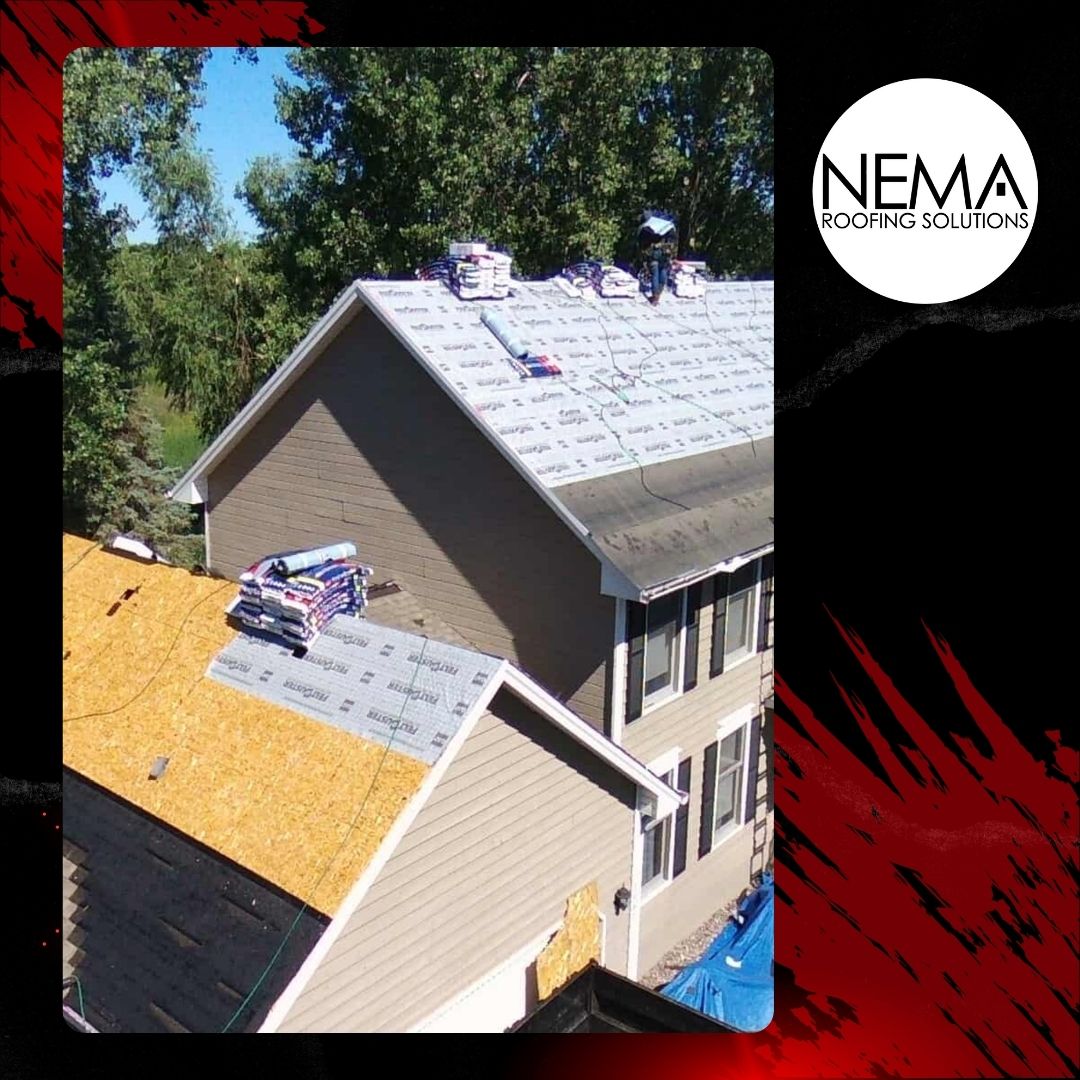
What does a roof replacement include? A full replacement removes the old roofing down to the wood deck, repairs any rotten sheathing, and rebuilds every layer that keeps water out: underlayment, metal drip edge and flashing, vents, the new roof covering and its ridge, followed by cleanup, haul-away and the building department’s final inspection. If a quote skips one of those layers, it is not a full replacement. To go over the scope for your roof, call NEMA Roofing at 866-631-3366.
What happens at each stage of a full roof replacement?
Each layer has one job. Seeing them side by side makes it easier to spot what a quote leaves out.
| Stage | What the crew does | What it protects against |
|---|---|---|
| Permit | Pulls the reroof permit from the city or county building department before work starts | A roof that fails a later sale inspection or insurance review because it was never signed off |
| Tear-off | Strips shingles, tile or membrane and the old underlayment to bare deck | Hidden rot staying buried under the new roof |
| Deck repair | Replaces soft, delaminated or water-stained sheathing | Nails that will not hold and a roof surface that dips |
| Underlayment | Lays the labeled underlayment the covering’s manufacturer and the code call for | Wind-driven rain that gets past the outer covering |
| Drip edge and flashing | Installs metal at eaves and rakes, and new flashing at walls, valleys, chimneys, skylights and pipes | Leaks at edges, walls and the joints around chimneys and pipes |
| Ventilation | Checks intake and exhaust vents and replaces worn roof vents | Attic heat and trapped moisture that shorten the life of the new roof |
| Roof covering | Installs the new shingles, tile, metal or flat system, then hips and ridge | Sun, rain and fire exposure |
| Cleanup and final | Hauls away debris, sweeps for nails, and schedules the final inspection | Punctured tires, loose debris in gutters and an open permit |
Why does a replacement start with a tear-off?
The 2025 California Residential Code draws the line. Section R908.3 defines roof replacement as removing the existing layers of roof covering down to the roof deck. Laying new roofing over old is a “recover”, a different job with limits: section R908.4 does not allow it when the existing roof is water soaked or too deteriorated to serve as a base, when the existing covering is slate, clay or cement tile, or when the roof already carries two or more layers.
The practical reason matters as much as the rule. Until the old layers are off, nobody can see the deck. Soft spots around a chimney, a valley that has leaked for years, or sheathing that has separated along the eaves only show up after tear-off, and that is when they can be fixed for good.
What gets replaced, and what can be reused?
- Underlayment and roof covering: always new on shingle, metal and flat roofs.
- Clay or concrete tile: the code (R908.5) lets sound tile be reinstalled on new underlayment; cracked or broken tile may not go back on.
- Flashing, vents and edge metal: any piece that is rusted, damaged or deteriorated must be replaced (also R908.5). On most roofs it is simpler and tighter to replace it all.
- Gravel surfacing on an old tar-and-gravel roof cannot be reinstalled.
- Drip edge is required at the eaves and rakes of a shingle roof (R905.2.8.5), so a shingle roof without it gets it during a replacement.
What is often left out of a roof replacement quote?
These items are real parts of many jobs but are priced separately, or not at all, on some quotes. Ask about each one before you sign:
- How damaged deck is priced (per sheet or per square foot) once the old roof is off.
- Rotted fascia boards or rafter tails at the eaves.
- Skylights: reflashed in place or replaced with new units.
- Gutters removed and reset, or replaced.
- Solar panels removed and reinstalled, and who handles the electrical side.
- A cricket (a small diverting ridge) behind a chimney; the code calls for one on the uphill side of any chimney or penetration wider than 30 inches.
- Attic insulation or a radiant barrier, which can change which cool-roof values the new roof must meet.
For how these items move the total, see what goes into the cost of a roof replacement.
Which California rules add to the scope?
- Fire rating. In fire hazard severity zones covered by the California Wildland-Urban Interface Code (in force since January 1, 2026), a roof that is replaced, or has 50 percent or more replaced within 12 months, must get a Class A covering. Outside those zones the state still sets a minimum fire class under Health and Safety Code 13132.7, and local rules can be stricter.
- Cool roof. Replacing more than half of a roof triggers the Title 24 energy code’s cool-roof values in many climate zones. The required reflectance depends on the zone and on whether the roof is steep or low-sloped, and some attic setups qualify for an exception.
- Permit. Reroofing needs a building permit in every jurisdiction we have checked across our area, from Oxnard and Camarillo to the City of Los Angeles and unincorporated Riverside County; small repairs are exempt in some of them, and the size limit differs. Our guide to roof replacement permits covers how that works.
How do you check that a quote covers a full replacement?
- It says “tear-off to the deck”, not “install over existing”, unless you chose a recover and the roof qualifies for one.
- It names the underlayment, the roof covering (brand and product line) and the fire class.
- It lists new drip edge, flashing and vents rather than “as needed”.
- It gives a unit price for deck repair.
- It includes the permit, debris disposal and the final inspection.
- It shows the contractor’s CSLB license number. California law requires a home improvement contract to describe the work and the significant materials, so vague wording is a reason to ask for a revision.
Not sure whether the whole roof needs to go? Read partial repair versus a full roof replacement, or book a roof inspection first.
How NEMA Roofing handles a replacement
Every roof replacement we do follows the stages above, on shingle, tile, metal and flat roofs. NEMA Roofing Solutions holds CSLB license #1083283 as a licensed roofing (C-39) and general building (B) contractor. With five locations (Oxnard, Tarzana, Downey, Santa Barbara and Woodland Hills), we replace roofs in every town of the five counties we serve: Ventura, Santa Barbara, Los Angeles, San Bernardino and Riverside. See the areas we serve. For a written, itemized scope for your roof, call 866-631-3366.




