
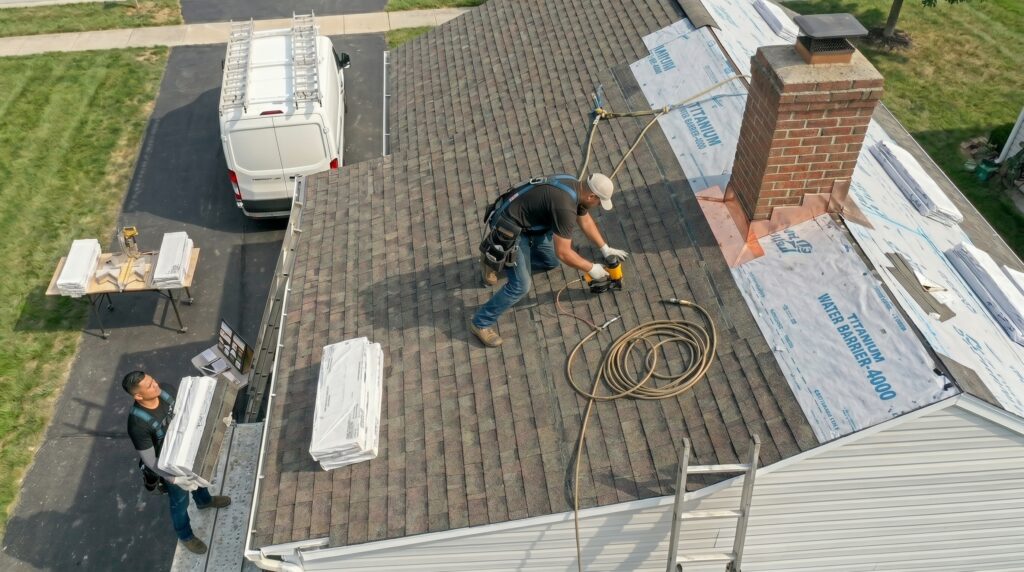
Commercial vs residential roof repair differs in five ways: the roof system (steep shingle, tile or metal on most homes, low-slope membranes on most commercial buildings), where leaks start, how the work is scheduled around the people inside, what the warranty requires, and which code rules apply if a repair grows into a reroof. A good roofer handles both, but the inspection, the repair methods and the paperwork are not the same. For either kind of property, call NEMA Roofing at 866-631-3366.
Different roofs, different failures
| Most homes | Most commercial buildings | |
|---|---|---|
| Roof shape | Steep slopes that shed water fast | Low-slope or flat, draining to drains, scuppers or gutters |
| Coverings | Asphalt shingles, clay or concrete tile, metal panels | Single-ply membranes (TPO, PVC, EPDM), modified bitumen, built-up roofs, coatings, some metal |
| Where leaks start | Flashing at walls and chimneys, pipe boots, valleys, missing shingles or cracked tiles | Seams, clogged drains and ponding, flashing at parapets and curbs, rooftop equipment and the holes cut for it |
| Typical repair | Replace shingles or tiles over new underlayment, new flashing, new boots | Membrane patch welded or adhered over clean, sound material, seam repair, drain and flashing rebuild |
| Hidden damage | Wet roof boards and insulation in the attic | Wet insulation board under the membrane, which can spread far from the leak |
Plenty of homes have flat sections (porch roofs, additions, modern designs), and some commercial buildings have tile or shingle roofs. The repair follows the roof type, not the building’s use. For flat roofs in detail, see flat roofing.
Finding the leak on each
On a sloped home roof, water that gets in usually runs downhill along the underlayment or a rafter before it drips, so the search starts in the attic and follows the trail uphill. On a flat commercial roof there is often no attic, and water can travel sideways through the insulation between the deck and the membrane, so the ceiling drip may be well away from the hole. Commercial leak searches rely on a careful walk of every seam, drain and penetration near the suspected area, and, where needed, cutting small test openings to find where the insulation turns wet.
How the entry point is traced on a pitched roof is covered in roof leak detection.
Access, safety and scheduling
- Homes: access is usually by ladder; tile roofs need careful foot placement to avoid cracking more tiles; the family may need to move cars or clear a side yard.
- Commercial buildings: access is often through a roof hatch or by lift; rooftop units, skylights and edges set the safety plan; work may be timed around business hours, deliveries and tenants, and odors or noise from some membrane work may need to be planned around air intakes and occupied spaces.
- Both: an active leak is protected first (a tarp on a slope, a temporary patch on a membrane) and the permanent repair follows in dry weather.
Warranties change who should do the repair
Many commercial roofs carry a manufacturer’s system warranty, and that warranty has rules. The U.S. Department of Defense’s roofing criteria (UFC 3-110-03) note that manufacturers list requirements for keeping a watertightness warranty intact, such as regular inspections, that the roof must be installed to the manufacturer’s requirements, which often specify the installers, and that cutting into a roof under warranty must follow the warranty’s requirements so it is not voided. Before anyone repairs a warrantied commercial roof or adds a penetration for new equipment, find the warranty and check who is allowed to do the work.
Home roofs can carry manufacturer warranties too, usually on the shingles or tile themselves, and a manufacturer-certified contractor is the safe choice for a repair on a newer roof. Ask for the warranty documents at the inspection.
When a repair grows into a reroof: the code is not the same
California’s 2025 energy code (Title 24, Part 6, in effect since January 1, 2026) sets different triggers for homes and for nonresidential buildings:
- Homes: cool-roof rules apply when more than 50 percent of the roof is replaced, in listed climate zones for steep and for low-slope roofs.
- Nonresidential low-slope roofs: the cool-roof rules reach every climate zone, and they start once the replaced, recovered or recoated area passes the smaller of two limits: half the roof, or 2,000 square feet. The altered area must then also be insulated to a set level, with exceptions.
On a large commercial roof, a “repair” of a few thousand square feet can therefore cross into reroof rules that a home repair of the same size would not. Ask the roofer to say, before the work, whether the scope crosses a code trigger.
Paperwork: who needs what
- Homeowners need a written scope naming the parts replaced, photos, and any permit your city requires.
- Property managers and owners’ associations usually also need a roof plan marking where the work was done, a report for the building file, and invoices that match the approved scope.
- Businesses with a warrantied roof need the repair recorded in a way the manufacturer accepts, and a copy for the warranty file.
- Anyone filing an insurance claim needs dated photos and a report that separates storm damage from existing wear; see roof storm damage vs wear and tear.
Home and commercial roof repair across Southern California
NEMA Roofing repairs home and commercial roofs from five Google-verified locations in Santa Barbara, Oxnard, Woodland Hills, Tarzana and Downey, covering Santa Barbara, Ventura, Los Angeles, Riverside and San Bernardino counties in full. We hold CSLB license #1083283 as a licensed roofing (C-39) and general building (B) contractor, and we are a Polyglass Preferred Contractor, an Owens Corning Preferred Contractor and a GAF Master Elite contractor. See our roof repair service, or call 866-631-3366 to book an inspection for your home or building.




