
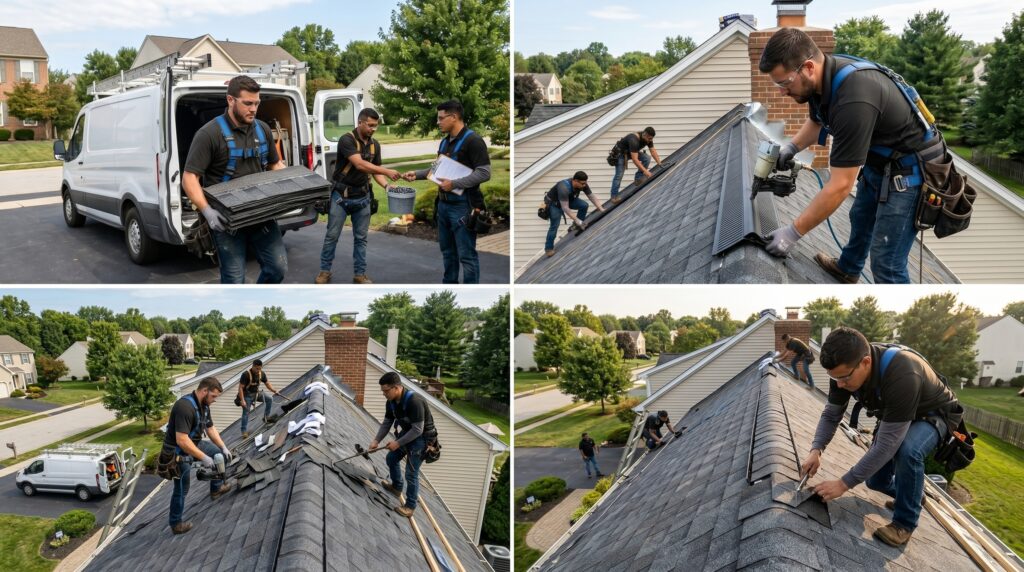
Whether to repair or replace a roof comes down to three things a professional roof contractor checks: how widespread the damage is, how much life the rest of the roof has left, and whether the fix crosses a code line that turns a repair into a full new roof. Isolated damage on a sound roof is a repair. Recurring leaks, a worn-out covering or a soft deck usually mean replacement. For an assessment of your roof, call NEMA Roofing at 866-631-3366.
When a repair is the right call
- The leak traces to one spot: a cracked pipe boot, a lifted flashing, a few missing shingles or a broken tile.
- The covering elsewhere still lies flat, holds its granules or glaze, and has no widespread cracking.
- The deck is firm when walked and dry when viewed from the attic.
- Matching material is still available (a problem with older tile, see below).
- The damaged area stays under the size your permit office treats as a minor repair.
A good repair fixes the cause, not the stain. If water came in at a chimney, the step and counter flashing get rebuilt; a bead of sealant over the old metal is a temporary patch, not a repair.
When replacement is the better investment
- Leaks keep returning in different places, a sign the covering or underlayment is failing across the roof rather than at one detail.
- The covering is near the end of its expected life. A 2007 study of home component life expectancy by the National Association of Home Builders put asphalt shingles at about 20 years and clay or concrete tile and slate at more than 50.
- The deck is soft or stained over a wide area, or the attic shows daylight or rot.
- The roof already has two layers, so the next covering cannot go on top (see the code rules below).
- Repairs would cover a large share of the roof, enough that the cost approaches a new roof or that a local rule requires the whole roof to be brought up to code.
How the answer changes by roof type
| Roof type | Often repairable | Points toward replacement |
|---|---|---|
| Asphalt shingle | Wind-torn or missing shingles, failed pipe boots, flashing at walls and chimneys | Curling, cracking or bald shingles across whole slopes; two existing layers |
| Clay or concrete tile | Cracked or slipped tiles, when replacement tiles that interlock with yours can be found | Underlayment worn out under sound tile (tiles come off, are set aside and relaid); no matching tile in production |
| Metal | Loose or backed-out fasteners, worn washers, open seams, flashing at penetrations | Rust through the panels or a failed coating over large areas |
| Flat or low-slope | Open seams, blisters, punctures, a failed drain detail | Wet insulation or deck below the membrane over a wide area; ponding that the roof’s slope cannot fix |
Tile deserves a note of its own. The Tile Roofing Industry Alliance points out that some concrete tile lines are discontinued, and a replacement tile that does not interlock and seat properly can lead to leaks and breakage; the options then are harvesting tiles from another roof plane, salvage yards, custom tiles or a full replacement. It also advises checking the underlayment and other components, since heat, moisture and UV can wear them out while the tiles look fine. See how long tile roofs last for the full picture.
Can a new roof go over the old one?
Sometimes. The reroofing rules in the 2025 California Residential Code (section R908.4) permit a recover, meaning a second covering laid over the first, if the new product’s installation instructions allow it; they also allow new coatings over existing coatings, metal panels, built-up, modified bitumen, single-ply and foam roofs without tear-off. It rules out a recover in three cases:
- the existing roof is water-soaked or too deteriorated to serve as a base;
- the existing covering is slate, clay or cement tile;
- the roof already has two or more layers of any covering.
When the roof is replaced, the code calls for tear-off down to the deck, allows sound slate or tile to be reinstalled (never cracked or broken pieces) and requires rusted or damaged flashings, vents and edgings to be replaced.
When a repair needs a permit, or triggers a whole new roof
Local rules decide where a repair ends. These are the published thresholds for several places NEMA serves:
| Place | Rule |
|---|---|
| City of Oxnard | A reroof permit is required for repairs over 40 square feet, and for any repair that goes past the covering into the underlayment or structure |
| City of Carpinteria | Weatherproof-coating patch repairs of no more than 40 square feet count as repair; deeper work needs a reroof permit |
| Santa Barbara County (county permits, including Montecito) | Roof repairs under 100 square feet within twelve months are exempt from a building permit |
| Montecito Fire Protection District | Replacing or adding roof material on more than 10 percent of the roof area requires the entire roof to be replaced with Class A material |
| Unincorporated Ventura County | The county’s exempt-work list has no exemption for reroofing or small roof repairs |
| Unincorporated Riverside County | No permit for work on less than 25 percent of the roof, up to 100 square feet, with no sheathing or roof members replaced |
Two statewide lines also matter. Replacing more than half of a roof can trigger the Title 24 cool-roof requirements, depending on the climate zone and roof slope. And in a mapped fire hazard severity zone, replacing 50 percent or more of the covering within 12 months requires a Class A roof under the California Wildland-Urban Interface Code. A contractor should tell you before work starts if your repair is close to either line.
What a professional repair-or-replace assessment includes
- A walk of the whole roof, not only the leak area, with photos of what was found.
- An attic check for stains, daylight, damp insulation and ventilation.
- A check of the deck for soft spots, and a count of existing layers.
- A look at every flashing, penetration and valley.
- A written recommendation that prices both options where both are reasonable, explains why one is better, and says whether a permit is needed.
If the damage followed a storm, read roof repair for leaks, storm damage and wear before calling your insurer.
Repairs and replacements with NEMA Roofing
NEMA Roofing handles both, as a licensed roofing contractor (CSLB license #1083283) and a GAF Master Elite contractor and Owens Corning Preferred Contractor. With five Google-verified locations in Santa Barbara, Oxnard, Woodland Hills, Tarzana and Downey, it takes repair and replacement work in every part of Santa Barbara, Ventura, Los Angeles, Riverside and San Bernardino counties; check your town on the service areas page. Learn more about the roofing contractor near me service, or call 866-631-3366 to book an assessment.




