
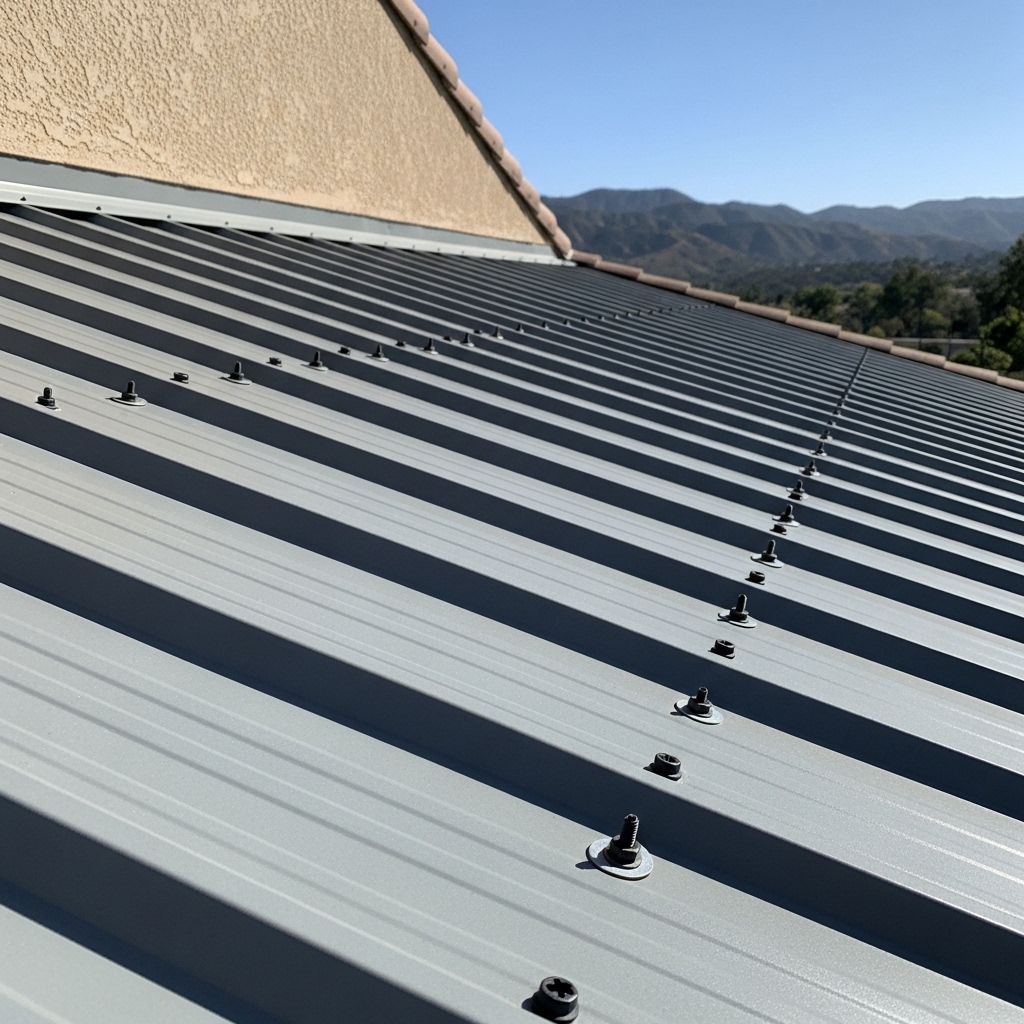
Ribbed metal roofing panels are exposed-fastener steel panels with repeating raised ribs, and on a Woodland Hills home they work well when five things are chosen with care: the rib profile, the steel’s coating and a cool-rated color, a high-temperature underlayment over a solid deck, the screws and washers, and the trim at edges and walls. Each is covered below, along with how ribbed panels compare with standing seam. Questions about your home: call NEMA Roofing at 818-528-6412.
What Defines Ribbed Panels
Ribbed panels are typically exposed fastener systems with repeating ribs that add stiffness and shed water effectively. The visible fasteners contribute to the classic aesthetic and simplify certain trim conditions. While standing seam gets attention for its hidden fasteners, ribbed panels excel for many homes because they offer a familiar texture, broad color choices, and dependable performance when installed over a solid deck with high-quality underlayment.
Profile Choices and Rib Spacing
Rib spacing, rib height, and panel width shape the look. Tighter rib spacing creates a fine, architectural texture that reads elegantly on smaller roof sections and porches. Wider spacing imparts a bold, farmhouse feel that has become popular in modern updates. Seeing sample panels on your roofline in real light helps you settle on a spacing that complements your home’s façade.
Steel, Coatings, and Color Strategy
Most residential ribbed panels are steel with protective substrates and advanced color coatings. In our hot, dry climate, finishes with infrared-reflective pigments reduce heat absorption, especially on south- and west-facing slopes. Light grays and earth tones are strong performers, while richer hues still hold their own when formulated for reflectance. Color selection should harmonize with exterior elements (stucco, stone, wood). Woodland Hills is in California climate zone 9, so a reroof covering more than half of a sloped roof needs a color with rated cool-roof values unless an exception applies; the local permit and fire-zone rules are summarized in steel metal roofing cost in Woodland Hills.
Underlayment and High Roof Temperatures
Ribbed panels need something solid underneath. Section 1507.4.1 of the 2025 California Building Code requires metal roof panels to be laid on a solid or closely fitted deck unless the panel is designed for spaced supports, which on a house means plywood or OSB sheathing, repaired or replaced wherever the tear-off shows damage. Over that deck, a high-temperature synthetic underlayment is the baseline for a Valley roof, with self-adhered membrane added in valleys, along eaves and around every penetration, the places where water collects or backs up. The solid deck also keeps the panels from drumming in wind and rain.
Fasteners: Small Parts, Big Role
Every screw in a ribbed roof passes through the weathering surface, so the fastener and its washer do the sealing. The building code (section 1507.4.4) says to use the panel maker’s specified fasteners; without that, steel roofs take galvanized fasteners, and stainless steel suits any metal roof. For the washers, the U.S. Department of Defense roofing criteria (UFC 3-110-03) call for EPDM rather than neoprene because it lasts longer in sun and heat.
Heat is the other load on those washers. The same criteria plan metal roofs for a panel temperature swing of 200°F between coldest and hottest, and 220°F for dark colors, which is why a dark ribbed roof on a south or west slope works its fasteners harder. Screws driven straight and seated snug, without crushing the washer, hold up best; plan a check of screws and washers after the first summer and then once a year.
Edges, Closures, and Wind Integrity
Ribbed panels perform beautifully when edges and penetrations are handled with precision. Eave trims with hemmed edges guide water cleanly into gutters, and ridge caps paired with closures block wind-driven rain and pests. At sidewalls and headwalls, kick-out flashings steer water away from stucco and siding. In winter storms, those details keep the assembly composed when wind pushes rain sideways across the roof.
Ventilation and Assembly Breathability
Balanced ventilation supports comfort and panel longevity. Soffit intake feeding a ridge vent allows hot air to escape naturally, reducing the load on coatings and underlayment. Some assemblies benefit from a ventilated space beneath panels to further moderate heat transfer. When the roof breathes, everything from finish to fasteners lives an easier life in Woodland Hills’ diurnal temperature swings.
Integrating Skylights, Chimneys, and Solar
Ribbed roofs accommodate accessories easily with the right flashings. Skylight curbs are wrapped with layered metal and membrane details, while pipe boots seal around vents. For solar, engineered brackets pair with flashing kits that respect the panel profile and protect fasteners from exposure. Planning attachment points and conduit routes during roofing avoids later disruptions and keeps the roof’s weatherproofing intact.
Rain Noise and Indoor Comfort
A ribbed metal roof installed over a solid deck with quality underlayment is quiet and composed. The idea that metal “pings” in the rain typically comes from open-frame installations or loose fasteners, not the material itself. Proper fastening and attic insulation keep the interior calm, even during stormy spells.
Maintenance: Simple and Predictable
Keeping a ribbed roof in top shape is straightforward: clean gutters, rinse dust and pollen periodically, and give trims and penetrations a quick visual once-over after big winds. On a schedule, verify that exposed fasteners remain seated and washers are healthy. Because panels are finished with UV-resistant coatings, color and gloss hold up well under our sun, especially when dust is rinsed away before it can abrade the surface.
When Ribbed Panels Are the Right Choice
Ribbed roofs suit a wide range of homes. They offer a grounded, familiar aesthetic on ranch and farmhouse designs and a rugged counterpoint to crisp modern additions. For accessory structures (garages, studios, covered patios), the profile can tie the property together. Where budgets and timelines favor efficient installation without sacrificing durability, ribbed panels deliver a compelling balance.
Comparing Ribbed Panels to Standing Seam
Standing seam’s concealed fasteners and tall ribs make it the minimalist’s favorite, while ribbed panels showcase texture and classic hardware. Both can excel in Woodland Hills. The deciding factors often include architectural intent, how much routine maintenance you want, and how you feel about visible fasteners. When installed by experienced crews with the right trims and closures, both profiles provide excellent weathering and heat management with reflective finishes.
Common Questions About Ribbed Panels
What roof pitch do ribbed panels need?
At least 3 in 12 for lapped panels installed without lap sealant, under section 1507.4.2 of California’s building code. With a lap sealant applied to the manufacturer’s instructions, the minimum drops to 1/2 in 12. A porch or addition flatter than that needs standing seam (allowed down to 1/4 in 12) or a low-slope roof system instead.
Can ribbed panels go over my old roof?
Sometimes, but not always. California’s code (section 1512.3) permits a recover only where the product’s instructions allow it, and rules it out when the existing roof is water-soaked or badly deteriorated, is slate or clay or cement tile, or already has two or more layers. On an older Woodland Hills house, a full tear-off also exposes the deck for the repairs the panels depend on.
What makes one ribbed-panel estimate higher than another?
Mostly the scope, not the panel. Compare the steel thickness, the coating and paint system, whether the color is a rated cool color, tear-off and deck repair (ideally priced per sheet), the amount of trim for hips, valleys, walls and skylights, and the fastener type (stainless costs more than galvanized). Two estimates that list these the same way are easy to compare; one that does not list them is hard to hold to.
If ribbed panels sound like the right blend of character and reliability for your home, let’s walk the property together. We’ll look at roof geometry, talk through color and coating performance, and map the details (fasteners, closures, flashings) that make a roof tight and handsome for years. When you’re ready to move forward with expert-installed metal roofing, schedule a visit and see how ribbed profiles can improve both style and performance on your Woodland Hills home.
Woodland Hills is one of five NEMA Roofing locations, together with Tarzana, Downey, Oxnard and Santa Barbara, and we install metal roofs in every corner of Los Angeles, Ventura, Santa Barbara, Riverside and San Bernardino counties; see roofing services in Woodland Hills and all service areas. If hidden fasteners appeal more, compare standing seam options in Woodland Hills. To schedule a visit, call 818-528-6412.




