
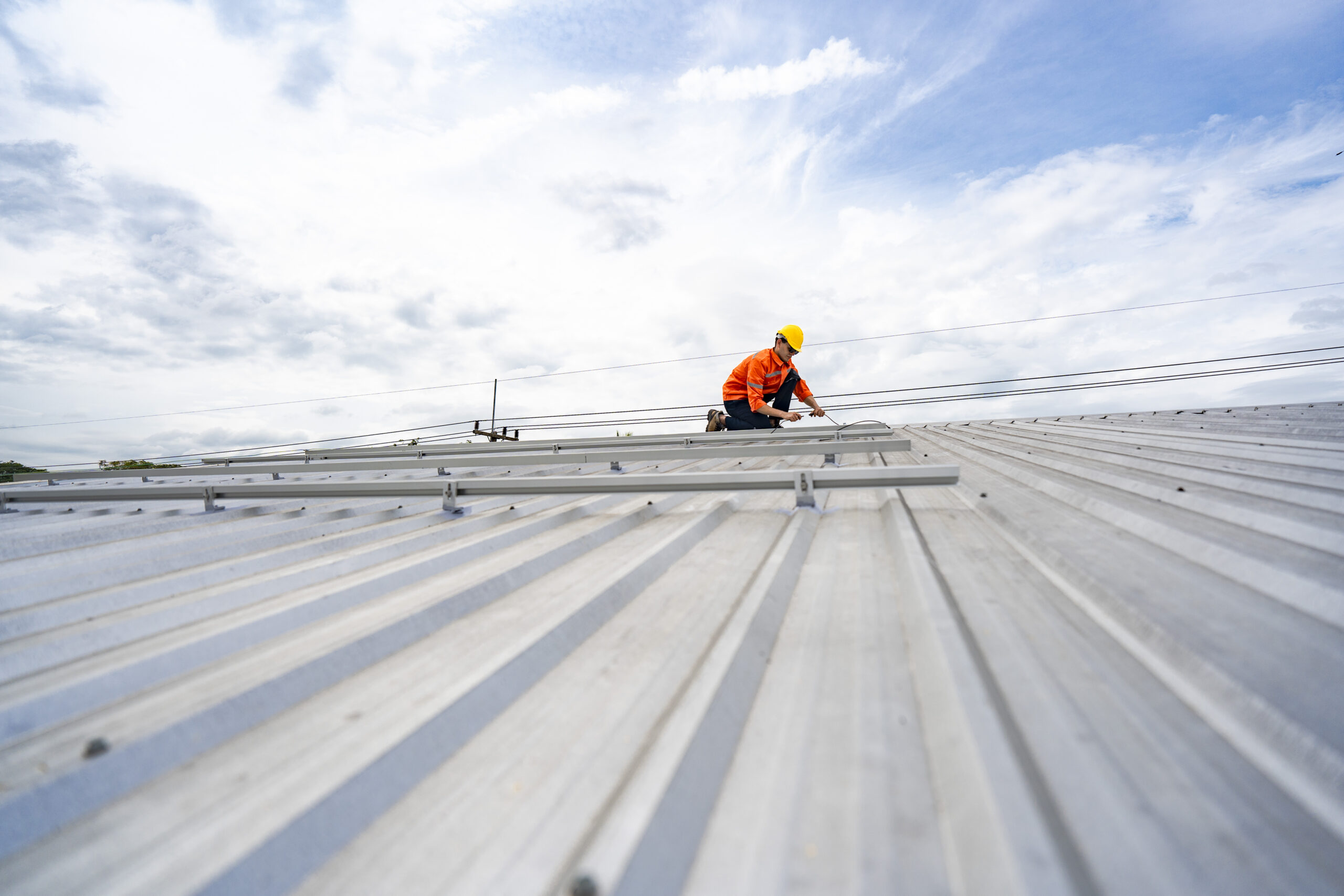
Commercial metal roofing gives property owners a long-lived roof that works on low slopes (standing seam down to a quarter inch per foot), can often go over the existing roof instead of a full tear-off, and carries rooftop equipment and solar on seam clamps without holes. Some systems also come with a single-source weathertightness warranty from the manufacturer. The trade-offs are a structural check, condensation control and California’s cool-roof rules for low-slope roofs. To plan a metal roof for your building, call NEMA Roofing at 866-631-3366.
Which metal roof systems suit commercial buildings?
| System | Minimum slope (2025 California Building Code 1507.4.2) | Typical use |
|---|---|---|
| Standing seam panels on concealed clips | 1/4 inch per foot (2 percent) | Low-slope offices, retail and multi-family roofs; roofs that will carry solar |
| Lapped, through-fastened panels with lap sealant | 1/2 inch per foot (4 percent) | Warehouses, shops and utility buildings where cost comes first |
| Lapped panels without lap sealant | 3 inches per foot (25 percent) | Steeper pitched buildings and canopies |
| Metal overbuild (new framing over a flat roof) | Set by the new framing | Converting a problem flat roof into a sloped, draining metal roof |
The code also requires metal panels to sit on a solid or closely fitted deck unless the panel is designed to span between supports. Structural standing seam panels that span purlins are common on commercial framing; architectural panels need a deck.
Can a metal roof go over the existing commercial roof?
Often, yes, and this is one of metal’s biggest advantages for an occupied building. The 2025 California Building Code (Section 1512.3) lets a complete and separate roofing system, such as standing seam metal that carries its loads directly to the structure, go on without removing the existing covering. The U.S. Department of Defense roofing criteria describe two common ways to do it:
- Retrofit over old metal. Custom sub-purlins nest over the existing panel ribs and give a level surface for a new standing seam roof, after a structural evaluation of the framing and the old panels.
- Overbuild on a flat roof. Lightweight framing creates a new slope on top of the old roof, and the metal may not need a new deck. The new attic space has to be addressed for fire hazard and ventilation, may need its own sprinkler coverage, and the old roof must keep draining during construction; wet insulation is removed first.
Because most of the old roof stays in place until the new one is closed in, tenants can usually keep working underneath; our post on commercial roofing that minimizes downtime covers scheduling around a business.
Which codes and energy rules apply?
- Fire classification. The building code sets the minimum roof class by type of construction: Class B for most types and Class C for types IIB, IIIB and VB, unless the Wildland-Urban Interface Code or a local fire district requires more. Listed metal assemblies can reach Class A where it is required.
- Cool roof on low-slope roofs. On a nonresidential low-slope roof, when more than half of the roof or more than 2,000 square feet (whichever is less) is altered, California’s 2025 energy code requires an aged solar reflectance of 0.63 and thermal emittance of 0.75, or a solar reflectance index of 75, in every climate zone, with an insulation trade-off; area under building-integrated solar is exempt. That points low-slope metal toward white or very light finishes.
- Wind. Clip spacing for standing seam comes from the panel’s uplift testing to ASTM E1592, which is why the tested panel, clip and spacing must match what is installed.
How does metal handle rooftop equipment and solar?
Every curb, pipe and conduit is a potential leak on a commercial roof. On standing seam, federal roofing criteria call for mounting equipment supports, conduit, condensate lines and similar items with non-penetrating seam clamps, and for keeping dissimilar metals apart. Solar arrays mount the same way. Those criteria also advise putting solar only on a roof with at least 10 years of service life left, which a new metal roof provides; see solar panels on a metal roof for the planning steps.
What about condensation and insulation?
Commercial buildings often hold more moisture than homes (kitchens, laundries, manufacturing, crowded spaces). Warm, moist air meeting the cold underside of metal condenses and corrodes the panels from inside. On new sloped metal roofs built over existing roofs, the federal criteria call for insulation and a continuous sealed vapor barrier directly under the panels for this reason, and they note the old roof cannot be counted on as a vapor barrier once framing is cut through it. The insulation plan and the vapor control belong in the design from the start.
What warranty can a commercial metal roof carry?
Beyond the paint and panel warranties, some standing seam systems are offered with a weathertightness warranty on the whole system. The Defense Department criteria call the no dollar limit warranty, where the manufacturer pays whatever it costs to return the roof to watertight condition, the best standard warranty in the industry, and they note that manufacturers do not warrant the contractor’s workmanship. Read our guide to the metal roof warranty before comparing bids.
How should a property owner plan the project?
- Commission a structural review of the framing for the new roof and any overbuild.
- Survey the existing roof: layers, wet insulation, drains and every penetration.
- List rooftop equipment and decide which curbs are rebuilt or relocated.
- Choose the system and slope, then confirm fire class, cool-roof values and wind design.
- Agree on a work schedule around tenants and business hours.
- Get the warranty terms and the permit plan in writing before work starts.
Commercial metal roofing from NEMA Roofing
NEMA Roofing handles commercial and metal roofing for buildings throughout Los Angeles, Ventura, Santa Barbara, Riverside and San Bernardino counties, with five Google-verified locations in Oxnard, Downey, Santa Barbara, Tarzana and Woodland Hills; start with our service areas to find yours. See our metal roofing and commercial roofing services, or call 866-631-3366 to walk the roof with us.




