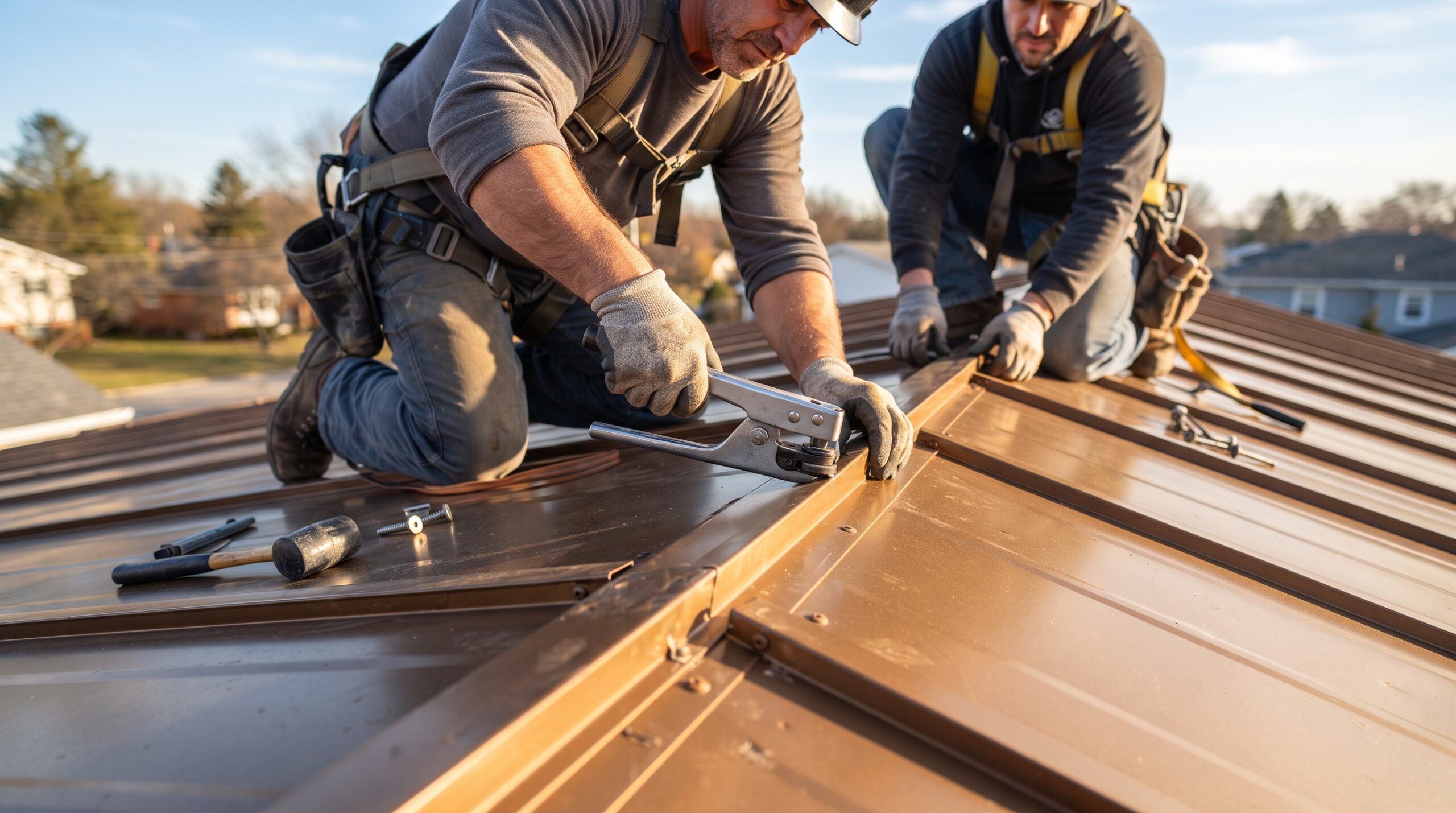
The most common metal roof problems are leaks at exposed screws and flashing, screws that back out, rust at cut edges and scratches, sealant that cracks, waviness in flat panels (oil canning), popping noises from panels that cannot move, and corrosion where another metal touches or drains onto the roof. Most trace back to installation details, and most are fixed without replacing the roof: new screws and washers, new flashing or pipe boots, spot rust treatment and the right sealant. For a metal roof repair visit, call NEMA Roofing at 866-631-3366.
What is the biggest problem with metal roofs?
On ribbed and corrugated roofs, it is the exposed fasteners. Every screw through the face of a panel is a hole sealed only by a rubber washer. Sun hardens the washer, the panel expands and contracts around the screw every day, and over the years screws loosen or washers crack and the roof starts to drip along the screw lines. The U.S. Department of Defense roofing criteria (UFC 3-110-03) reflect this: they call for keeping face fasteners to a minimum, and for EPDM rubber washers rather than neoprene where screws are used.
On standing seam roofs, which hide their fasteners under clips, the weak points move to the details: flashing at pipes, skylights, chimneys and walls, and any spot where a panel has been pinned so it cannot slide.
Metal roof problems, causes and fixes
| What you see | Likely cause | How it is fixed |
|---|---|---|
| Drips or stains in line with the screw rows | Cracked or hardened washers; screws driven too tight, too loose or at an angle | Replace with new screws and EPDM washers (often one size larger to bite fresh metal), driven to the correct compression |
| Leak at a pipe, vent, skylight or chimney | Failed pipe boot or sealant; flashing that locks the panel in place | New boot or re-flashing that lets the panel move; exposed sealant of polyurethane, hidden sealant of non-curing butyl |
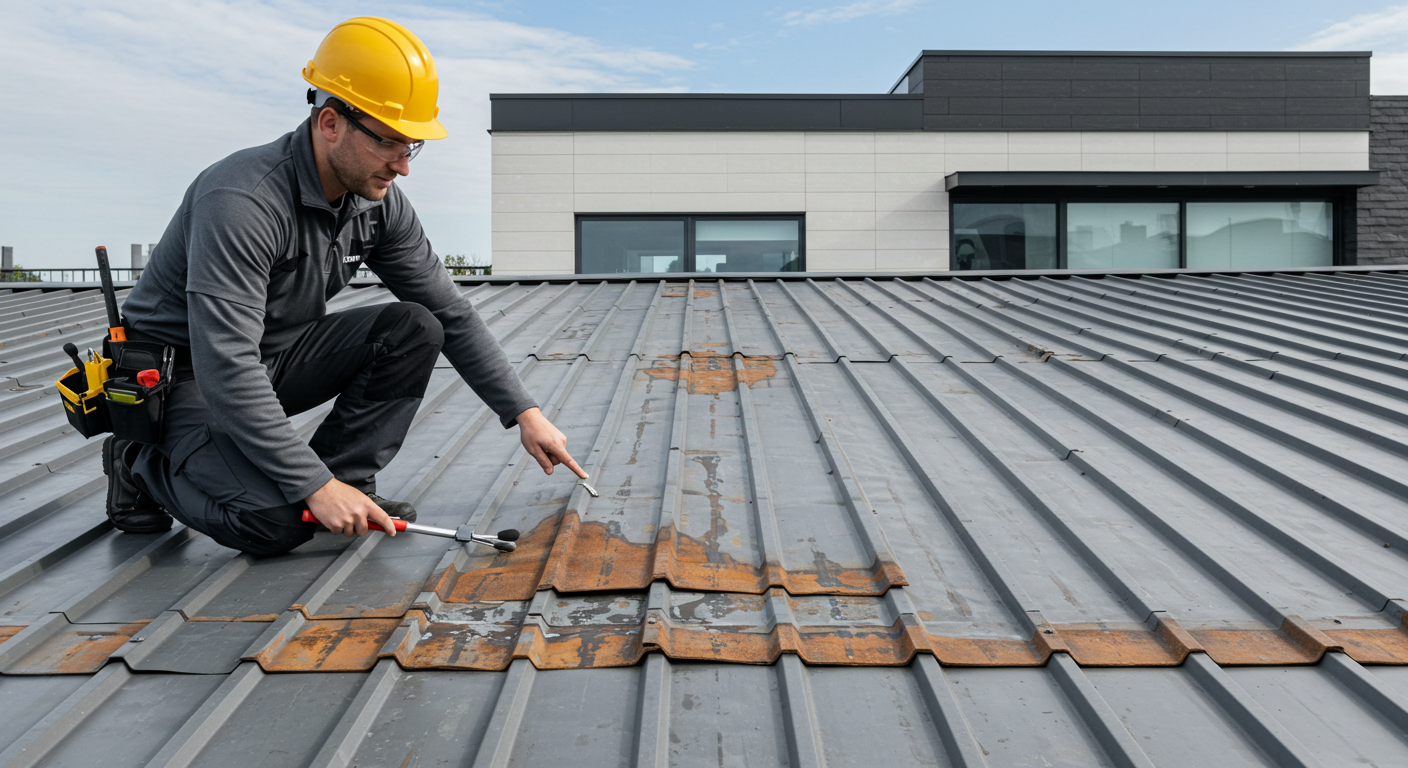
| Rust at panel ends, cut edges or scratches | Bare steel at cuts; metal shavings left on the roof after drilling; foot traffic scuffs | Remove shavings, clean the rust, prime and touch up with the panel maker’s matching paint |
| Rust or corrosion around a pipe, antenna or flashing of another metal | Dissimilar metals in contact, or copper lines draining onto steel | Separate the metals with a non-conductive layer, swap in compatible fasteners and flashing, jacket copper lines |
| Wavy look in flat panels (oil canning) | Wide flat pans, thin gauge, an uneven deck, or panels fastened too tightly | Mostly cosmetic; fixing a pinned panel can help, but prevention (striated or ribbed pans, heavier gauge, a flat deck) works better than repair |
| Loud pops or bangs as the roof heats or cools | Panels fixed so they cannot expand and contract | Find the pinned points (screws through standing seam pans, rigid flashing) and restore the sliding attachment |
| Lifted ridge cap, rake or eave trim after wind | Too few fasteners, missing cleats or closures at the edges | Re-secure with correct fastener spacing and continuous cleats; replace bent trim |
| Leaks at panel side or end laps | Missing or aged sealant tape in the laps, often on low slopes | Open the lap, clean it, install butyl tape and refasten; on very low slopes consider a standing seam system instead |
| Drips on a dry morning in a shop or barn | Condensation under panels installed without underlayment or insulation | Add insulation with a vapor retarder, or panels with an anti-condensation backing when the roof is replaced |
Which fixes can a homeowner do?
From the ground and the attic you can find most problems early: stains on ceilings, drips in the attic after rain, lifted trim, rust spots, and debris in valleys and gutters. You can clean gutters from a ladder and rinse the roof gently with a hose. Leave anything on the panels to a roofer. Walking on metal dents and creases panels, and the most common home repair, a bead of caulk smeared over a leaking joint, often makes things worse: it blocks joints that are meant to move, cracks as the metal moves, and traps water behind it.
What goes wrong with corrugated metal roofs?
Corrugated roofs, common on shops, barns and carports, have the most exposed screws of any metal roof, so washer failure and backed-out screws top the list. Their laps are the second weak point: without sealant tape, wind-driven rain works sideways through the overlap. Edges and ridge caps lift in wind when fastened too sparsely, and uncoated or thin panels rust at the laps where water sits. The fixes are the same as in the table: new screws and washers, taped laps, extra fasteners at the edges, and rust treatment. Our post on corrugated metal roofing for shops and barns covers choosing the panels.
Should a metal roof be repaired or replaced?
- Repair when the problems are local: a few leaks, a failed boot, some rusted screws, a section of trim.
- Refasten the whole roof when washers are failing everywhere on an exposed-fastener roof but the panels are sound.
- Consider a restoration coating or replacement when rust has spread across the panels or the finish has chalked away over large areas.
- Replace when panels are rusted through or perforated. The UFC notes that standing seam systems work well to re-cover aged metal roofs, which can be an option on some buildings.
How do you prevent these problems on a new metal roof?
Most of the table comes down to choices made on installation day: concealed-clip standing seam instead of face-fastened panels where the budget allows, clips that let panels move, correct fastener spacing at edges, the right sealant in the right place, compatible metals, and shavings swept off before the crew leaves. Our guide to metal roof durability explains the specification behind a long-lived roof, and metal roof maintenance covers the yearly checks. Weighing metal against shingles? Read metal roof vs shingle roof.
NEMA Roofing repairs metal roofs from five locations (Santa Barbara, Oxnard, Woodland Hills, Tarzana and Downey) across all of Santa Barbara, Ventura, Los Angeles, Riverside and San Bernardino counties, including every town in Ventura County. See our metal roofing service, or call 866-631-3366 to book a repair visit.