
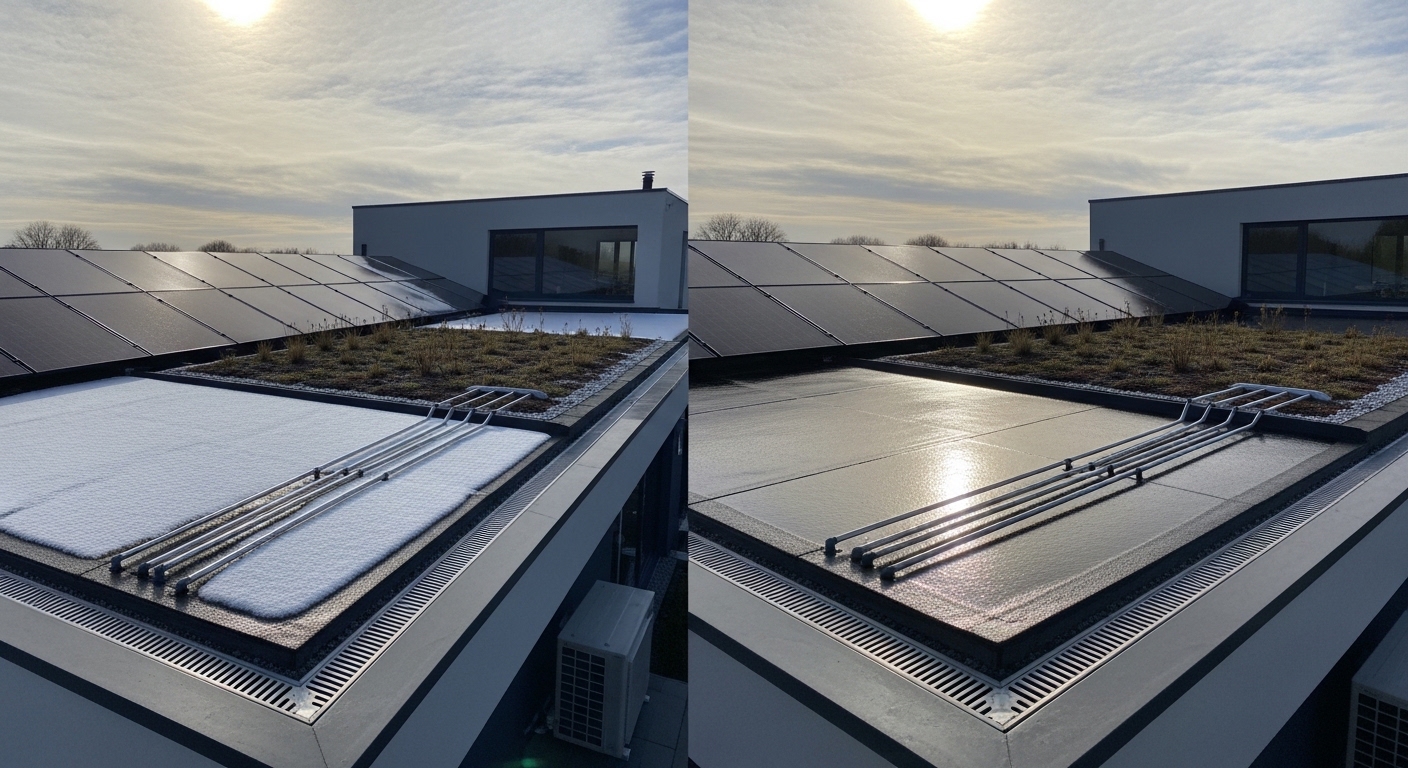
Flat roof insulation is the layer that slows heat moving through a flat roof, usually rigid foam board laid on the deck under the membrane, or insulation packed between the ceiling joists below. Where it sits matters as much as how thick it is: board above the deck protects the structure and can build in drainage slope, while insulation between joists needs ventilation or a code-approved unvented design to avoid condensation. To have a flat roof’s insulation checked, call NEMA Roofing at 866-631-3366.
Where does the insulation go in a flat roof?
| Position | How it is built | Where you find it |
|---|---|---|
| Above the deck | Rigid boards on the roof deck, often topped by a cover board, with the membrane over them | Most commercial roofs; new and reroofed homes |
| Between the joists | Batts or spray foam in the spaces between ceiling joists, under the roof sheathing | Many older flat-roofed houses, additions and garages |
| Both | Board above the deck plus insulation below | Houses upgraded at reroof |
| Inverted (protected membrane) | Membrane on the deck, moisture-resistant boards laid over it and held down with ballast or pavers | Some concrete decks and roof terraces |
Above-deck insulation has a practical advantage beyond heat: it keeps the deck and framing at a steadier temperature, and it can be cut tapered to give a level deck the slope it needs.
Which insulation boards are used on flat roofs?
The U.S. Department of Defense roofing criteria (UFC 3-110-03) describe the common boards and where each fits:
- Polyisocyanurate (polyiso): the most commonly used roof insulation, chosen where insulating value per inch matters most.
- Polystyrene (EPS and XPS): XPS resists moisture better and suits inverted roofs; polystyrene must not touch hot-mopped asphalt, and usually needs an underlayment board and a cover board for fire ratings and adhesion.
- Perlite: used where fire resistance is the priority and vapor intrusion is limited; the criteria rule it out in high-wind areas.
- Cellular glass: costly, used where heavy moisture would ruin other boards, as in cold storage.
- Phenolic foam: no longer made in the United States; it corrodes steel decks, so when it turns up on an old roof over steel, the criteria call for replacing it and checking the deck.
A cover board over the insulation separates incompatible materials, protects the foam and gives the membrane a firm base; that is why good commercial assemblies include one.
How does insulation help a flat roof through the seasons?
Summer. A flat roof faces the sun all day. Insulation keeps most of that heat in the roof instead of the rooms below, and the reflective surface does the rest; the two work together.
Winter nights. Warm, moist indoor air that reaches a cold deck can condense inside the roof. The DoD criteria stress that a vapor retarder, where one is needed, works only if it is continuous: moist air leaking through gaps in it “defeats their purpose and creates interior moisture problems.”
Rainy season. Insulation that gets wet from a leak stops insulating and gets heavy, and water spreads through it well beyond the drip inside. Wet boards are cut out and replaced, which is why a leak on an insulated flat roof should be repaired quickly and the area around it checked for moisture.
Can insulation fix ponding water?
Yes, in the form of tapered insulation: boards made thicker at one end, laid out so the finished surface slopes to the drains. The DoD criteria use tapered boards where an existing roof has too little slope and other ways of adding slope would cost more over the building’s life, and in crickets and saddles, whose slope should be twice the main roof slope. They also rule out wet fill for building slope on existing roofs. The goal is the code minimum for membrane roofs, a design slope of at least 1/4 inch per foot. How drains, scuppers and overflows then carry the water away is covered in our guide to flat roof drainage.
What about insulation between the joists?
On many flat-roofed houses the ceiling is fastened straight to the bottom of the roof joists, so the insulation sits in closed joist bays. The 2025 California Residential Code calls these enclosed rafter spaces and gives two ways to build them:
- Vented: each space needs cross ventilation through openings protected from rain (R806.1), with a net free vent area of at least 1/150 of the space in the basic case (R806.2). On a flat roof with parapets, getting air to flow across every joist bay is often impractical.
- Unvented: allowed when the assembly meets R806.5, for example with air-impermeable insulation such as spray foam applied directly to the underside of the roof sheathing, or with enough rigid insulation directly above the sheathing to keep the sheathing warm enough to control condensation.
An old flat roof with batts between the joists and no real ventilation is a common source of hidden moisture. A reroof is the moment to correct it, often by adding rigid insulation above the deck, with the design checked against R806.5.
What does Title 24 ask for at reroof?
On homes in climate zones 4 and 6 through 15, a low-sloped reroof must meet the state’s cool-roof values, but the code’s first exception to that rule lets the aged solar reflectance requirement be met with insulation at the roof deck as specified in the code’s Table 150.2-B. In other words, insulation above the deck can stand in for a bright white surface on a house. For nonresidential low-sloped roofs, the replaced or recovered area must itself be insulated to the level in the code’s Table 141.0-C, with exceptions explained in our guide to flat roof recover vs replacement.
When is the best time to add insulation?
At a tear-off, when the whole deck is open and new boards go down as part of the same job, with nothing extra to remove. Plan for what the extra thickness changes: flashing at walls, curbs and door thresholds must still turn up high enough above the new surface, and edge metal and wood nailers are raised to match. Our guide to flat roof flashing explains why that height matters.
Insulated flat roofs from NEMA Roofing
NEMA Roofing installs and replaces flat roofs on homes and commercial buildings, including the insulation and cover boards under the membrane; see our flat roofing service. With five locations (Santa Barbara, Oxnard, Woodland Hills, Tarzana and Downey), we cover the coastal and inland parts of all five counties we serve, Santa Barbara, Ventura, Los Angeles, Riverside and San Bernardino; our San Bernardino County page is one example. To plan insulation into your next flat roof, call 866-631-3366.




