
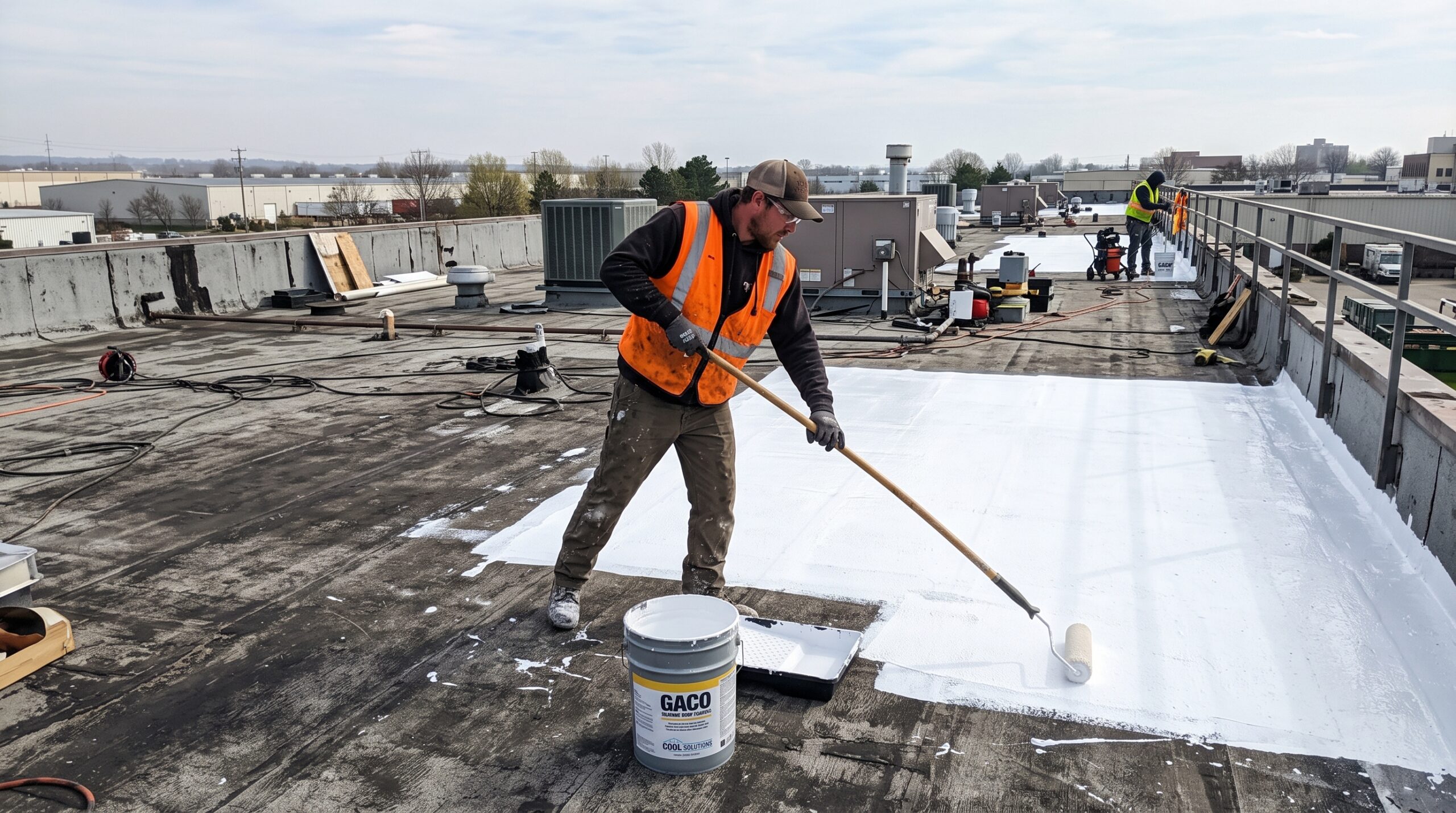
PVC roofing is a single-ply flat roof membrane made of polyvinyl chloride, reinforced with a fabric scrim and joined at every seam by hot-air welding, so the finished roof behaves like one continuous sheet. It is usually white and reflective, holds up well to grease and many chemicals, and suits restaurants, busy commercial roofs and homes that need a cool roof. It costs more to buy than asphalt-based systems and needs careful welding and the right materials beneath it. To ask about a PVC roof, call NEMA Roofing at 866-631-3366.
How a PVC roof is built
PVC is a thermoplastic: heat softens it and it regains its strength as it cools. That property is the whole point of the system. Sheets overlap at the edges and a welder melts the two layers together; U.S. Department of Defense roofing criteria (UFC 3-110-03) note that properly welded thermoplastic seams can match the strength of the sheet itself. Corners, pipe boots and curb wraps come prefabricated from the same material and are welded in, so the details are part of the membrane rather than glued on.
The California Residential Code lists PVC, and PVC blended with KEE (ketone ethylene ester), under ASTM D4434 in its single-ply table (Table R905.12), and requires single-ply roofing to be installed to the manufacturer’s instructions and tested for wind resistance (sections R905.12.3 and R905.12.4). As with every membrane roof, the code’s minimum design slope for drainage applies: 1/4 inch per foot.
The sheet is either fully adhered to a board beneath it or fastened with plates and screws along the laps. The federal criteria treat fully adhered as the preferred method, because it stops the membrane from billowing in wind; in fastened systems the reinforcing fabric keeps that movement limited. Their minimum thickness for military PVC roofs is 60 mils.
PVC, TPO and EPDM compared
| PVC | TPO | EPDM | |
|---|---|---|---|
| Material family | Thermoplastic | Thermoplastic | Thermoset rubber |
| Code material standard | ASTM D4434 (PVC and PVC/KEE) | ASTM D6878 | ASTM D4637 |
| Seams | Hot-air welded | Hot-air welded | Seam tape and adhesive |
| Usual color | White, other colors available | Typically white | Black, white versions made |
| Near kitchen grease exhaust | A common choice; confirm the product’s grease rating | Check the manufacturer’s chemical-resistance data | Not resistant to grease and oil, per the federal criteria |
| Main watch point | Contact with asphalt or polystyrene; weld quality | Weld quality | Seam tape, shrinkage at edges |
The rubber option has its own page: EPDM roofing, pros and limits.
Where PVC earns its higher price
- Restaurants and food businesses. Grease blown out of kitchen exhaust fans settles on the roof around the fan and softens many membranes. PVC grades made for this are a common specification there, often with a grease-containment box at the fan as well.
- Roofs crowded with equipment. Every curb, conduit and pipe gets a welded, prefabricated detail instead of a field-cut patch, which cuts down the number of places a leak can start.
- Cool-roof requirements. White PVC is widely rated as a cool roof. When California’s energy code requires a reflective surface at reroofing, look up the exact product in the Cool Roof Rating Council’s Rated Products Directory and check its aged (weathered) values, not only its new ones. The rules themselves are explained in making a flat roof energy efficient.
- Roofs that change. Because it welds, new equipment can be flashed later with the same material, as long as the old sheet is cleaned and prepared properly first.
Military criteria also note the other side of the ledger: material costs for weldable thermoplastics run higher than for bituminous roofing, while labor costs are generally lower. How that balances out depends on the roof, which is why the only honest price is a written estimate after an inspection.
What PVC must not touch
PVC stays flexible because of plasticizers blended into it. Direct contact with old asphalt roofing, coal-tar pitch or polystyrene foam insulation can draw those plasticizers out, and the sheet then shrinks and turns brittle. Manufacturers therefore call for a separator sheet or a compatible board wherever a PVC membrane goes over an existing asphalt roof or polystyrene. When a proposal says “PVC over existing roof,” ask what separates the two.
What a good PVC installation looks like
- A cover board or suitable insulation under the sheet, dry when covered.
- Test welds at the start of the day and whenever conditions change, so the welder’s heat and speed are right for the sheet and the weather.
- Every seam probed after welding, and any gap re-welded.
- Prefabricated corners and boots at the details, welded on, with no exposed sealant doing the waterproofing.
- Metal edges and gutters in PVC-coated metal where the system uses it, so the membrane welds to the edge as well.
For the other quality points that apply to every flat roof, from slope to flashing height, see flat roof installation mistakes.
Caring for and repairing a PVC roof
- Keep it clean. Dirt and grease lower the reflectance, and grease left in place attacks the surface. Washing around kitchen fans is part of normal upkeep on a restaurant roof.
- Check the welds and details after the rainy season and after any contractor has worked on the roof.
- Repair by welding. A puncture or open seam is fixed with a new PVC patch welded over the cleaned area. Weathered PVC often needs a specific cleaner before it will weld; caulk and roof cement are not repairs on this membrane.
- Coatings are optional. An aging PVC roof can be coated with a compatible product, but surface preparation matters more than on most roofs: see coating TPO and PVC roofs.
PVC roofs and NEMA Roofing
NEMA Roofing is licensed by the state as a roofing and general building contractor (CSLB license #1083283), bonded and insured. With five Google-verified locations, in Santa Barbara, Oxnard, Woodland Hills, Tarzana and Downey, we serve every part of Santa Barbara, Ventura, Los Angeles, Riverside and San Bernardino counties, from beach towns to the Inland Empire; the San Bernardino County page shows how far that reaches. Read about our flat roofing services, or call 866-631-3366 to have a PVC roof inspected, or to talk through which membrane suits your building.




