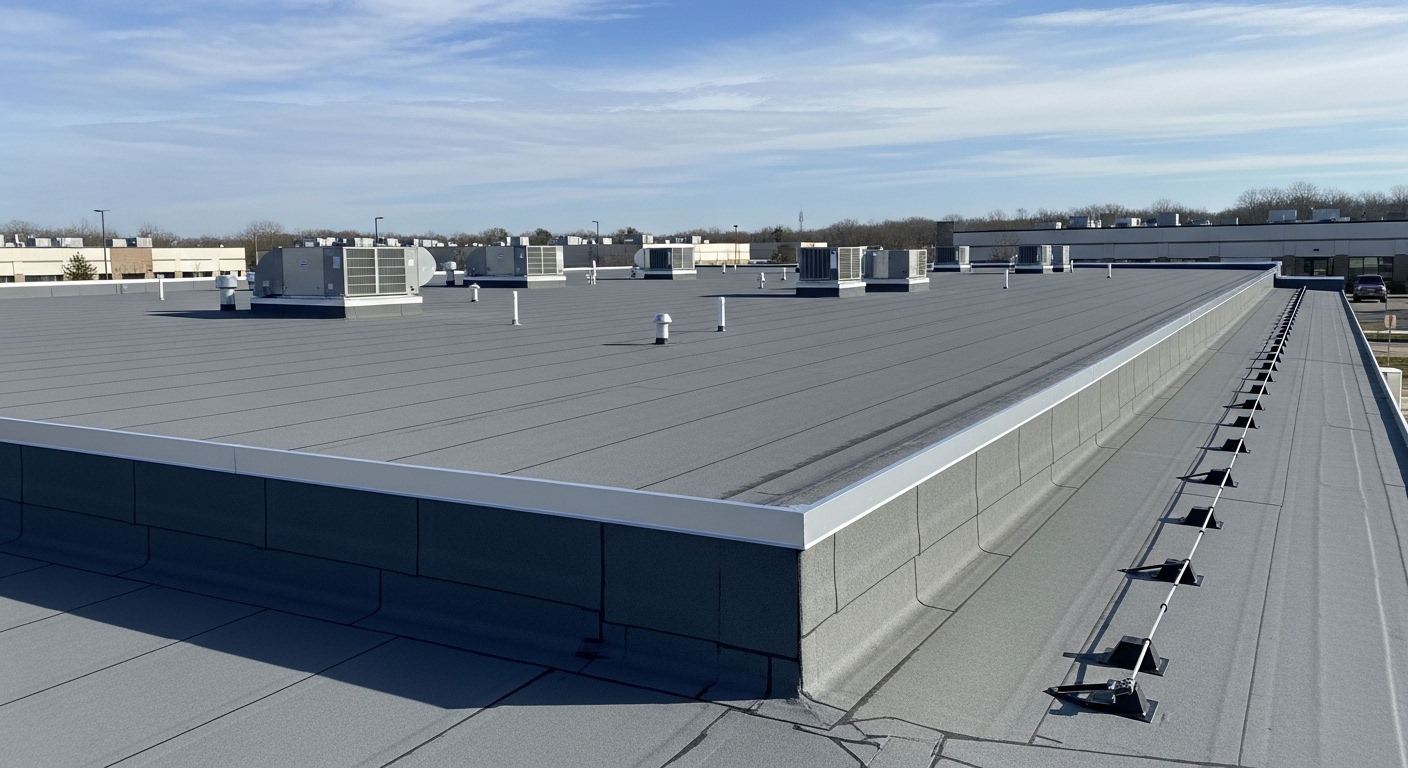
EPDM roofing is a synthetic rubber membrane (ethylene propylene diene monomer) laid in wide single sheets over a low-slope roof, joined at the laps with seam tape, and held down by adhesive, fasteners or ballast. It stays flexible in heat and cold, shrugs off sunlight better than most rubbers and has few seams, but it cannot be heat-welded, its standard black surface absorbs heat, and oil or grease attacks it. For an EPDM repair, replacement or a second opinion on a quote, call NEMA Roofing at 866-631-3366.
What EPDM is, and how it differs from TPO and PVC
All three are single-ply membranes, and the California Residential Code lists each with its own material standard (Table R905.12: EPDM to ASTM D4637, TPO to ASTM D6878, PVC to ASTM D4434). The difference that matters most on a roof is chemistry:
- EPDM is a thermoset. Once cured it does not soften again with heat, so sheets are joined with seam tape and adhesives, never welded.
- TPO and PVC are thermoplastics. Heat softens them, so a hot-air welder fuses the laps into one piece.
That makes EPDM forgiving to handle and simple to patch, and it makes the quality of every taped seam the thing to watch. U.S. Department of Defense roofing criteria (UFC 3-110-03) describe EPDM as giving “predictable serviceability” in all climates, and ask for 6-inch seam tape at every lap with cover strips over the joints.
Fully adhered, mechanically fastened or ballasted?
How the sheet is held down changes its wind behavior, its weight and how easy leaks are to find.
| Method | How it works | Strengths | Trade-offs |
|---|---|---|---|
| Fully adhered | The sheet is glued to a cover board or insulation across its whole area | No flutter in wind; smooth surface; the preferred method in the federal criteria | More adhesive and labor; the substrate must be clean and dry |
| Mechanically fastened | Plates and screws at the laps hold the sheet to the deck | Fast; works over many decks | The membrane can billow between fastener rows; the federal criteria do not permit it on military roofs |
| Ballasted | Loose sheets held down by stone or concrete pavers | Large sheets with factory seams; quick to lay | The criteria put ballast at 10 to 12 pounds per square foot, which the structure must carry; leaks are harder to trace under the stone |
On most homes and small commercial buildings in Southern California, a fully adhered sheet is the sensible default: it adds no ballast weight to older framing and gives a surface that is easy to inspect.
Black or white EPDM under California’s energy code
Classic EPDM is black, and black roofs run hot. California’s Title 24 energy code sets a reflective surface for many low-slope reroofs: on homes in climate zones 4 and 6 through 15, when more than half of a low-slope roof is replaced (section 150.2(b)1I), and on nonresidential buildings in every zone once more than half the roof, or more than 2,000 square feet, whichever is less, is redone (section 141.0(b)2Bi). The new surface needs an aged solar reflectance of at least 0.63 with a thermal emittance of at least 0.75, or a Solar Reflectance Index of 75 or more. A black sheet will not reach that.
The usual answers are white EPDM (often a white layer laminated over a black core) or a reflective coating over black EPDM. For severe, corrosive exposures the federal criteria prefer a factory-laminated reflective surface, because a coating applied on site there needs renewing every 3 to 5 years to stay highly reflective, while the membrane underneath lasts far longer. A rated product and its listing should be named in the proposal. More on reflectivity, insulation and solar: how to make a flat roof energy efficient.
Where EPDM is a poor choice
- Near kitchen or restaurant exhausts. The federal criteria state plainly that EPDM is not resistant to grease and oil and should not go near food-preparation exhaust vents. PVC is the usual alternative there.
- Roofs with heavy foot traffic or lots of equipment. Rubber punctures more easily than a thicker cap sheet; walkway pads help, but a busy roof may suit another system.
- Where a cool roof is required and no white or coated option fits the budget. The reflectance rule above decides this before price does.
To compare EPDM with asphalt-based systems, read the guide to modified bitumen roofing; for which system suits a house, see the best flat roof material for a home.
How EPDM roofs fail
- Seam tape letting go. Laps open from the ends when the tape was laid on a dirty or unprimed sheet, or after years of movement.
- Shrinkage at the edges. An aging sheet can pull tight at walls and corners and stretch the flashing away from the wall, leaving a bridge of rubber with a gap behind it.
- Punctures. Dropped tools, sharp debris and service technicians’ boots.
- Flashing failures at curbs, vents and drains, the same weak points as any flat roof.
- Chemical damage from oil, grease or solvents, which leaves swollen or soft patches.
How an EPDM roof is repaired
EPDM is patched with EPDM: the area is cleaned, primed and covered with a rubber patch or cover tape, with rounded corners so the edges do not lift. Asphalt-based roof cement and generic sealants do not belong on it; they do not bond reliably and petroleum products can soften the rubber. A seam that opened is re-cleaned, primed and re-taped rather than smeared over. When shrinkage is the cause, the edge is released and re-flashed with new material instead of stretched again.
Where seams are failing all over or the sheet has gone brittle, repairs chase leaks around the roof. Covering the old roof or tearing it off are then the choices, and how long each flat roof material lasts helps put the age of your roof in context.
Keeping an EPDM roof in service
- Walk or look over the roof after the rainy season and after any contractor has been up: seams, edges, flashings and anything newly mounted.
- Keep drains and scuppers clear so water does not sit on the laps.
- Keep oils, grease and solvents off the membrane, including from equipment servicing.
- If the roof is coated, watch for the coating wearing thin and plan the recoat before bare rubber shows.
EPDM roofs and NEMA Roofing
We roof homes and commercial buildings alike, and on both one thing holds for EPDM as for every flat system: it rewards precise work at the seams and edges. NEMA Roofing holds CSLB license #1083283 (roofing C-39 and general building B) and is bonded and insured. Six locations, Santa Barbara, Oxnard, Woodland Hills, Tarzana, Downey and San Bernardino, put our crews within reach of every community in the five counties we cover in full: Santa Barbara, Ventura, Los Angeles, Riverside and San Bernardino; the service areas list shows them. Our flat roofing services page covers repair, replacement and new roofs, or call 866-631-3366.