
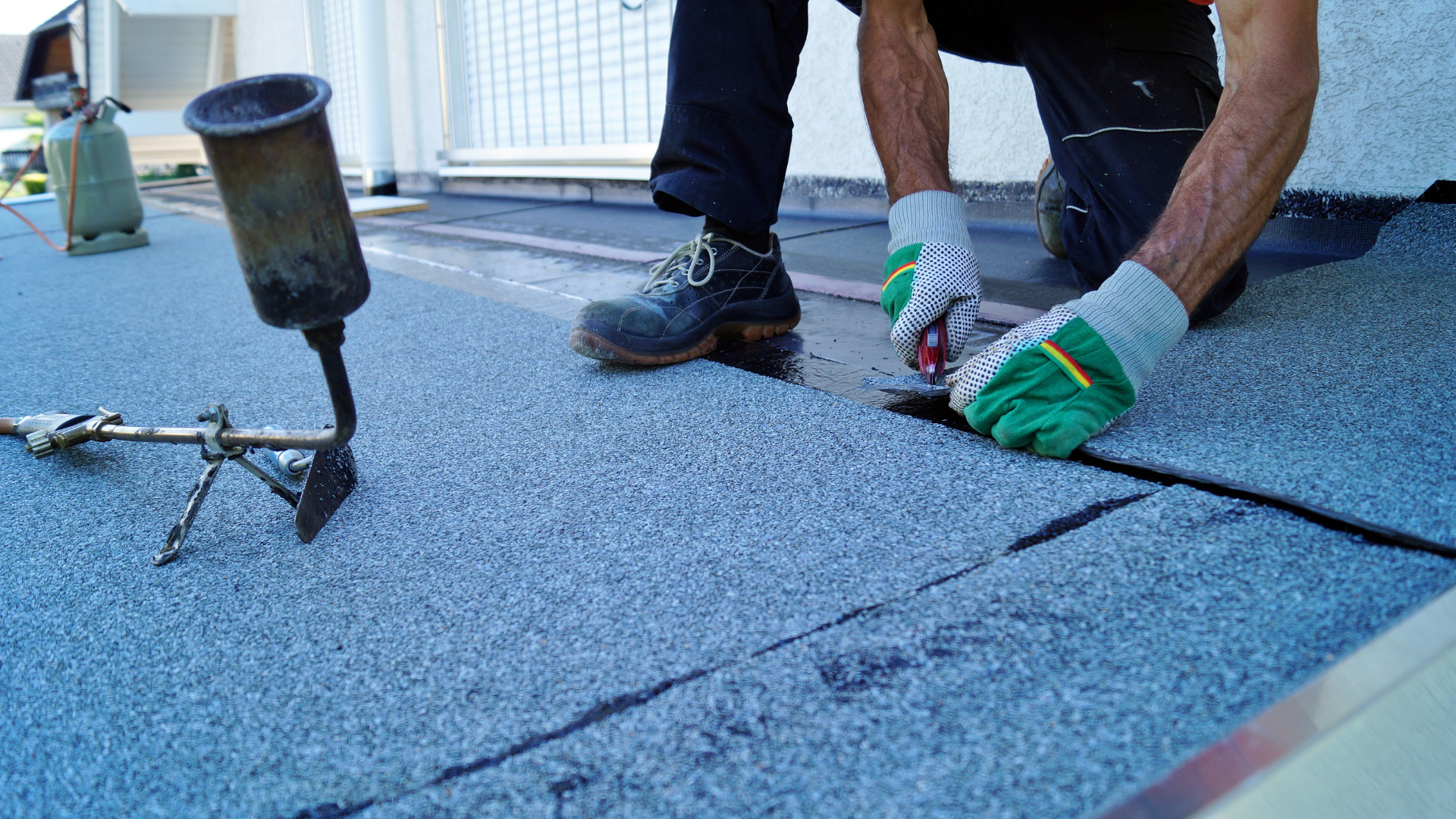
How to choose a flat roofing contractor: confirm an active California C-39 roofing license, then judge each proposal by the flat-roof details it spells out: the membrane system and the maker’s approval, how water will reach the drains, how walls, curbs and edges will be flashed, whether a moisture check decides between recover and tear-off, and which permit and cool-roof rules apply. A contractor who cannot answer those in writing is guessing. To talk through your flat roof, call NEMA Roofing at 866-631-3366.
Why does a flat roof need a flat roof specialist?
A pitched roof sheds water in seconds, so small installation flaws often go unpunished. A flat roof holds water for hours after rain, and every seam, lap and flashing is tested by it. The work also depends on system-specific skills and tools: hot-air welding for TPO and PVC, seam tapes and primers for EPDM, torch, mop, cold adhesive or self-adhered plies for modified bitumen, and spray equipment for foam and coatings. A good steep-slope crew does not automatically have them. Look for a company that installs and repairs flat roofs routinely, on buildings like yours.
What should you check before comparing proposals?
Roofing in California is licensed by the Contractors State License Board under the C-39 Roofing classification. Look the license up on the CSLB website by number or business name, read its status and any disciplinary history, and ask for proof of workers’ compensation: the board requires every active C-39 contractor to carry it (or a valid certification of self-insurance), whether or not they have employees. The full set of license, insurance and contract checks, including what California requires in a home improvement contract, is in our guide to what to look for in a roofing contractor. The rest of this page covers what is specific to flat roofs.
Ten questions to ask a flat roofing contractor
| Ask | A good answer includes |
|---|---|
| 1. Which system do you recommend for this roof, and why? | A reason tied to your building: foot traffic, equipment, grease, slope, deck type, look, budget; not “we only do one kind” |
| 2. Is your company approved by that system’s manufacturer? | The program name and the warranty they can register, with what it covers (materials only, or workmanship too) |
| 3. How will you know whether the insulation is wet? | A moisture survey or core cuts, not a guess from the surface |
| 4. Recover or tear-off, and why? | The reason in terms of wetness, number of existing layers and flashing height |
| 5. How will water get to the drains? | Slope of at least 1/4 inch per foot, tapered insulation or crickets where water now ponds, drain and overflow plan |
| 6. How will walls, curbs, pipes and edges be flashed? | New flashing to full height, new edge metal, boots or pitch pockets at pipes; nothing reused if worn |
| 7. How is the roof attached? | The attachment method, with tighter fastening at corners and perimeter, on a tested assembly |
| 8. Will you use a torch? | If yes, the fire precautions; if the building is wood-framed, a flame-free option |
| 9. Does the new surface meet the cool-roof rule, and who pulls the permit? | The product’s rated values where the rule applies, and the permit in the contractor’s scope |
| 10. What exactly is in the price? | Membrane type and thickness, plies, insulation and its R-value, cover board, edge metal, walkway pads, deck repair as a unit price, cleanup and disposal |
Questions 3 and 4 decide more of a flat roof’s life than any other line in the bid; our guide to flat roof recover vs replacement explains the code limits behind them.
What makes flat roof bids hard to compare?
Two prices for “a new flat roof” can describe very different roofs. Put the bids side by side on:
- Membrane and thickness. Single-ply membranes come in several thicknesses, and modified bitumen in two or three plies; a thinner or fewer-ply roof costs less and gives less.
- Insulation. Whether it is replaced, added or left, and whether tapered sections fix ponding.
- Tear-off. Whether all layers come off, or the price assumes a recover.
- Details. Edge metal, coping, curbs and drains: included and new, or “as needed”.
- Warranty. Manufacturer material warranty, manufacturer system warranty, and the contractor’s own workmanship terms, each in writing.
The CSLB warns that a bid far below the others may reflect a mistake or missing work. On a flat roof, the missing work is usually in the details listed above.
Warning signs in a flat roof proposal
- A coating or recover proposed with no moisture check.
- “Reseal” or caulk offered as the fix for a leak whose source was never traced.
- No mention of flashing, edge metal or drains.
- No mention of the cool-roof rule on a replacement where it applies.
- A claim that a reroof needs no permit, without naming the building department’s rule.
- Pressure to sign the same day.
Leak repairs follow their own steps, from tracing the source to confirming the fix; see what to expect from a flat roof leak repair.
What services should a flat roofing contractor cover?
A roof is served best by one company that can do the whole cycle: installation and replacement, leak repair, inspections and routine maintenance. The same crew that installed a roof knows its details when it needs service, and a record of every visit shows a future buyer or insurer how the roof was cared for. Key areas on every visit are the drains, the membrane surface and the flashing.
Flat roofing services from NEMA Roofing
NEMA Roofing is licensed by the CSLB (license #1083283) in the C-39 roofing and B general building classifications and is listed by manufacturers as a GAF Master Elite contractor, an Owens Corning Preferred Contractor and a Polyglass Preferred Contractor. Our flat roofing service covers installation, repair, inspection and maintenance of flat roofs on homes and businesses. If you are looking for flat roof repair in Ventura County, or anywhere in Santa Barbara, Los Angeles, Riverside and San Bernardino counties, NEMA covers all five counties from five locations: Santa Barbara, Oxnard, Woodland Hills, Tarzana and Downey. The Ventura County service area page lists the towns there. Call 866-631-3366 to ask us any of the ten questions above.




