
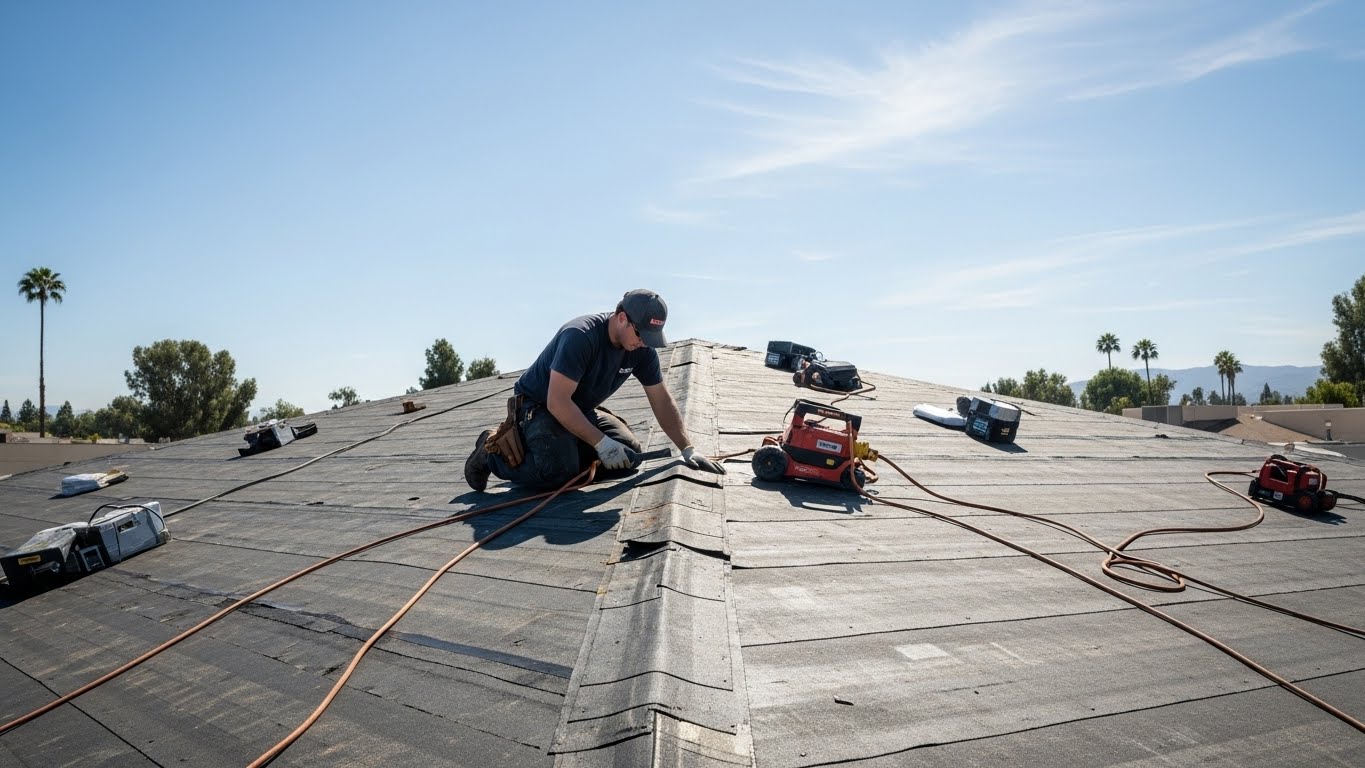
Commercial roof repair solutions in Tarzana range from a spot repair of one seam or flashing, through edge re-securing, drainage correction and section replacement, to a restoration coating over the whole roof. Which one fits depends on how far water has spread under the membrane, what the roof is made of, and the City of Los Angeles and California energy rules that apply to the work. For a repair assessment, call NEMA Roofing at 818-528-6412.
Find the cause and the extent before choosing a fix
Water rarely comes through the ceiling directly under the opening. It runs along fasteners, follows the underside of a metal deck or slips behind a coping before it drips, so the stain and the breach can be several feet apart. A good repair starts with two questions: where is the water getting in, and how much of the roof is already wet?
- Tracing the entry. Seams, flashings, curbs and drains near the stain are checked first; the U.S. Department of Defense roofing criteria (UFC 3-110-03) note that a reported roof leak can also come from walls, windows or mechanical units.
- Mapping the wet area. Infrared, capacitance or nuclear scans show where insulation holds moisture, and core cuts confirm it. Infrared covers the whole roof surface, while grid-based meters sample points.
- Reading the drainage. Silt rings and dirt lines show where water stands. Water often moves toward a drain that now sits high because insulation around it has settled, and the ponding hides the original breach.
Six repair solutions and when each one fits
| Solution | Fits when | Not the answer when |
|---|---|---|
| Spot repair (seam weld, patch, sealant renewal) | One clear breach, dry insulation around it, membrane still flexible | The membrane is brittle across wide areas or scans show spread moisture |
| Flashing and penetration rebuild | Leaks at curbs, pipe boots, pitch pans, goosenecks or parapet base flashing | The curb or unit itself is failing; the equipment has to be reset first |
| Edge and perimeter re-securing | Lifted edge metal, loose coping clips, membrane peeling at the perimeter | The deck at the edge is deteriorated and will not hold fasteners |
| Drainage correction (crickets, tapered insulation, drain reset, new strainers) | Water stands more than two days after rain at the same spots | The whole roof is flat or sagging; that is a structural or reroof question |
| Section replacement | Wet insulation confined to one area; the rest of the roof is sound | Wet areas are scattered across much of the roof |
| Restoration coating (reinforced where needed) | The roof is dry and sound but aging; the goal is to extend its life | Insulation is saturated or the membrane is failing; a coating would trap the water |
Water standing more than 48 hours after rain is the federal definition of ponding. Even a sound membrane ages faster under it, so a repair that ignores drainage often just moves the problem.
How the membrane changes the repair
- TPO and PVC: repaired by heat-welding new membrane over a cleaned, prepared surface. Oil and dirt left by rooftop HVAC service keep a weld from bonding, so the cleaning step matters as much as the weld.
- EPDM: usually repaired with primer and pressure-sensitive flashing or patches made for EPDM.
- Modified bitumen and built-up roofs: the surfacing decides the method. A cold-applied patch needs a sound surface; where the cap sheet has dried and cracked, the aged layer is cut back to a stable ply first.
We usually find sun damage first on the edges and parapets that face south: single-ply surfaces chalk and modified bitumen dries and cracks there before the rest of the field.
What Tarzana’s climate means for repairs
Tarzana’s roofs work in heat. The nearest NOAA normals station, at Pierce College in Woodland Hills, averages about 115 days a year at or above 90 F (1991-2020 normals), and a daily swing from cool mornings to hot afternoons makes membranes expand and contract at seams, terminations and penetrations. Rain comes in a short season: January and February are the wettest months in the same station’s normals, while June through September average well under a tenth of an inch each. That makes summer and early fall the time for planned repairs, and the first storms the test of whatever was left undone.
Rules that apply to commercial roof repairs in Tarzana
- Permits. Tarzana is part of the City of Los Angeles, so the Los Angeles Department of Building and Safety (LADBS) is the permit authority. Ask your contractor to confirm whether the scope of a repair needs a permit.
- Cool roof on large recoats. A spot repair does not trigger California’s cool-roof rule, but a whole-roof restoration coating can: once a recoat covers more than half the roof or more than 2,000 square feet, whichever comes first, section 141.0(b)2B of the 2025 Energy Code (Title 24, Part 6) asks for a surface rated at 0.63 aged solar reflectance and 0.75 emittance, or an SRI of 75, subject to its exceptions.
- Fire zones. Part of the Tarzana ZIP code 91356 lies in a Very High Fire Hazard Severity Zone on the state and City of Los Angeles maps, where LADBS requires Class A roof coverings. Check the address before choosing materials for a large repair.
Keeping a manufacturer warranty intact
On a roof still under warranty, contact the warranty holder before repairs, as the federal criteria advise, and use the manufacturer’s approved repair method and materials. Keep a record of what was used, photos of the work and any seam probes. On older roofs past their warranty, the same records still show what was done and why, which helps the next repair decision.
Upgrades worth adding to a repair
- Walkway pads on the routes HVAC and other technicians use.
- Protection pads under kitchen exhaust fans, where grease attacks some membranes.
- Solar stanchions at the right height with proper flashing, and wiring clipped off the roof surface.
- A simple roof map for property managers showing drains, conduit and access routes.
If the repair has to happen while the building stays open, read how to plan commercial roof work around business hours; for flat roof systems on Tarzana buildings, see commercial flat roofing in Tarzana.
Scheduling a repair assessment
Tarzana is one of NEMA Roofing’s five locations, alongside Woodland Hills, Downey, Oxnard and Santa Barbara, and we repair commercial roofs across Los Angeles, Ventura, Santa Barbara, Riverside and San Bernardino counties; see our Tarzana roofing page and our commercial roofing services. Call 818-528-6412 to have the leak traced and the right repair scoped.




