
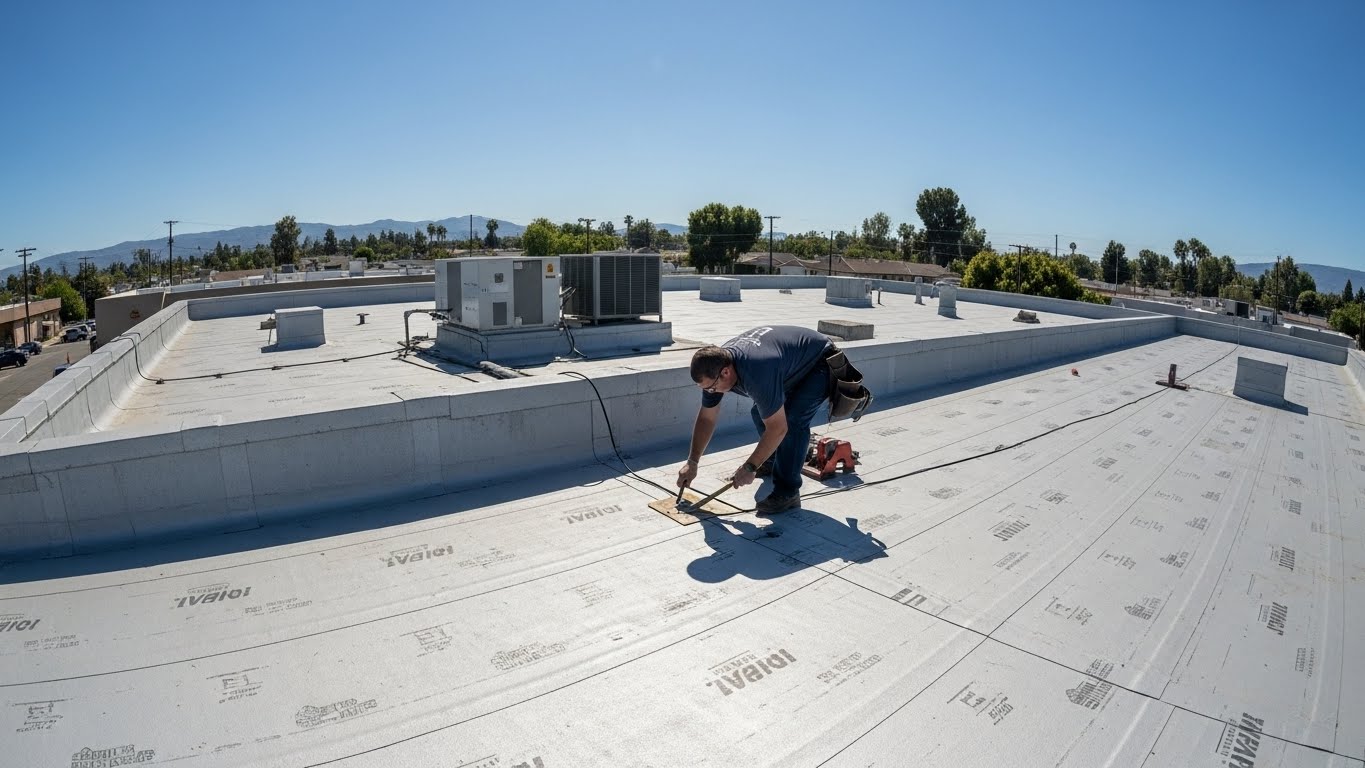
Commercial flat roofing in Tarzana has to be built for three local facts: summers where the nearest weather station averages about 115 days a year at 90 F or hotter, an older building stock whose roofs often already carry several layers, and City of Los Angeles rules (an LADBS permit, and Class A roofing in the Very High Fire Hazard Severity Zone that reaches into ZIP code 91356). The layers, attachment and details of the new roof follow from those. To plan a flat roof for a Tarzana building, call NEMA Roofing at 818-528-6412.
What Tarzana’s buildings mean for a flat roof project
The Census Bureau’s 2020-2024 American Community Survey counts 12,719 housing units in ZIP code 91356. About 42 percent of them are in buildings with five or more units, and about 78 percent were built before 1980 (median year built: 1973). In practice, many low-slope roofs coming up for replacement in Tarzana sit on apartment, mixed-use and commercial buildings that are several decades old and may already have been reroofed more than once.
That history drives the first decision. The 2025 California Building Code does not allow a new roof over an existing one where two or more roof layers are already in place, or where the existing roof is water-soaked or deteriorated. So a Tarzana flat roof proposal should start with a layer count and a moisture survey (infrared or capacitance scans, confirmed with core cuts); if either rules out a recover, the job is a tear-off down to the deck, and the old deck gets inspected and repaired before anything new goes on.
Built for Tarzana’s heat
NOAA’s 1991-2020 normals for Pierce College in neighboring Woodland Hills, the closest normals station, show an August average high of 97.4 F and an average low of 60.8 F, with about 115 days a year at or above 90 F and about 35 at or above 100 F. A membrane there expands in the afternoon and contracts overnight for months on end, and that movement concentrates at corners, seams and terminations. For a Tarzana flat roof, that means:
- A reflective surface. A white or light single-ply membrane or a rated cool cap sheet runs cooler and ages more slowly in this sun. On a nonresidential low-slope reroof it is also required once the work covers more than half the roof or more than 2,000 square feet (whichever is less): the 2025 Energy Code (Title 24, Part 6, section 141.0(b)2B) calls for 0.63 aged solar reflectance and 0.75 emittance, or an SRI of 75, and for insulation to the code’s level.
- Seams and flashings that tolerate movement. Heat-welded TPO or PVC seams, reinforced corners, and flashings with room to move rather than rigid sealant joints.
- Enough insulation under the cover board. The top floor of a Valley building takes the heat through the roof; polyisocyanurate board, the most common roof insulation according to the U.S. Department of Defense roofing criteria (UFC 3-110-03), sits under a rigid cover board that protects it from foot traffic.
Timing the work around Tarzana’s short rainy season
The same station averages about 16.4 inches of rain a year, and more than 80 percent of it falls from December through March (February is the wettest month at about 4.6 inches), while June through September average under a tenth of an inch each. A tear-off leaves the deck open, so the dry months are the natural window for replacing a Tarzana flat roof. Whatever the season, each day’s work should be sealed watertight before the crew leaves, and the existing drains must keep working until the new drainage is complete.
The LADBS permit for a Tarzana flat roof
Tarzana is a neighborhood of the City of Los Angeles, so the Los Angeles Department of Building and Safety issues the permit. LADBS lists re-roofing as an Express Permit item, issued without plan check, when the new Class A or B covering weighs under 6 pounds per square foot and goes over solid sheathing; the bulletin adds that non-residential roofs may also have to meet the Title 24 cool-roof section, 141.0(b)2B. The same list includes applying an approved coating to an existing roof. Two consequences for flat roofs:
- Most adhered or fastened membrane systems are light enough to fit the Express description; confirm the assembly weight on the product data.
- A ballasted system does not: the federal roofing criteria put stone ballast at about 10 to 12 pounds per square foot, which may also affect the structure, and it makes leaks harder to trace. Expect a different permit path if ballast is proposed.
Fire rating in the 91356 fire zone
The state’s 2025 fire hazard map for local responsibility areas and the City of Los Angeles’s own Very High Fire Hazard Severity Zone layer both show Very High zone land inside ZIP code 91356, and LADBS requires a Class A roof covering in that zone. For a flat roof, Class A is a rating of the whole tested assembly, not only the membrane, so the cover board matters: the federal criteria note that glass-mat gypsum cover boards add fire resistance as well as impact and moisture resistance. Check the building’s address on the city’s map before the specification is final.
Details that keep a flat roof working
- Slope to every drain: new membrane and built-up roofs need at least 1/4 inch per foot under the building code, and a reroof over an existing low-slope deck may keep a flatter slope only with positive drainage, so crickets and tapered insulation go where water stands today.
- Equipment curbs tall enough to keep flashings above water and allow the next reroof; the federal criteria use at least 8 inches.
- Removable counterflashings at unit curbs, conduit on supports, condensate piped to drains, and walkway pads from the hatch to every unit.
- Continuous cleats and anchored edge metal at parapets and roof edges.
For fixing an existing roof rather than building a new one, see commercial roof repair solutions in Tarzana, and for flat roof systems in general, our flat roofing service.
Plan a Tarzana flat roof with NEMA Roofing
Tarzana is one of NEMA Roofing’s five locations, with Woodland Hills, Downey, Oxnard and Santa Barbara, and the company builds commercial flat roofs throughout Los Angeles, Ventura, Santa Barbara, Riverside and San Bernardino counties. As a Polyglass Preferred Contractor, NEMA can offer Polyglass warranties, which Polyglass issues through registered contractors. Visit our Tarzana roofing page or our commercial roofing services, or call 818-528-6412 to schedule a roof survey.




