
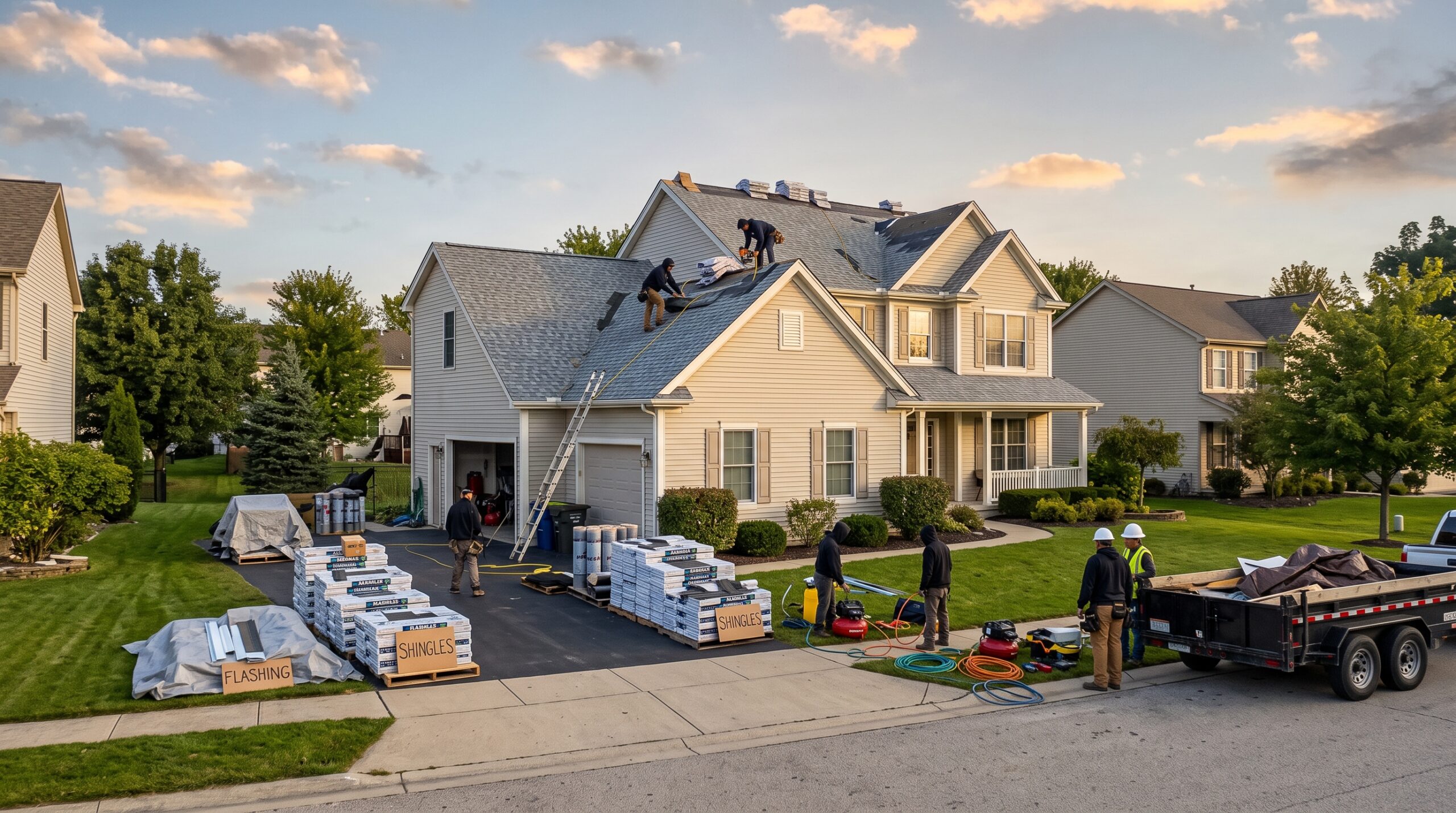
To choose a roofing material for a new roof, start with what the house and the address allow (the roof’s slope, how much weight the framing can carry, fire-zone and cool-roof rules, salt air or inland heat), then weigh what you want from it: solar, looks, upkeep, budget and lifespan. Asphalt shingles, clay or concrete tile, metal and low-slope membranes each come out ahead on a different mix of those factors. To talk through the options for your roof, call NEMA Roofing at 866-631-3366.
Step 1: What does your roof’s slope allow?
Slope rules out some materials before any other question. California’s residential code allows asphalt shingles from a slope of 2 in 12, clay and concrete tile from 2 1/2 in 12, and metal shingles from 3 in 12; lapped metal panels need 3 in 12 unless the laps are sealed. Below those slopes, and on flat sections over garages, porches and additions, the roof needs a low-slope system such as a single-ply membrane or a built-up roof. Many houses have both, so the material choice may really be two choices.
Step 2: Can the framing carry the weight?
Weight matters most when a house changes from shingles to tile. The Tile Roofing Industry Alliance defines standard-weight roof tile as 9 pounds or more per square foot installed, before the underlayment and battens are counted, while the roof was framed for the much lighter covering it has now. Before switching, have the rafters and sheathing checked; heavier tile can mean added framing and an engineered design.
Weight also changes the permit path. In the City of Los Angeles (including Woodland Hills, Tarzana and Encino), the building department’s express reroof permit covers Class A or B coverings under 6 pounds per square foot over solid sheathing, so standard-weight tile falls outside that quick path. Metal and lighter-weight products ease both questions; the installed weight is on the product’s data sheet.
Step 3: What does your address require?
- Fire hazard zones. A replacement roof in a Fire Hazard Severity Zone or wildland-urban interface area must have a Class A fire classification as an assembly. Tile, metal and many shingles can meet it, but the underlayment and deck are part of the rating, so check the listing of the whole assembly.
- Cool-roof rules. When more than half of a steep-slope roof is replaced in California climate zones 4 or 8 through 15, the product must meet cool-roof values unless an exception applies. That narrows the color list, but the California Energy Commission notes that cool roofs come in light, dark and vibrant shades.
- Design review and associations. Some communities review roof material and color before a permit is issued; the Montecito Board of Architectural Review, for example, considers colors and types of building materials. Homeowners’ associations often have their own list.
Step 4: Coast or inland?
Near the ocean, salt spray is hard on coated steel. The U.S. Department of Defense’s roofing criteria note that aluminum-zinc coated steel performs less well in direct salt spray and that aluminum may be the better choice there, at a higher cost; fasteners and flashing should match the panel metal. Inland valleys trade salt for heat and sun: reflective finishes, rated cool colors and good attic ventilation carry more weight there.
Step 5: How will you use the roof?
- Solar. On tile, every solar mount needs flashing at the deck and at the tile surface, and nothing may be fastened to a single tile. Standing seam metal can take mounts clamped to the seams; the Department of Defense criteria call for non-penetrating seam clamps so the weathering surface is never breached. Shingles take flashed mounts easily. If panels are planned, choose the roof with them in mind.
- Foot traffic. Tile can crack underfoot; the tile industry advises keeping walking to a minimum, stepping on the lower 3 inches of each tile where the tile below supports it, and notes that most makers do not warrant breakage from foot traffic. If the roof will be walked for equipment or cleaning, plan walkways or choose a sturdier surface.
- Repairs later. Ask how easy the exact product will be to match; the tile industry notes that some tiles are no longer manufactured, which makes a like-for-like repair harder.
How do the main materials compare?
| Material | Where it fits best | What to weigh |
|---|---|---|
| Asphalt shingles | Most pitched roofs, moderate budgets, easy solar mounting | Shorter life than tile or metal; color choice limited by cool-roof rules in some zones |
| Clay or concrete tile | Mediterranean and Spanish-style homes, fire zones, long service life | Weight and framing; the underlayment beneath ages first; careful walking and repairs |
| Metal (standing seam or panels) | Fire zones, solar with seam clamps, low weight, modern looks | Coating and metal choice near salt air; trim and fastener details; price varies widely by profile |
| Low-slope membranes (TPO, PVC, built-up) | Flat and nearly flat sections | Drainage design; cool-roof values on low-slope roofs are stricter |
For prices by material, read comparing roof installation costs. For material detail, see our tile roofing and metal roofing services.
What should the estimate say about materials?
- The manufacturer, product line and color of the covering.
- The underlayment, flashing metal and ventilation parts, by name.
- The fire rating of the assembly and the color’s cool-roof rating where either applies.
- Any framing work for a heavier roof, priced on its own line.
- Which manufacturer warranty the job will be registered for. NEMA Roofing is a GAF Master Elite contractor and an Owens Corning Preferred Contractor, which lets us register GAF’s enhanced warranties and the Owens Corning Preferred Protection warranty.
NEMA Roofing’s five locations (Santa Barbara, Oxnard, Woodland Hills, Tarzana and Downey) put a team near every home we serve across Santa Barbara, Ventura County, Los Angeles, Riverside and San Bernardino counties. See our new roof installation service, or call 866-631-3366 to compare materials for your house.




