
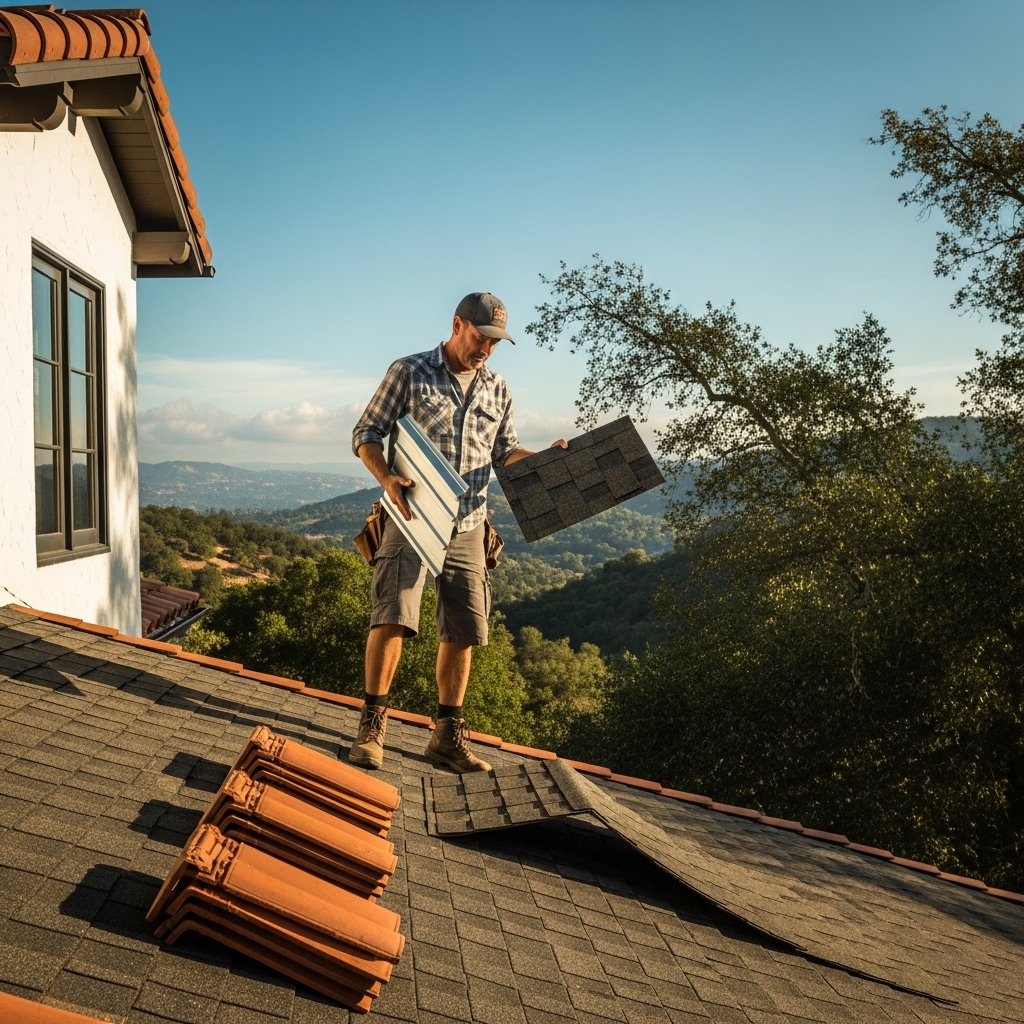
The eco friendly roofing materials that suit Tarzana, California are cool-rated asphalt shingles, clay or concrete tile (including reused tile), coated metal, and reflective membranes for flat sections, with a planted roof only where the structure is built for it. Whichever you pick has to meet the cool-roof values for climate zone 9 on a reroof, and on Tarzana’s Very High fire zone land it must also be a Class A roof covering. For a material recommendation on your home, call NEMA Roofing at 818-528-6412.
Eco-friendly roofing materials compared
| Material | Where it fits | Green strength | Tarzana check |
|---|---|---|---|
| Cool-rated asphalt shingles | Most sloped roofs | Reflective granules cut heat gain at a modest cost | Aged rating of the exact color; Class A listing on fire zone lots |
| Clay or concrete tile | Sloped roofs framed for tile weight | Long life; batten air gap; existing tile can often be reset | Weight and framing; cool-rated color for new tile |
| Coated metal | Sloped roofs, homes planning solar | Reflective paint; recyclable at the end of its life | Aged rating of the finish; Class A assembly listing |
| Single-ply or cap-sheet membrane | Flat roofs, additions, ADUs, garages | White and light surfaces reflect most sunlight | Stricter low-slope cool-roof values |
| Planted (extensive) roof | Flat roofs with checked structure | Shade, cooling, stormwater and habitat | Engineer’s load review, irrigation, drought-tolerant plants |
Which Tarzana rules shape the material choice?
Tarzana is a neighborhood of the City of Los Angeles, so reroof permits come from the Los Angeles Department of Building and Safety (LADBS). The rules that affect materials:
- Climate zone 9. Tarzana’s ZIP code, 91356, is in California energy climate zone 9. When more than half of a sloped roof is replaced, the new product needs an aged solar reflectance of at least 0.20 and thermal emittance of at least 0.75 (or a solar reflectance index of at least 16), unless the house qualifies for an exception such as R-38 ceiling insulation, a radiant barrier, no ducts in the attic, or insulation at the deck. Low-slope roofs need an aged solar reflectance of at least 0.63 and emittance of 0.75 (or an index of 75), with an insulation trade-off allowed.
- Rated product. LADBS requires a product certified by the Cool Roof Rating Council on residential roof replacement over 50 percent of the roof area.
- Fire zone. CAL FIRE’s 2025 fire hazard map and the City of Los Angeles fire zone layer both show Very High Fire Hazard Severity Zone land inside ZIP 91356. LADBS requires a Class A roof covering there.
- Express Permit. LADBS issues reroofing with Class A or B coverings weighing under 6 pounds per square foot over solid sheathing as an Express Permit, without plan check. Heavier coverings follow the regular permit path, so check the weight on the product data sheet.
- Tile reset. Removing existing roof tiles, installing new underlayment and resetting the same tiles is its own Express Permit item, and LADBS states that cool-roof compliance is not required for that scope.
Cool-rated asphalt shingles
A cool shingle looks like a standard architectural shingle; the difference is in the granules, which reflect more sunlight and shed absorbed heat faster. Cool-rated lines now include grays, tans and browns, so a ranch or Spanish-style house does not need a white roof to comply. Compare the aged values (not the initial ones) in the Cool Roof Rating Council directory, because reflectance drops as a roof weathers. On shingle roofs we pay close attention to eave edges, where wind can lift material, and to valleys, where leaves from street trees collect.
Clay and concrete tile, and reusing the tile you have
Tile is common on Tarzana homes. It is noncombustible, it lasts for a long time, and because it sits on battens there is an air space under it that carries heat away before it reaches the deck. Its mass also slows heat gain through the hottest part of the day. New tile comes in cool-rated colors that keep the traditional look.
The greenest tile roof is often the one already on the house. When the tiles are sound and only the underlayment has failed, a remove-and-reset job replaces the waterproofing, reuses the tiles and, as noted above, is a separate LADBS scope without the cool-roof requirement. Replace cracked tiles and add bird stops at the eaves to close gaps embers could enter. Our tile roofing service covers both reset and full replacement.
Coated metal roofing
Standing-seam panels and metal shingles with reflective factory paint reflect sunlight and cool off quickly after sunset. The surface is noncombustible, and the metal can be recycled when the roof is eventually replaced. Low-gloss and earth-tone finishes limit glare and blend with stucco and stone. Solid sheathing and underlayment under the panels dampen rain noise. Metal is also a strong base for solar, since panels can be mounted without drilling through the covering on some standing-seam systems.
Membranes for flat sections, additions and ADUs
Many Tarzana homes have a flat or low-slope section over a garage, an addition or an accessory dwelling unit. White or light gray single-ply membranes (TPO or PVC) reflect most sunlight and have welded seams; modified bitumen with a reflective cap sheet handles complicated flashing around skylights and parapet walls. Tapered insulation under the membrane fixes ponding, which ages low-slope roofs early. The low-slope cool-roof values are much higher than the sloped ones, so confirm the product meets them. See our flat roofing service.
Is a planted roof practical in Tarzana?
On a flat roof with the structural capacity for it, yes, in its lightweight (extensive) form: a few inches of growing medium, drought-tolerant succulents or native groundcovers, a root barrier and drainage layer under it. The EPA notes extensive green roofs need little maintenance once established and that green roofs capture more of the rain in smaller storms, which fits the Valley’s short rainy season. Plan for efficient irrigation through the hot months and an engineer’s review of the load before anything is planted.
The layers under any green covering
The covering gets the attention, but the layers beneath decide how it performs. High-temperature synthetic underlayment holds up on hot decks; self-adhered membrane at eaves and valleys adds a second line against heavy rain. In the attic, balanced intake and ridge ventilation plus enough ceiling insulation keep heat out of the rooms below. Across Tarzana, we match the insulation and ventilation to the roofing material so the assembly works as a whole. How those layers change the energy picture is covered in our guide to energy-efficient roofing in Tarzana, and the wider list of options is in roof replacement materials for Tarzana homes.
Tarzana is one of NEMA Roofing’s five Google-verified locations, alongside Santa Barbara, Oxnard, Woodland Hills and Downey, and our crews install these materials throughout Los Angeles, Ventura, Santa Barbara, Riverside and San Bernardino counties. Visit our Tarzana roofing page or the green and eco-friendly roofing service, or call 818-528-6412 to compare materials for your roof.




