You can repair flat roofing without replacing the entire roof when the damage is limited to a few places (an open seam, a puncture, a lifted flashing, a blocked drain) and the membrane, insulation and deck around it are still sound and dry. The repair has three parts: find where the water really gets in, fix it with a material that bonds to your existing roof system, and correct the drainage problem that caused it. When the roof is wet or failing in many places, patching stops being good value, and this guide explains how to tell the difference.
This guide is for owners who want to understand the work, whether they do a small patch themselves or hire a roofer. For a repair visit anywhere in Santa Barbara, Ventura, Los Angeles, Riverside or San Bernardino county (NEMA has five Google-verified locations, in Santa Barbara, Oxnard, Woodland Hills, Tarzana and Downey), see NEMA Roofing’s flat roof repair service or call 866-631-3366.
First, decide: repair, re-cover or replace?
California’s building code uses three terms for this, and they are useful when you compare advice or proposals. A roof repair renews part of an existing roof to correct damage. A roof recover installs a new covering over the existing one without removing it. A roof replacement removes the existing covering, repairs damaged substrate and installs a new one.
| What you find | Usually the right move |
|---|---|
| One or a few leaks, the membrane still flexible and bonded, dry insulation around them | Repair |
| Surface worn across the roof (cracking, granule loss, chalky single-ply) but insulation and deck dry | Restore with a coating, or re-cover |
| Wet insulation over large areas, soft deck, several old layers, leaks that keep moving | Replace |
The deciding question is almost always moisture. A patch or a coating over wet insulation traps the water, and the roof keeps deteriorating from the inside. The building code draws the same line: a new covering or coating may not go over a roof that is water-soaked or too deteriorated to serve as a base, or over a roof that already has two or more layers (California Building Code 2025, section 1512.3).
Step 1: Find where the water gets in
Flat roofs hide leaks well. Water sits on the surface, gets under a loose lap or flashing, travels along the insulation and drips somewhere else, so the stain inside is often several feet from the hole. Work from the likely entry points outward:
- Drains and scuppers. A blocked outlet ponds water against seams that were never meant to be under water.
- Flashing at parapets, walls, curbs, vents and skylights, where the membrane turns up and is under the most stress.
- Seams and laps between sheets of membrane.
- Penetrations: pipes, equipment curbs, solar and satellite mounts.
- Ponding areas, where the surface ages fastest.
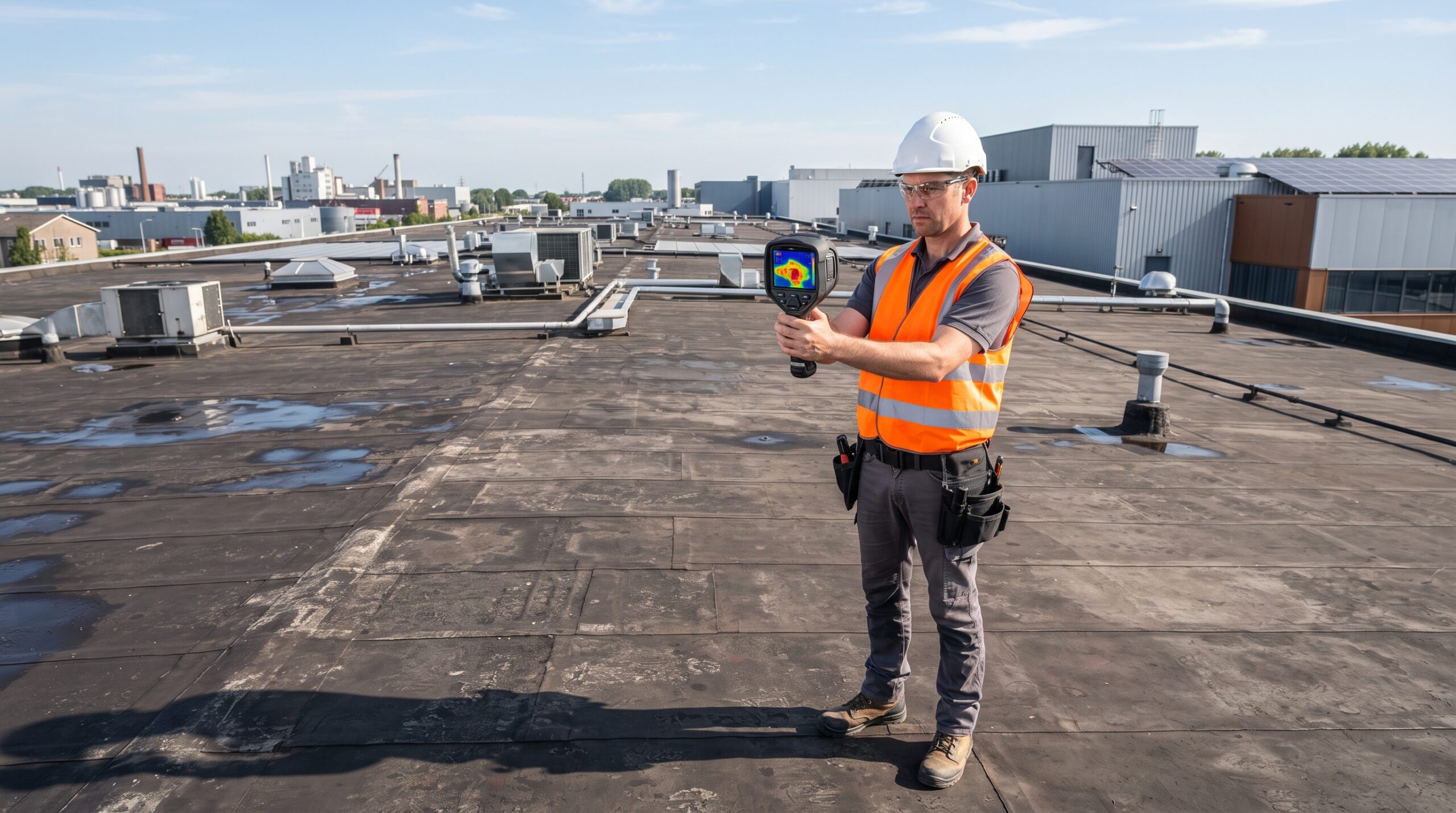
A controlled water test helps when the source is not obvious: with someone inside watching the ceiling, run a garden hose over one small area at a time, starting low and working uphill, and wait between areas. Never do this, or walk on the roof at all, when it is wet, windy or steep at the edges.
Step 2: Identify your roof system
A patch has to bond to what is already there. The wrong material can look fine for a season and then peel off.
| System | How to recognize it | What bonds to it |
|---|---|---|
| Built-up roof (BUR) | Layers of felt and asphalt, often under loose gravel | Asphalt-based roofing cement and new felt plies |
| Modified bitumen | Asphalt rolls, often with a granule surface, overlapping seams | Compatible modified bitumen patch, asphalt-based cements |
| TPO or PVC | Smooth white or light sheets with hot-air-welded seams | A patch of the same material, heat-welded; general sealants do not bond well |
| EPDM | Black or dark rubber sheets with taped or glued seams | EPDM primer with EPDM seam tape or patches |
| Spray foam (SPF) | A seamless foam surface under a coating | New foam and a compatible coating |
If you are not sure which system you have, find out before buying anything. Mixing asphalt products with single-ply membranes is one of the most common causes of failed patches.
Step 3: Patch small damage properly
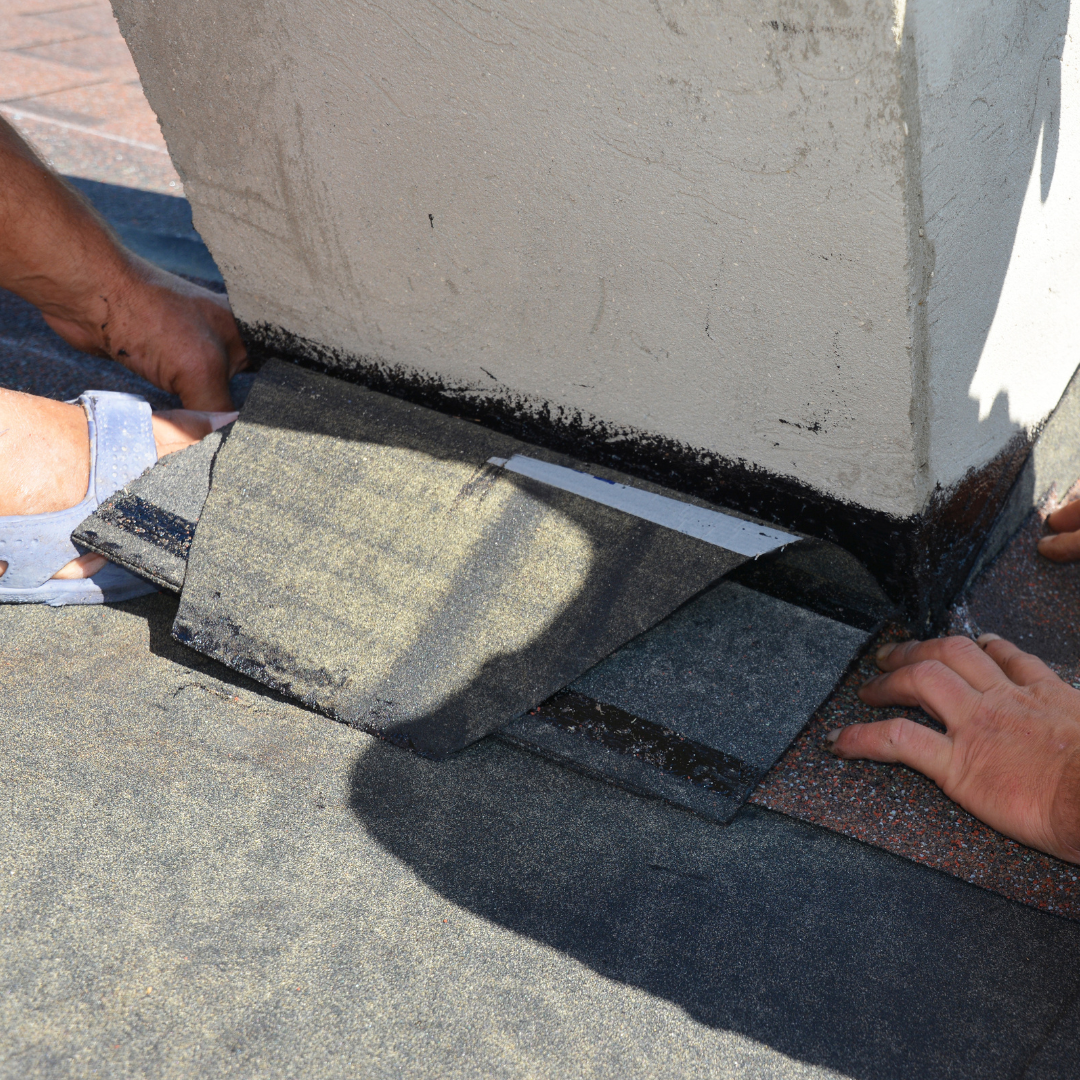
For a small puncture, split or blister on a sound roof, the method is similar across systems:
- Dry and clean. Remove gravel and debris from the area, then clean the surface; patches do not stick to dirt, oxidation or moisture.
- Open and flatten blisters. A blister is cut open, allowed to dry and pressed flat before it is covered.
- Prime where the product calls for it (EPDM and many modified bitumen repairs do).
- Patch generously. Cut the patch well past the damage on every side and round its corners so they do not lift.
- Seal the edges with the sealant or welding method made for that membrane.
- Check it after the next rain, and look again at the ceiling below.
Torch-applied modified bitumen uses an open flame on a roof and belongs to a trained crew. Heat-welding TPO and PVC needs the right welder and a test seam; a sealant smeared over a split thermoplastic seam rarely lasts.
Step 4: Repair seams and flashing
Most flat roof leaks start at seams and flashing, not in the open field. A lifted lap on a single-ply roof is cleaned and re-welded or re-taped along its whole loose length, not only where it leaks. Flashing at a parapet or wall is checked from the roof surface to the top termination: a loose termination bar, cracked sealant at the top edge or a gap behind a counterflashing lets water run down behind the membrane. Pipe boots and curb flashings are replaced when their material has cracked, since resealing an aged boot buys little time.
Step 5: Fix the ponding, not just the leak
The California Building Code (2025 edition) defines positive roof drainage as a design in which the roof drains within 48 hours of precipitation (chapter 2, definitions), and it requires built-up, modified bitumen, single-ply and spray foam roofs to have a design slope of at least 1/4 inch per foot (section 1507). Water standing longer than two days after rain points to a slope or drain problem that will reopen any patch in that area. The usual fixes:
- Clear and enlarge clogged drains and scuppers, and keep strainers on them.
- Add tapered insulation or a cricket to steer water toward the outlet.
- Add a drain or scupper where water has nowhere to go.
Drainage changes usually mean opening the roof, so they are roofer’s work, but knowing the cause keeps you from paying for the same patch every winter.
Step 6: Consider a coating on a sound, dry roof
A fluid-applied roof coating (the code’s own definition: a coating used for roof maintenance or repair, or as part of a roof system) can restore an aged but sound roof surface and add reflectivity. It works only after leaks are repaired and wet material is removed, and the coating has to be compatible with the membrane. On a house, re-coating counts as re-roofing under California’s 2025 Energy Code, so a low-slope re-coat in climate zones 4 and 6 through 15 is expected to meet the cool-roof values (an aged solar reflectance of at least 0.63 together with a thermal emittance of at least 0.75, or a solar reflectance index of at least 75) unless an exception applies. Santa Barbara, Ventura and Oxnard are in zone 6, Westlake Village and Ojai in zone 9. The cool roofing page explains the rule.
When to stop and call a roofer
- The roof is soft underfoot, or insulation is wet over a wide area.
- The leak is at a parapet, a wall termination or a drain body.
- The roof is modified bitumen that needs torching, or single-ply that needs welding.
- You have patched the same area more than once.
- The roof is high, steep at the edges or hard to reach safely.
A professional visit should trace the leak, check every drain, identify the system, look for wet insulation, photograph what it finds and tell you plainly whether a repair, a re-cover or a replacement is the better buy. NEMA Roofing’s flat roof repair page lists what that visit includes, and commercial roofing covers larger low-slope buildings.
Keep the roof out of the repair column
- Clear drains, scuppers and gutters before the rainy season and after storms.
- Walk the seams and flashing once or twice a year, and after any work on rooftop equipment.
- Keep foot traffic to a path; punctures from service visits are common.
- Recoat a coated roof before the coating wears through.
A scheduled visit covers all of this; see roof maintenance.
Flat roof repair questions
Can I repair a small flat roof myself?
A small puncture or split on an EPDM or modified bitumen roof, on a low and safe roof, is within reach of a careful owner using the membrane maker’s patch materials. Torching, heat-welding, flashing work and anything involving wet insulation are better left to a roofer.
Is roofing cement a permanent fix?
On asphalt-based roofs it can seal a small defect for a while, but it dries and cracks, and it does not bond to TPO, PVC or EPDM. Treat it as temporary.
Can I replace only part of a flat roof?
Yes, when the rest is dry and sound; the new section has to be tied into the old membrane with compatible materials. If the partial work is large, the Energy Code’s re-roof rules can apply to it.
What does a flat roof repair cost?
It depends on the system, the number of problem areas, access, flashing work and whether insulation has to be replaced; the flat roof repair page lists the cost factors. NEMA’s on-site assessment is free.
NEMA Roofing Repair Company – Santa Barbara
(805) 977-5949
https://nemaroofing.com/
7 W Figueroa St, Santa Barbara, CA 93101, United States